How Does the GENIAC “Electronic Brain” Actually Work?
◆ Revised

Introduction
The first thing to understand about the GENIAC “electronic brain” is that it is not electronic in the modern sense at all. There are no transistors, no software, no memory chips, and no hidden digital magic inside the box.
What GENIAC actually gives you is something much stranger and, in many ways, more educational.
It turns reasoning into visible physical pathways.
That is the real achievement of the machine.
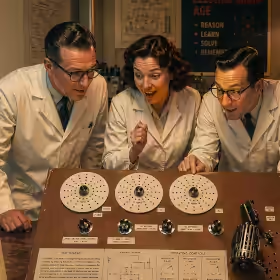
Modern readers often approach GENIAC expecting a tiny primitive computer. Instead, they find a board full of wires, rotary switches, brass contacts, and flashlight bulbs. At first glance it can look disappointingly simple. Then the deeper idea arrives. Every switch position represents a condition. Every completed path represents a logical outcome. The “brain” is not hidden somewhere inside the machine. The wiring itself is the reasoning.
If you have not already read What Is GENIAC?, it helps frame the kit properly before diving into how the system actually behaves.
The machine works by completing circuits
At the core of GENIAC is a small flashlight battery. Electricity leaves one side of the battery and attempts to return to the other side. Wires carry the current. Switches either allow or interrupt the path. If the circuit completes correctly, a bulb lights up.
That simple mechanism is responsible for everything the machine does.
The brilliance of GENIAC is that the switches do not merely turn power on and off. They represent decisions, conditions, numbers, or logical states. One switch might represent whether a burglar entered through a window. Another might represent whether two numbers are equal. Another might represent whether a statement is logically true.
Once the user selects those conditions using the switches, the wiring determines which output path becomes electrically valid. The illuminated bulb is the machine’s answer.
That answer could represent:
- a correct arithmetic result
- a valid logical conclusion
- a successful code translation
- a winning game move
- a comparison between values
- a warning condition in a simulated system
The machine is not calculating dynamically the way a modern computer does. The possible outcomes are already built into the wiring layout. GENIAC simply reveals which outcome matches the selected conditions.
That distinction matters. The machine is less like a modern computer and more like a physical map of decisions.
The switches are the real “thinking” mechanism
The most important parts of the kit are the large multi-position rotary switches. These switches physically reroute electricity through different pathways as they turn. Unlike modern computing, where logic disappears into silicon and abstraction, GENIAC leaves the entire process exposed.
You can literally trace the logic with your eyes.
That physical visibility is one of the machine’s most interesting qualities. Modern technology often hides its reasoning behind interfaces and software layers. GENIAC does the opposite. It externalises logic into something mechanical and observable.
This is why the machine still feels intellectually satisfying today. Not because it is powerful, but because it is understandable.
The educational intent becomes clearer as you move through the original project list. The manual deliberately progresses from simple switching exercises into arithmetic machines, code systems, reasoning circuits, binary translators, and game-playing logic systems. GENIAC Project List: Building Thinking Machines and Circuits shows just how ambitious that progression really was.
It was quietly teaching computational thinking years before most households had ever seen a real computer.
The “electronic brain” hype was both wrong and useful
The 1950s language around machines like GENIAC now sounds exaggerated. Calling a switchboard an “electronic brain” feels almost absurd beside modern artificial intelligence. But the exaggeration reveals something important about the era.
Mid-century computing culture genuinely believed that reasoning itself might eventually be mechanised. Logic was treated as the foundation of intelligence. If reasoning could be broken into formal steps, perhaps machines could reproduce parts of thought itself.
That wider intellectual atmosphere sits behind GENIAC and is explored further in Why Early Computers Were Built Around Logic and Machine Reasoning and the Age of Syllogisms.
GENIAC was not a fake computer. But it was also not the futuristic “thinking machine” implied by many advertisements. It lived in the awkward middle ground between education, engineering, performance, and cultural imagination.
Oddly enough, that tension is part of its appeal.
GENIAC’s real achievement was demystification
The machine did not truly think.
But it did something arguably more important for its moment in history. It showed ordinary people that machine reasoning was constructed rather than magical.
The user could see the wires. Follow the signal paths. Tighten the contacts. Break the logic accidentally. Repair it again. The system was visible in a way modern computing rarely is.
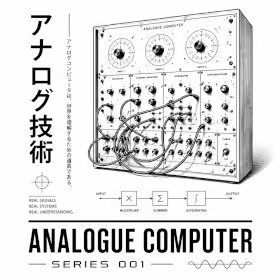
That transparency still resonates today, especially among readers drawn toward visible systems, analogue instrumentation, and mid-century computational design culture. It is part of the same visual language that continues through projects like the Analogue Computer Series 001 design, where signal paths and circuit structure become aesthetic statements as much as engineering diagrams.
In the end, the GENIAC “electronic brain” works by turning logical possibilities into physical electrical routes.
That sounds simple because it is simple.
And that simplicity is precisely why the machine still explains computing so well.
Featured Product
Analogue Computer Series 001 T-Shirt
The phrase “reason in syllogisms” belonged to a time when computing was visible, tactile, and mechanical. The Analogue Systems 01 retrocomputing themed t-shirt celebrates that era of electric brains, logic circuits, switches, and learning machines, when reasoning could be traced through wires and confirmed by the glow of a lamp.
Disclosure: this is a commercial product link to an external Zazzle store associated with philreichert.org. Purchases are handled by Zazzle.

Writer's Notes
What I particularly like about this piece is that it strips away the mythology around the phrase “electronic brain” without mocking the people who used it. There is something oddly honest about GENIAC once you stop expecting a miniature modern computer and start looking at it as a visible reasoning machine built from switches and bulbs. I think that tension matters. Mid-century computing culture was simultaneously overconfident and genuinely curious, and GENIAC sits right in the middle of that contradiction. The machine is mechanically simple, sometimes almost crude, yet it still manages to communicate one of the core ideas behind computation remarkably well: that logic can be structured, routed, and physically observed rather than merely imagined.
Reader Guide
The following material expands on the terminology, historical context, technical concepts, and related reading connected to this article.
Journey Map - GENIAC Analogue Computer Kit
This article sits within the GENIAC Analogue Computer Kit topic cluster. The sequence below moves from discovery and explanation through historical advertising culture and into broader reflections on computing, learning and the changing relationship between humans and machines.
Reading context: This journey combines historical reconstruction, vintage advertising, analogue computing concepts and reflective essays about digital culture. Most readers will move through the sequence gradually rather than in a single sitting. The complete journey takes approximately 45–90 minutes.
- Foundations and Discovery
- Remember a Kit Computer from the 1950s?
- What Is the GENIAC Computer?
- Why Was the GENIAC Computer Created?
- Advertising, Imagination and Electric Brains
- How the GENIAC Computer Was Marketed to Learners
- The GENIAC “Electronic Brain” Explained
- Was GENIAC a Computer or a Toy?
- Reflections on Computing Culture
- Why GENIAC Still Matters
- Why Did We Stop Teaching This?
- The Decline of Hobbyist Computing Culture
Glossary
- Electronic Brain
- A mid-20th century phrase used to describe machines that could calculate or follow logical rules. In this article, it reflects both the excitement and exaggeration surrounding early computing culture. The phrase now sounds theatrical, but it captured a genuine belief that reasoning itself might eventually be mechanised.
- Logic Circuit
- A physical arrangement of electrical connections that produces a predictable result. In GENIAC, switches and wires form logic circuits that guide electricity toward the correct bulb. What feels abstract in modern computing becomes surprisingly tangible when the “answer” appears as light.
- Rotary Switch
- A switch that changes connections as it is turned through different positions. GENIAC uses large rotary switches to represent conditions, numbers, and choices. They give the machine a wonderfully mechanical feel, somewhere between laboratory equipment and a puzzle box.
- Computational Thinking
- A way of breaking problems into structured steps, conditions, and outcomes. The article shows how GENIAC quietly taught this long before home computers became common. Users were learning how machines “reasoned” by physically wiring decisions together.
- Signal Path
- The route electricity follows through a circuit. In the article, signal paths are the visible representation of logic itself. One of GENIAC’s enduring fascinations is that you can literally trace the machine’s reasoning with your eyes and fingers.
- Binary
- A numbering system based on only two states, usually written as 0 and 1. GENIAC introduced users to binary logic through switches and bulbs, making an important computing concept feel less mathematical and more physical and approachable.
Frequently asked questions
Did the GENIAC electronic brain actually think?
No. GENIAC did not think like a person or a modern computer. It used switches, wires, a battery, and bulbs to represent logical conditions and show pre-wired outcomes.
How did GENIAC produce an answer?
GENIAC produced an answer by completing an electrical path. When the user set the switches to represent certain conditions, the wiring directed current to the bulb that matched the correct result.
Why was GENIAC called an electronic brain?
GENIAC was called an electronic brain because 1950s computing culture often described machines that performed reasoning or calculation in brain-like terms. The phrase was partly promotional, but it also reflected real interest in mechanised logic.
What makes GENIAC useful for understanding early computing?
GENIAC makes early computing ideas visible. Instead of hiding logic inside software or chips, it shows reasoning as physical pathways through switches, wires, contacts, and light bulbs.
Connected Threads
- The Miscellaneum 005 – GENIAC Analogue Computer Kit - This article was featured in The Miscellaneum Issue 005, a themed exploration of visible machine logic, analogue computing, hobbyist computer culture, and the educational history of the electric brain.
Related articles…


Source Note
This article draws on GENIAC manual and advertising material from the 1950s, especially the way those sources described reasoning, circuits, switches, and “electric brain” learning. The aim is interpretive rather than academic: to explain how mid-century learners were invited to understand machine logic through visible parts and practical experiments.
Disclosure
This page presents a curated exploration of the GENIAC analogue computer kit and its associated materials. Content reflects the author’s interpretation of historical sources, including instructional manuals, advertisements, and related artefacts. The GENIAC system is discussed as an educational and conceptual model for understanding logic, circuits, and early computing ideas, rather than as a complete or authoritative account of computing history. References to “thinking machines” and reasoning systems follow the language and framing of the original material and are included for historical context. Readers seeking formal technical, historical, or academic treatment of computing should consult primary literature, scholarly sources, and specialist texts.