The Miscellaneum 005 – GENIAC Analogue Computer Kit

Editorial
A simple battery, wires, and cardboard were once enough to build a usable thinking machine.
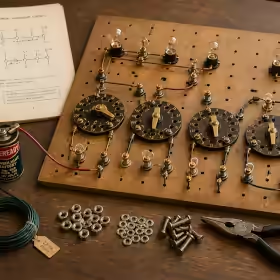
The more I explored early computing history for philreichert.org, the more one strange little machine kept resurfacing. The GENIAC analogue computer kit was not large, expensive, or especially powerful, yet it carried an idea that now feels surprisingly radical: ordinary people should be able to understand how machines think.
That fascination slowly grew into this issue of The Miscellaneum.
The GENIAC emerged during the age of the “electric brain”, when logic itself still felt futuristic. Long before modern personal computers, learners could build small reasoning machines from switches, wires, lights, and rotating contacts mounted onto a simple board. The kit demonstrated binary logic, decision systems, signalling circuits, and primitive machine reasoning using parts that were intentionally affordable and expandable. Once curiosity took hold, the owner was encouraged to grow the system further using ordinary components and experimentation.
That philosophy feels strangely familiar today.
Modern systems such as Arduino projects, maker electronics, and even devices like the Cardputer continue part of that same tradition. The technology has changed enormously, but the core idea remains recognisable: learning through construction, experimentation, and visible systems rather than sealed black boxes.
What surprised me most while researching GENIAC was not the technology itself, but the culture surrounding it. Mid-century computing kits assumed that curiosity could survive difficulty. Learners were expected to wire circuits, make mistakes, diagnose problems, and slowly understand how logic became behaviour. Friction was not considered bad design. Friction was part of the educational process.
Today, many of our most powerful systems have become invisible. Software hides the mechanism. Artificial intelligence often appears as something mysterious or unreachable. Yet the GENIAC reminds us that logic can still be physical, understandable, and approachable. A simple task can often be solved with simple components. Reasoning does not belong exclusively to software engineers or hidden systems inside distant servers.
Perhaps that is why these old electric brains still resonate.
They remind us that computing was once something people were invited to participate in directly.
This issue explores the GENIAC itself, the culture that produced it, and what modern readers might still recover from that older relationship with machines. And perhaps, just perhaps, some readers may even feel inspired to begin building systems of their own.
That would make the old electric brain very happy indeed.
Featured Product
Analogue Computer Series 001 T-Shirt
The phrase “reason in syllogisms” belonged to a time when computing was visible, tactile, and mechanical. The Analogue Systems 01 retrocomputing themed t-shirt celebrates that era of electric brains, logic circuits, switches, and learning machines, when reasoning could be traced through wires and confirmed by the glow of a lamp.
Disclosure: this is a commercial product link to an external Zazzle store associated with philreichert.org. Purchases are handled by Zazzle.

The GENIAC Analogue Computer Kit Feature


Visible Thinking and Vintage Computer Culture


Journey Map - GENIAC Analogue Computer Kit
This journey combines historical reconstruction, vintage advertising, analogue computing concepts and reflective essays about digital culture. Most readers will move through the sequence gradually rather than in a single sitting. The complete journey takes approximately 45–90 minutes.
Foundations and Discovery
- Remember a Kit Computer from the 1950s?
- What Is the GENIAC Computer?
- Why Was the GENIAC Computer Created?
Advertising, Imagination and Electric Brains
- How the GENIAC Computer Was Marketed to Learners
- The GENIAC “Electronic Brain” Explained
- Was GENIAC a Computer or a Toy?
Reflections on Computing Culture
In The Margins
A small linguistic aside. One word that helps describe how simple systems, ideas, and even advertisements build influence over time.
Accretion
- Meaning
- The gradual accumulation of small parts into a larger whole. In technical and scientific contexts, it often describes how matter gathers over time to form structured bodies. In a cultural or systems sense, it reflects how repeated exposure, small ideas, or incremental additions build into something with coherence and weight.
- Pronunciation (Australian English)
- /əˈkriːʃən/ “uh-KREE-shən”
- In a sentence
- The GENIAC kit did not teach computing in the first use; understanding emerged through accretion, each small experiment adding weight until the system began to make sense.
- Why use it (rather than “growth”, “collection”, or “learning”)
-
- Accretion emphasises layered buildup over time, where structure emerges from accumulation rather than design.
- Growth suggests increase, but not how that increase is formed or structured.
- Collection implies gathering, but not integration into a coherent whole.
- Learning describes the outcome, not the underlying process by which understanding forms.
- Miscellaneum note
- The GENIAC analogue computer kit reflects a model of knowledge built through accretion. Each wiring change, each logic path tested, and each small success adds to a growing internal model of how systems behave. The advertisements surrounding the kit follow the same pattern: repeated messages, diagrams, and claims accumulate into a sense of possibility. Over time, the user does not simply follow instructions—they begin to think in systems. This is the quiet power of accretion: once enough mass is gathered, understanding begins to exert its own pull.
Web Finds
Some links we’ve been exploring lately that connect to analogue computing, visible logic systems, and the wider culture of experimental machine building.
- Handbook of Analog Computation – A substantial historical handbook covering analogue computing concepts, techniques, circuits, and mathematical approaches in remarkable depth. Less a casual read and more a serious engineering reference from the era when analogue systems still occupied an important place in scientific and industrial computing. (Note: large PDF file)
- Introduction to Analogue Computer Programming – A fascinating period document explaining how analogue computer problems were structured, programmed, and solved. This is not a hobbyist introduction so much as a professional engineering text, but that seriousness gives it enormous heritage value for readers interested in how analogue computation was actually practiced. (Note: large PDF file)
- Analog Paradigm Systems – A visually striking modern analogue computing project demonstrating that analogue machines never completely disappeared. The site combines engineering seriousness with strong presentation and offers one of the clearest modern examples of professionally developed analogue computing hardware still available today.
- THE ANALOG THING – A modern enthusiast analogue computer designed around visible patching, operational amplifiers, and hands-on experimentation. Expensive enough to remain aspirational for many readers, but philosophically very aligned with the GENIAC tradition of learning computation through direct interaction with physical systems.
Computational Curiosities
41 ◆ 86 ◆ 71 ◆ 8 ◆ 73
Generated using the site’s digital-hybrid numerical engine.
Paper Games

Free PDF download inspired by early computing and machine logic
Creator's Log
A few notes from the workshop: what's been fixed, improved, or learned on the road to keeping this site fast, useful, and brimming with curiosities.
- Developing the Journey Maps
- As senior editor of this site, I care deeply about readership, discovery, and the entertainment value of the overall experience. Reviewing site statistics over time revealed a consistent pattern: many readers arrive, read a single article, then leave satisfied. That is not necessarily a failure. In many cases, the article has successfully answered the reader’s question or curiosity.
- However, we increasingly felt there was an opportunity to better reveal the broader structure surrounding the work. Many articles belong to carefully developed topical clusters designed to be explored as curated reading journeys rather than isolated pages. Readers can enter and leave these sequences freely, but those who continue through the full path gain a much richer understanding of the subject.
- This led to the development of the site’s Journey Maps. These maps act as guided pathways through connected articles, moving from discovery and explanation into deeper cultural, technical, and reflective material. In many ways they function as miniature documentary series assembled through linked web essays.
- The GENIAC series became one of the first major implementations of this idea, connecting early computing, hobbyist culture, visible logic systems, and machine reasoning into a single curated exploration. Readers interested in exploring these structured topic journeys can browse the growing catalogue of maps at Journey Maps.
- The First Release of Our Merchandise Range
- This issue also marks an exciting small milestone for the site. We are now working with Zazzle to develop a growing range of merchandise connected to the themes, aesthetics, and ideas explored throughout the publication. Our merchandise is available for purchase at the Phil Reichert Zazzle store.
- Our first release draws directly from the early computing movement explored in this issue. The Analogue Computer Series 001 design celebrates the era of visible logic, machine reasoning, signal paths, switches, and experimental computing kits that inspired so much of the GENIAC research.
- Rather than treating merchandise as generic branding, we want these pieces to function more like wearable artefacts connected to the culture surrounding the articles themselves. In this case, the designs reflect the tactile optimism of early computing and the idea that ordinary people could build, understand, and experiment with machines directly.
- If the spirit of the early computer movement resonates with you, we encourage you to explore the new release, share the project with others, and perhaps even join the growing family of readers, hobbyists, and curious builders who continue to keep this older culture of experimentation alive.
In the Next Issue…
The next edition turns its attention to the golden age of vintage hi-fi, where analogue engineering, industrial design and a little mechanical theatre combined to make listening an event in itself. We'll step inside classic reel-to-reel tape recorders, revisit some of AIWA's finest components and advertising campaigns, explore an imaginative loudspeaker concept inspired by the optimism of an earlier era, and uncover a collection of remarkable corners of the early internet where vintage audio knowledge continues to be preserved. If you've ever wondered why these beautifully engineered machines still inspire collectors nearly half a century later, you won't want to miss The Miscellaneum 006 – Vintage Hi-Fi Special.