How GENIAC Sparked the Electric Brain Revolution
◆ Revised
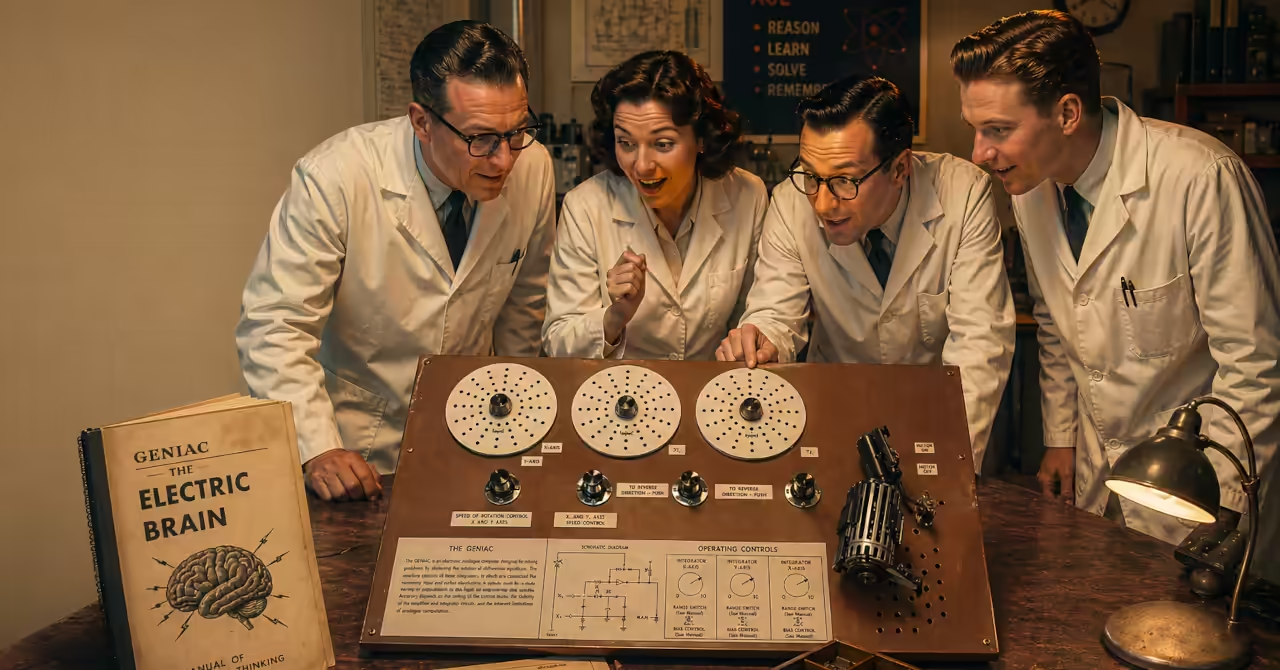
Electric Brains and a New Industrial Imagination
The GENIAC manual connects early computing with the idea of a Second Industrial Revolution. The relationship is simple but important: if the first industrial revolution mechanised physical labour, the second began to mechanise reasoning, calculation, and the handling of information.
That claim gives the GENIAC a larger meaning than its modest materials suggest. It was not only a board, switches, wires, bulbs, and a battery. It was a small educational answer to a much larger cultural problem. People were beginning to hear about machines that could “think”, but few had any practical way to understand what that meant. GENIAC brought the idea down from the laboratory and placed it on a table.
Reasoning Became Something a Machine Could Show
The core idea in the manual is that reasoning can be represented by electrical paths. A switch selects a condition. A wire carries the result. A light displays the answer. In that arrangement, thought is not treated as mystery. It becomes a sequence of choices, connections, and visible outcomes.
This was a powerful shift in the 1940s and 1950s. Automatic computers were still remote, expensive, and often described in dramatic language as “giant brains” or “electric brains”. The public image was impressive, but also distant. GENIAC responded by making the principle small enough to build. A user did not need access to a mainframe. They needed patience, instructions, and a willingness to trace cause and effect through a circuit.
The manual’s introduction makes this educational purpose clear. It presents computing as a field already moving quickly, then argues that physical engagement teaches more than words and pictures alone. The kit becomes a bridge between news of machine intelligence and personal understanding of how such machines behave.
Switches Turn Decisions into Physical Mechanisms
The mechanism of GENIAC is wonderfully plain. It converts a logical problem into a circuit. The user defines possible states, assigns those states to switches, then wires outputs to lights. The machine does not “think” in a human sense. It produces a result because its physical arrangement embodies a rule.
That is the educational brilliance of the kit. A burglar alarm, a hall light, a combination lock, an adding machine, and a reasoning machine can all be treated as variations of the same basic pattern. Each problem has conditions. Each condition can be represented by a switch position. Each answer can be represented by a glowing bulb.
In this form, computing becomes tangible. The user can see that a machine’s intelligence is not magic. It is structured behaviour. The act of wiring the machine is also the act of understanding the problem. A wrong wire produces a wrong answer. A corrected circuit becomes a corrected idea.
For a broader index of this material, see GENIAC Journal: Hands-On Analogue Computer Kit (1950s). That journal page gathers the GENIAC as a topic, treating the kit not as an isolated curiosity but as part of a wider cluster of articles about analogue computing, educational circuits, and mid-century machine intelligence.
A Tabletop Kit Against the Giant Brain Myth
The implication is that GENIAC sits between wonder and demystification. On one side were the large automatic computers that captured public imagination. They were expensive, institutional, and physically inaccessible. On the other side was the home experimenter or student, curious about the same principles but unable to approach the machines themselves.
GENIAC narrowed that gap. It did not compete with automatic computers in speed, memory, or power. It competed with ignorance. It showed that the logic behind computing could be separated from the scale of the machine. A small switchboard could explain ideas that also operated inside far larger systems.
This contrast is central to its cultural value. If the giant brain made computing seem futuristic, GENIAC made it teachable. It turned machine intelligence from a spectacle into a workshop activity. The kit’s limits were part of its strength. Because it was slow and visible, it exposed the structure of reasoning rather than hiding it inside machinery.
The same teaching principle is explored more directly in The GENIAC Approach: Learning with Analogue Circuits. That related article follows the learning method itself, showing how simple circuits turned abstract logic into something visible, testable, and repairable by hand.
GENIAC as a Public Response to Machine Intelligence
The GENIAC manual also shows how early computing entered public culture before personal computers existed. It invited users to build machines for arithmetic, games, coding, signalling, comparison, and logical deduction. These examples were not random tricks. They mapped the expanding territory of information work.
In that sense, GENIAC was a response to a new kind of machine age. Earlier mechanical devices had extended muscle, speed, and production. Electric brain machines suggested that judgement-like tasks could also be formalised. They could compare, select, translate, score, and decide within defined limits.
This helps explain the phrase Second Industrial Revolution. The revolution was not only in factories or power systems. It was in the growing belief that information itself could be processed by machines. GENIAC taught that idea in miniature. Its user did not merely read about computing. They enacted it, one circuit at a time.
The public-facing language around that promise appears in How the GENIAC Analogue Computer Kit Was Marketed to Learners. That article looks at how advertising framed the kit as a learning tool, using the romance of “thinking machines” to sell a practical form of computational education.
From Electric Brain to Hands-On Computing Culture
The next step is to read GENIAC less as a novelty and more as an early example of public computing education. It belongs in the same conversation as hobby electronics, school science kits, cybernetics, and later personal computing culture.
Its real importance is not that it predicted the modern computer in detail. Its importance is that it helped ordinary people grasp a new relationship between logic and machinery. A machine could now handle information according to rules. A person could build that rule into a device. Between those two ideas sits much of the computing culture that followed.
Featured Product
Analogue Computer Series 001 T-Shirt
Inspired by early analogue computing kits and circuit logic, this design translates the GENIAC concept into a wearable form. Part of the Analogue Computer Series
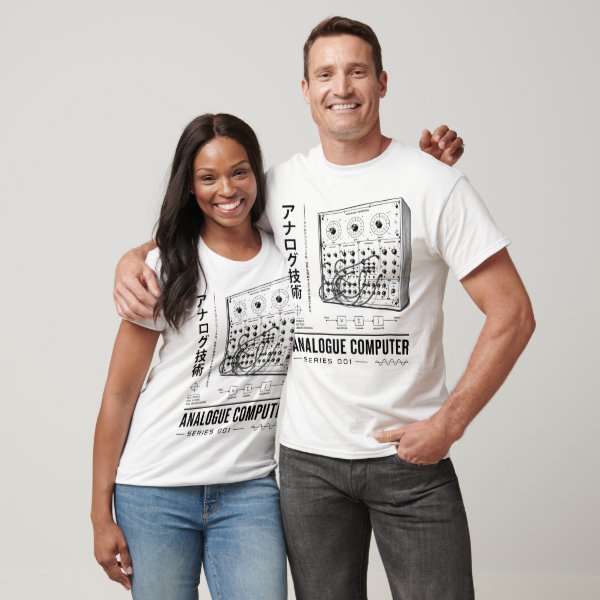
Exhibit Notes
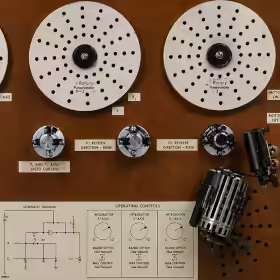
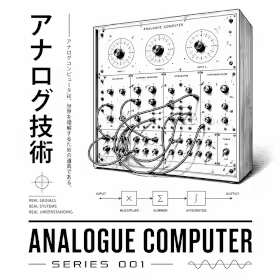
This configuration of GENIAC shifts the emphasis from puzzle to process. Rather than presenting a fixed question, it presents a field of control: rotating discs, adjustable axes, and visible inputs that can be tuned and observed. The machine becomes less a challenge to be solved and more a system to be explored.
What stands out is the physical expression of variables. Each rotary plate functions as a continuous input, suggesting motion, rate, and relationship rather than simple on–off logic. This aligns closely with the tradition of analogue computation, where understanding emerges through adjustment and observation rather than discrete steps.
The presence of labelled axes, integrators, and motor controls introduces a language of engineering that is more explicit than the earlier “electric brain” framing. Here, the learner is not only building a thinking machine but interacting with a simplified model of real-world systems — motion, feedback, and dynamic change.
This interpretation reinforces the broader purpose of GENIAC as described in its original material: a device designed to be handled, adjusted, and understood through use. The machine teaches not by abstraction, but by exposing its workings directly to the hands and eyes of the user.
In that sense, this version of GENIAC sits closer to a laboratory instrument than a toy. It invites iteration. It rewards careful adjustment. And it frames computation not as something hidden inside a machine, but as something that unfolds visibly, one controlled movement at a time.
Glossary
- Second Industrial Revolution
- In 1950s computing literature, a phrase used to describe the emerging shift from machines that performed physical labour to machines that could handle calculation, reasoning, and information processing.
- Electric Brain
- A popular mid-century term for computing devices that appeared to “think” by performing logical or mathematical operations through electrical circuits, often used in both technical writing and public advertising.
- Automatic Computer
- A machine capable of carrying out sequences of calculations or reasoning steps without continuous human intervention, typically large, expensive, and associated with research or industrial use in the 1940s and 1950s.
- Circuit Diagram
- A schematic representation of electrical connections used to describe how a machine operates, focusing on logical relationships between components rather than their physical arrangement.
- Reasoning Machine
- A term used in early computing contexts to describe a device that could produce correct logical outcomes by following predefined electrical pathways, demonstrating structured reasoning rather than human-like thought.
Frequently asked questions
What did people in the 1950s mean by an “electric brain”?
In the 1950s, an “electric brain” referred to a machine that could perform calculations or logical operations using electrical circuits. The term was often used to describe early computers or educational devices like GENIAC, which appeared to make decisions by following predefined electrical pathways.
How is GENIAC different from modern computers?
GENIAC does not store programs or process instructions like modern computers. Instead, it represents logic physically through switches, wires, and circuits. Each problem is built as a specific configuration, making the reasoning process visible rather than hidden in software.
Why was GENIAC considered educational rather than just a toy?
GENIAC was designed to teach the principles of logic and computation through hands-on construction. By building circuits that solved problems, users learned how machines could represent decisions and reasoning, making it a practical educational tool rather than simple entertainment.
What does it mean for a machine to “reason” using circuits?
Reasoning in this context means producing correct outcomes based on defined conditions. In GENIAC, switches represent inputs and conditions, while circuits determine the outcome. If the wiring is correct, the machine will always produce the correct result for a given set of inputs.
Connected Threads
- GENIAC Project List: Building Thinking Machines and Circuits - This article connects the GENIAC projects to the broader “electric brain” idea, showing how physical circuits were used to model reasoning and decision-making.
- Why Early Computers Reasoned in Syllogisms - Before AI became conversational, machines were presented as systems that could reason through visible logic. This article traces the phrase “reason in syllogisms” back to GENIAC, electric brain culture, and the moment when thought seemed to glow through a lamp.
Related articles…
References
- Berkeley, Edmund C. Geniac Electric Brain Construction Kit No. 1: Manual. Fifth Printing, February 1956.
Disclosure
This article interprets the GENIAC manual within its 1950s context, using original language such as “electric brain” to reflect how computing was understood at the time. It presents GENIAC as an educational model for logic and circuits, not a complete account of computing history. Readers seeking deeper technical or historical analysis should consult primary and scholarly sources.