4 Reasons Why the GENIAC Still Matters Today
◆ Revised

Introduction
Most people assume old computers matter only because they eventually led to modern computers. That explanation is too simple for GENIAC.
The real reason GENIAC still matters is that it exposed the mechanics of computing before computing disappeared behind polished screens and invisible software. It forced people to see logic happening physically through switches, wires, contacts, and illuminated pathways.
That may sound quaint now. In practice, it feels strangely modern.
If you browse the GENIAC Analog Computer Kit overview, one thing becomes obvious very quickly. The machine was never just a novelty toy. It was an attempt to teach ordinary people how machine reasoning actually worked.
1. GENIAC Made Logic Visible
Modern computing is mostly hidden. We tap icons, ask questions, and receive outputs without seeing the structure underneath.
GENIAC came from a completely different philosophy.
The kit used switches, jumper paths, bulbs, and circuits to model reasoning directly. If the wiring was correct, the answer appeared. If the logic path failed, the machine failed.
That made computing tangible in a way modern devices rarely are. A learner could physically trace why a condition produced a result. Logic stopped being abstract mathematics and became something mechanical and observable.
Even now, many people who regularly use artificial intelligence systems possess almost no mental model for how computational decisions occur. GENIAC stripped away the illusion of magic and showed that machine reasoning depends on structured pathways and formal conditions.
That clarity is part of why the machine still feels fresh. It teaches by exposing the mechanism, not hiding it.
2. It Captured a Lost Era of Computing Culture
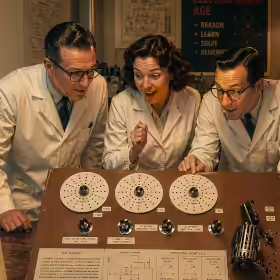
GENIAC belonged to the age of the “electric brain”. Mid-century advertisements promised reasoning machines, mechanical intelligence, and futuristic automation. Some of the language was exaggerated. Some of it now sounds charmingly dramatic.
But the excitement was genuine.
The article How GENIAC Sparked the Electric Brain Revolution captures this atmosphere well. Computing still felt mysterious enough to seem philosophical, not merely technical.
That tension matters historically because modern computing culture often treats technology as sealed consumer infrastructure. GENIAC treated computing as an idea worth exploring.
There is also an honesty in its limitations.
The machine did not truly “think” in any human sense. It followed designed logical structures. Yet that limitation is exactly what makes the kit valuable as a historical artefact. It reveals how quickly society began attaching concepts like intelligence and reasoning to machines built from formal logic.
The conversation has clearly not ended.
3. It Treated Learning as Participation
GENIAC assumed the user wanted to build, test, wire, troubleshoot, and understand the machine.
That assumption now feels surprisingly rare.
The projects gradually moved from simple circuits into arithmetic machines, code translators, game-playing systems, and logical reasoning structures. The progression described in the GENIAC Project List shows how carefully the learning path was designed.
The kit did not merely explain computational thinking. It trained people to construct it.
There was friction involved. Wiring mistakes mattered. Poor connections mattered. The machine demanded patience and attention.
In other words, it behaved more like engineering than entertainment.
That is partly why GENIAC still attracts historians, collectors, educators, and vintage computing enthusiasts. The system respected the intelligence of the learner instead of reducing technology into passive consumption.
4. GENIAC Feels Relevant Again
The irony of GENIAC is that it looks increasingly modern as computing becomes more opaque.
Artificial intelligence systems, recommendation engines, and automated decision-making tools now influence everyday life, yet their internal logic is often invisible to users. GENIAC represented the opposite approach. It exposed the machinery of reasoning directly.
That transparency gives the machine an unexpected contemporary relevance.
It also explains why the visual language of early computing still resonates. Exposed signal paths, labelled controls, and visible system structures communicate a kind of intellectual honesty modern devices often hide behind minimalism.
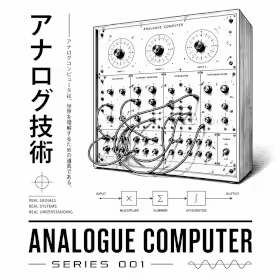
That aesthetic and philosophy carry naturally into pieces like the Analogue Computer Series 001 design, which treats visible systems and traceable logic as part of a broader design culture rather than simple nostalgia.
The Machine Was Smaller Than the Idea
GENIAC was never the most advanced computer of its era. That was never its real importance.
What mattered was its ability to make machine reasoning visible, physical, and understandable to ordinary people. It transformed logic into something you could wire together on a table at home.
The closer modern computing moves toward invisible systems and black-box intelligence, the more valuable that older clarity becomes.
For readers interested in how these ideas connected to the wider rise of computational thinking, Why Early Computers Were Built Around Logic is the natural next step.
Featured Product
Analogue Computer Series 001 T-Shirt
The phrase “reason in syllogisms” belonged to a time when computing was visible, tactile, and mechanical. The Analogue Systems 01 retrocomputing themed t-shirt celebrates that era of electric brains, logic circuits, switches, and learning machines, when reasoning could be traced through wires and confirmed by the glow of a lamp.
Disclosure: this is a commercial product link to an external Zazzle store associated with philreichert.org. Purchases are handled by Zazzle.

Writer's Notes
What I like about this piece is that it stops treating the GENIAC as merely a charming old kit and instead treats it as a cultural argument about visibility. The machine matters because it exposed the internal structure of reasoning at a moment when computing still had physical texture. You could literally follow the logic with your eyes. I think that tension becomes more interesting, not less, as modern systems become increasingly opaque and abstracted. Some of the surrounding GENIAC articles focus on projects, parts, or historical context, but this one leans harder into the uncomfortable observation that many people now interact with “intelligent” systems while understanding less about them than a teenager wiring a GENIAC circuit in 1956.
Glossary
- Machine Reasoning
- The use of a machine to follow logical rules and produce conclusions from given conditions. In this article, GENIAC matters because it made machine reasoning visible through switches, bulbs, and circuits, turning an abstract idea into something a learner could physically trace.
- Logic Circuit
- An electrical arrangement that represents a rule, condition, or decision. The article uses GENIAC’s logic circuits to show how computation can begin with simple pathways where a result appears only when the correct connections are made.
- Electric Brain
- A mid-century phrase for machines that seemed to calculate, reason, or make decisions. The article treats the phrase as both charming and revealing, showing how people once reached for almost magical language to describe early computing.
- Analogue Computer
- A computer or computing device that represents problems through physical states rather than modern digital software alone. In this article, GENIAC is valued because its visible switches and signal paths help readers see computing as a built system, not just a hidden screen process.
- Black-Box Intelligence
- A system that produces answers while hiding the steps that led to them. The article contrasts GENIAC with modern opaque technologies, suggesting that its exposed wiring still teaches something important about trust, understanding, and machine behaviour.
Frequently asked questions
Why does the GENIAC still matter today?
The GENIAC still matters because it made machine reasoning visible and physical. Its switches, wires, bulbs, and circuits showed how logic could be arranged into working systems, which remains valuable in an age when most computing is hidden behind screens and software.
Was the GENIAC a real computer or just a toy?
The GENIAC was not a modern programmable computer, but it was more than a simple toy. It was an educational construction kit that used physical circuits to model logic, calculation, reasoning, coding, and game-playing machines.
What can the GENIAC teach modern readers about artificial intelligence?
The GENIAC reminds modern readers that machine reasoning depends on structured pathways, conditions, and rules. It helps demystify intelligent-seeming systems by showing that computational behaviour can emerge from carefully designed logical arrangements.
Why is the GENIAC useful for understanding computing history?
The GENIAC captures a period when computers were often described as electric brains and machine reasoning was becoming a public fascination. It preserves the educational, cultural, and technical imagination of early computing before computers became sealed consumer devices.
Connected Threads
- The Miscellaneum 005 – GENIAC Analogue Computer Kit - This article was featured in The Miscellaneum Issue 005, a themed exploration of visible machine logic, analogue computing, hobbyist computer culture, and the educational history of the electric brain.
Related articles…


Source Note
This article draws on GENIAC manual and advertising material from the 1950s, especially the way those sources described reasoning, circuits, switches, and “electric brain” learning. The aim is interpretive rather than academic: to explain how mid-century learners were invited to understand machine logic through visible parts and practical experiments.
Disclosure
This page presents a curated exploration of the GENIAC analogue computer kit and its associated materials. Content reflects the author’s interpretation of historical sources, including instructional manuals, advertisements, and related artefacts. The GENIAC system is discussed as an educational and conceptual model for understanding logic, circuits, and early computing ideas, rather than as a complete or authoritative account of computing history. References to “thinking machines” and reasoning systems follow the language and framing of the original material and are included for historical context. Readers seeking formal technical, historical, or academic treatment of computing should consult primary literature, scholarly sources, and specialist texts.