5 Design Features of the GENIAC Explained

Introduction
Most people looking at a GENIAC for the first time misunderstand what they are seeing.
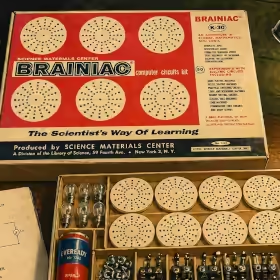
It looks like a toy. A wooden board covered in wires, switches, flashlight bulbs, and bolts hardly resembles the future of computing. Yet the GENIAC was trying to teach something surprisingly serious. Long before home computers existed, it showed ordinary people how machines could make decisions, compare information, solve problems, and follow logical rules.
That is what still gives the machine its strange appeal. The GENIAC did not hide computation behind polished screens or sealed electronics. It exposed the machinery of reasoning itself.
Readers wanting the broader story behind the machine should begin with What Is GENIAC?, while How GENIAC Sparked the Electric Brain Revolution explores the wider 1950s fascination with “electric brains” and machine intelligence.
The multiple switches turned logic into machinery
The most important design feature of the GENIAC was its circular multi-position switches.
These were not ordinary household switches. Each one could reroute several independent electrical paths at once. By wiring the contacts differently, the same hardware could represent numbers, decisions, conditions, game states, or logical relationships.
This gave the GENIAC remarkable flexibility. One project might become a burglar alarm. Another might become a binary calculator or a reasoning machine.
The deeper significance is easy to miss. The switches physically demonstrated the central idea of computing itself: structured pathways producing structured outcomes.
Modern computers hide that process inside silicon. The GENIAC forced it into the open.
The light bulbs made reasoning visible
The small flashlight bulbs were technically simple, but educationally brilliant.
Instead of hiding results internally, the GENIAC displayed them dramatically. A correct answer glowed. A contradiction stayed dark. A comparison machine illuminated “greater”, “equal”, or “less”.
This transformed abstract logic into something immediate and physical. The machine felt active because its conclusions appeared in light.
That theatrical quality mattered in the 1950s. Computing was still mysterious to most people. The glowing lamps gave machine reasoning a sense of presence and authority that modern readers can easily overlook.
The broader language surrounding machine reasoning is explored further in Machine Reasoning and the Age of Syllogisms, which examines how logic became closely tied to ideas of intelligence and automation.
The low-voltage battery made the kit approachable
The GENIAC ran on a simple flashlight battery. That design choice was practical, but it also shaped the machine’s personality.
The kit was meant for desks, classrooms, and living rooms rather than laboratories. Users could experiment safely, rebuild circuits repeatedly, and learn through trial and error without dangerous electrical equipment.
This separated the GENIAC from many early computing systems, which were expensive, institutional, and intimidating.
The machine deliberately reduced computing to something manageable and personal.
The perforated panel encouraged experimentation
The drilled masonite panel gave the kit its modular character.
Bulbs, switches, terminals, and wires could be rearranged repeatedly to create entirely different machines. Nuts and bolts acted as both fasteners and electrical connection points, allowing circuits to be rebuilt without soldering.
The panel was effectively a workshop for structured thinking.
This mattered because the GENIAC manual was carefully designed as a progression of increasingly sophisticated ideas. Users moved from simple switching circuits into arithmetic, binary translation, coding systems, reasoning machines, and even game-playing logic.
GENIAC Project List: Building Thinking Machines and Circuits shows how deliberately that educational progression was constructed.
The machine exposed the limits of “electric brains”
This may be the most interesting design feature of all, even though it was never marketed that way.
The GENIAC revealed that machine reasoning depended entirely on human-designed pathways. The machine did not “think” independently. It followed structured logic established by the builder.
That tension between genuine educational insight and exaggerated “electric brain” marketing gives the GENIAC much of its historical character. It was simultaneously honest and theatrical.
The kit encouraged users to feel they were building miniature intelligent machines while quietly teaching them that logic systems only work within the boundaries humans create.
Modern computing often hides those boundaries behind seamless interfaces. The GENIAC exposed them openly.
A computing kit that still feels relevant
Many educational kits become obsolete once technology advances. The GENIAC survived as an idea because it focused on fundamentals rather than novelty.
Its switches, lights, and wiring paths demonstrated something that remains true today: computation is organised logic flowing through constrained systems.
Readers interested in reconstructing the physical hardware should continue with GENIAC Kit Parts List and Modern Rebuild Guide, which examines the components in detail and explains how modern recreations are possible.
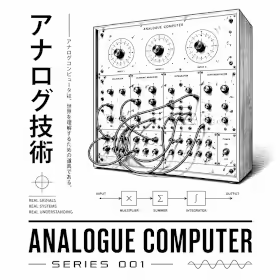
And for readers drawn to visible circuitry, mid-century instrumentation, and exposed system design, the Analogue Computer Series 001 Design carries the same visual philosophy into a modern wearable form.
Featured Product
Analogue Computer Series 001 T-Shirt
The phrase “reason in syllogisms” belonged to a time when computing was visible, tactile, and mechanical. The Analogue Systems 01 retrocomputing themed t-shirt celebrates that era of electric brains, logic circuits, switches, and learning machines, when reasoning could be traced through wires and confirmed by the glow of a lamp.
Disclosure: this is a commercial product link to an external Zazzle store associated with philreichert.org. Purchases are handled by Zazzle.

Writer's Notes
What stayed with me while working on this piece was how deliberately physical the GENIAC was. Modern computing culture tends to hide logic behind smooth interfaces and sealed hardware, but the GENIAC almost insisted that reasoning should be visible, touchable, and slightly awkward. The section on the rotary switches ended up carrying much more weight than I expected because those switches are really the entire philosophy of the machine condensed into hardware. You can trace the decisions. You can see the constraints. There is also something mildly unsettling about how confidently the 1950s spoke about “electric brains” while simultaneously exposing how dependent those systems were on human-defined pathways. The machine reveals its own limitations if you spend enough time looking at it.
Glossary
- Multi-position switch
- A switch that can select between several possible contact points rather than simply turning on or off. In the article, GENIAC’s circular switches let one dial represent numbers, conditions, game states, or logical choices, making abstract reasoning feel like something the reader could turn by hand.
- Electrical path
- The route electricity follows through wires, switches, bulbs, and terminals. In the GENIAC, these paths acted like visible lines of reasoning, with each completed route producing a result the user could see in a glowing lamp.
- Machine reasoning
- The use of structured rules or circuits to produce logical conclusions. The article treats GENIAC’s machine reasoning carefully: impressive as a teaching device, but limited because the machine only followed pathways designed by people.
- Binary translation
- The conversion of numbers between ordinary decimal notation and binary notation, which uses only 0 and 1. In the article, binary translation shows how the GENIAC moved beyond simple switching into ideas that connect directly with digital computing.
- Masonite panel
- A hard pressed-fibre board used as the GENIAC’s physical base. The article presents the panel as more than a mounting surface: it became a small workshop where switches, bulbs, and wires could be rearranged into different thinking machines.
- Electric brain
- A mid-century phrase for machines that appeared to calculate, decide, or reason. In the article, “electric brain” carries both excitement and exaggeration, capturing the 1950s hope that logic circuits might make intelligence visible.
Frequently asked questions
What made the GENIAC different from an ordinary electronics kit?
The GENIAC was designed to demonstrate reasoning and computation, not just electrical switching. Its reusable switches, lamps, wiring paths, and modular panel allowed users to build machines that compared values, followed logical rules, translated codes, and displayed decisions visibly.
Why were the GENIAC switches so important?
The circular multi-position switches were the core of the GENIAC design. They could reroute several independent electrical paths at once, allowing one physical switch to represent numbers, conditions, game states, logical statements, or decision points.
Did the GENIAC really think like an electric brain?
The GENIAC did not think independently. It followed human-designed wiring paths and displayed the resulting logical outcome. Its value was educational: it showed how machine reasoning could be built from structured circuits and visible constraints.
Why does the GENIAC still matter today?
The GENIAC still matters because it made computation visible. Modern computers hide logic inside chips and software, while the GENIAC exposed decision paths through switches, wires, bulbs, and circuits that users could physically inspect and rebuild.
Related articles…


Source Note
This article draws on GENIAC manual and advertising material from the 1950s, especially the way those sources described reasoning, circuits, switches, and “electric brain” learning. The aim is interpretive rather than academic: to explain how mid-century learners were invited to understand machine logic through visible parts and practical experiments.
Disclosure
This page presents a curated exploration of the GENIAC analogue computer kit and its associated materials. Content reflects the author’s interpretation of historical sources, including instructional manuals, advertisements, and related artefacts. The GENIAC system is discussed as an educational and conceptual model for understanding logic, circuits, and early computing ideas, rather than as a complete or authoritative account of computing history. References to “thinking machines” and reasoning systems follow the language and framing of the original material and are included for historical context. Readers seeking formal technical, historical, or academic treatment of computing should consult primary literature, scholarly sources, and specialist texts.