Why Early Computers Reasoned in Syllogisms

The Strange Promise Hidden in One Old Phrase
“Reason in syllogisms” is the kind of phrase that can stop a modern reader in their tracks. It sounds formal, distant, almost theatrical. Yet in the 1950s it appeared in advertisements for “electric brain” kits aimed at ordinary learners. The claim was simple but ambitious: this machine could follow logical arguments and arrive at conclusions.
That promise mattered because early computing still needed a language the public could recognise. People did not yet speak about software, algorithms, or artificial intelligence assistants. They spoke about switches, relays, and visible mechanisms. A syllogism provided a bridge between old logical reasoning and new electronic machines. If a machine could reason in syllogisms, then perhaps thinking itself could be broken into understandable steps.
Logic Became Something You Could Wire Together
A syllogism is a structured argument. One statement leads to another through a formal rule. The classic example is familiar: all people are mortal, Socrates is a person, therefore Socrates is mortal. The power lies not in the subject matter, but in the structure. If the premises are correct and arranged properly, the conclusion follows.
That made syllogisms ideal for early reasoning machines. A switch position could represent a statement. A circuit path could represent a logical relationship. A lamp could display the permitted conclusion. Instead of reading logic in a philosophy text, the learner could physically operate it.
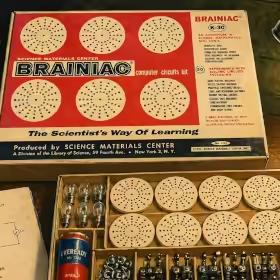
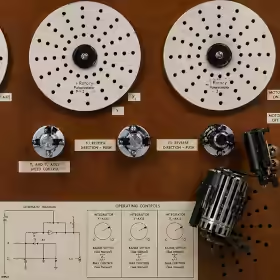
Machines such as GENIAC turned this into a hands-on experience. Users selected conditions with switches, completed circuits, and watched the result appear through illuminated bulbs. The machine did not understand fighter pilots, jet pilots, or mathematical puzzles in a human sense. Those were labels placed over a logical framework. The circuit only cared whether the chosen conditions matched a valid path.
This is one reason the GENIAC Journal: Hands-On Analogue Computer Kit (1950s) remains such an interesting historical resource. The kit reveals a moment when logic was treated not as invisible software, but as a visible machine assembled on a tabletop.
The Real Trick Was Translating Thought Into Switches
The important step was translation. Human statements had to become machine conditions. “All fighter pilots are bomber pilots” became one switch position. “No bomber pilots are jet pilots” became another. Once the conditions were selected, the wiring determined which conclusions were allowed.
If the premises matched a valid logical arrangement, electricity flowed to a lamp assigned to the correct answer. If no useful conclusion could be drawn, another lamp might indicate that deduction was impossible. The machine was not inventing ideas. It was enforcing a structure.
That is the practical meaning of “reason in syllogisms”. The intelligence existed partly in the design of the circuit and partly in the human who understood how to encode the problem. What fascinated people was seeing reasoning reduced to something physical and observable.
GENIAC made this unusually accessible because the user could follow the reasoning path directly. Logic was no longer hidden behind abstraction. You could trace the route from switch to wire to lamp and see how the conclusion emerged.
The Machine Was Limited, But Its Limits Were Visible
Compared with modern artificial intelligence, these machines were extremely narrow. They could not improvise, generalise, or generate fluent explanations. They only operated within the logical world already built into their circuits.
Yet that limitation created a kind of clarity modern systems often lack. Every result could be inspected. If the machine produced the wrong answer, the fault could usually be traced to a misplaced wire, an incorrect switch position, or a flawed design. The reasoning process was exposed rather than hidden.
That contrast still feels surprisingly modern. Today, large language models work through enormous statistical relationships in language. A GENIAC-style machine followed explicit logical pathways. One system predicts patterns. The other enforces structure.
The article How GENIAC Sparked the Electric Brain Revolution explores why this distinction mattered so much during the 1950s, when the idea of a machine that could “think” captured public imagination long before personal computing existed.
Advertising Turned Logic Into Public Imagination
The phrase “reason in syllogisms” also worked as marketing. It made a small educational kit sound intellectually serious. The wording connected electronics with philosophy, mathematics, and the future of information itself.
That was part of the appeal of the “electric brain” era. These machines suggested that reasoning could be engineered. A learner was not just assembling wires and bulbs. They were participating in a new technological culture built around information, logic, and automated decision making.
Advertisements understood this perfectly. They framed the machine almost as a challenge. Could a device really reason faster than you? Could logical thought itself be turned into hardware? The related article How the GENIAC Analogue Computer Kit Was Marketed to Learners looks directly at how those advertisements transformed formal logic into a compelling hands-on experience.
Follow the Phrase Back to the Circuit
Early computers reasoned in syllogisms because syllogisms provided a practical bridge between human logic and machine behaviour. They were structured enough to wire into circuits, familiar enough for the public to understand, and dramatic enough to help define the early mythology of the “electric brain”.
The most rewarding next step is to move from the phrase to the artefact itself. Start with the learner advertisement article, then explore the wider GENIAC Journal to see how switches, diagrams, and visible circuits introduced generations of readers to machine reasoning. Readers drawn to the visual language of early computing may also enjoy the Analogue Systems 01 retrocomputing themed t-shirt, which carries the same machine-age fascination with logic and circuitry into a modern collector piece.
Featured Product
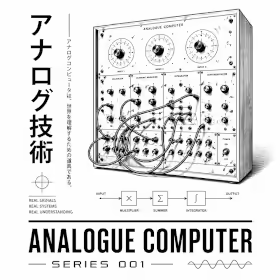
Analogue Computer Series 001 T-Shirt
The phrase “reason in syllogisms” belonged to a time when computing was visible, tactile, and mechanical. The Analogue Systems 01 retrocomputing themed t-shirt celebrates that era of electric brains, logic circuits, switches, and learning machines, when reasoning could be traced through wires and confirmed by the glow of a lamp.
Disclosure: this is a commercial product link to an external Zazzle store associated with philreichert.org. Purchases are handled by Zazzle.

Writer's Notes
I was not especially familiar with the phrase “reason in syllogisms” before working through this GENIAC material. It sounded archaic at first, almost like a leftover from an older schoolroom vocabulary. Yet the more I sat with it, the more contemporary it became. With artificial intelligence back at the centre of public attention, these older words for logic, reasoning, deduction, and machine thought are starting to feel newly useful.
What interests me most is that GENIAC still works as a learning object. Not just as a collectible, and not only as a charming 1950s artefact, but as a practical way to understand how logic can be translated into a physical system. Switches become choices. Wires become relationships. Lamps become conclusions. That is still a solid lesson.
Modern AI can feel hidden and atmospheric. GENIAC moves in the opposite direction. It makes reasoning visible. You can follow the path from premise to result with your eyes and hands. For anyone trying to understand what “machine reasoning” might mean, that old analogue computer kit still has something surprisingly fresh to teach.
Glossary
- Syllogism
- A formal argument where a conclusion follows from two related statements. In this article, it explains how early machines could appear to reason by following a fixed logical pattern.
- Electric Brain
- A mid-century phrase for machines that seemed to calculate or reason automatically. Here, it captures the wonder of seeing thought-like behaviour produced by switches, wires, and lamps.
- GENIAC
- A 1950s educational computer kit that let users build small reasoning and calculating machines. In this article, it is the key example of logic made physical and visible.
- Circuit
- A closed path that allows electric current to flow. The article uses circuits as the physical routes that turn selected statements into visible conclusions.
- Switch Position
- A selectable setting on a switch, used to represent a condition or statement. In GENIAC-style reasoning, choosing a switch position was like giving the machine a premise.
- Logical Pathway
- A designed route from input to conclusion. In the article, it describes how a machine follows prepared connections rather than inventing new ideas.
- Artificial Intelligence
- Computer systems that perform tasks associated with human intelligence. The article contrasts modern AI with earlier machines whose reasoning was narrow, inspectable, and physically wired.
Frequently asked questions
What does reason in syllogisms mean?
To reason in syllogisms means to reach a conclusion from structured statements that follow a formal logical pattern. In the article, the phrase explains how early computing machines could appear to reason by turning premises into switch positions and conclusions into visible outputs.
Did GENIAC really think?
GENIAC did not think in the human sense. It followed fixed logical pathways created by its wiring. Its appeal came from making reasoning visible, so users could see how selected conditions led to a conclusion.
How could switches and bulbs perform logic?
Switches represented statements or conditions, wires created possible logical paths, and bulbs displayed the result. When the selected switch positions matched a valid circuit path, current flowed to the bulb assigned to the correct conclusion.
How was GENIAC different from modern artificial intelligence?
GENIAC used visible, fixed circuits to follow explicit logic. Modern artificial intelligence systems usually work through complex statistical patterns in data and language. GENIAC was much narrower, but its reasoning process could be inspected directly.
Connected Threads
- Why Early Computers Reasoned in Syllogisms - Before AI became conversational, machines were presented as systems that could reason through visible logic. This article traces the phrase “reason in syllogisms” back to GENIAC, electric brain culture, and the moment when thought seemed to glow through a lamp.
Related articles…

Source Note
This article draws on GENIAC manual and advertising material from the 1950s, especially the way those sources described reasoning, circuits, switches, and “electric brain” learning. The aim is interpretive rather than academic: to explain how mid-century learners were invited to understand machine logic through visible parts and practical experiments.
Disclosure
This page presents a curated exploration of the GENIAC analogue computer kit and its associated materials. Content reflects the author’s interpretation of historical sources, including instructional manuals, advertisements, and related artefacts. The GENIAC system is discussed as an educational and conceptual model for understanding logic, circuits, and early computing ideas, rather than as a complete or authoritative account of computing history. References to “thinking machines” and reasoning systems follow the language and framing of the original material and are included for historical context. Readers seeking formal technical, historical, or academic treatment of computing should consult primary literature, scholarly sources, and specialist texts.