Why Did We Stop Teaching People How Machines Think?
◆ Revised

Introduction
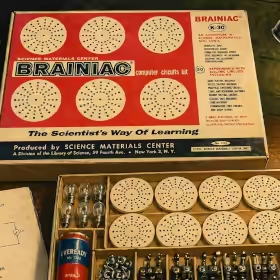
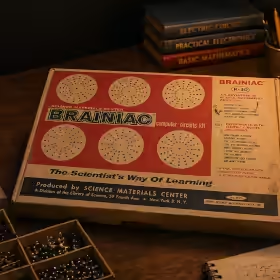
The strange thing about the GENIAC is not that it was made from cardboard, wire, flashlight bulbs, and a battery.
The strange thing is that its creators believed ordinary people should understand it.
Not engineers. Not mathematicians. Not military researchers. Ordinary people. Including children.
That assumption now feels surprisingly distant.
Today, most people interact with systems vastly more powerful than a 1950s “electric brain,” yet understand far less about how those systems actually work. Modern AI can write essays, generate images, recommend videos, rank search results, and shape public conversation through invisible algorithms. For most users, the process behind those outputs remains abstract and inaccessible.
GENIAC approached computation from the opposite direction.
The machine was not hidden behind the interface. The machine was the lesson.
For readers unfamiliar with the kit itself, GENIAC Analog Computer Kit provides a broader overview of how the system used switches, circuits, and visible logic pathways to model reasoning and calculation.
When Technology Expected Participation
Mid-century hobbyist culture carried a very different expectation about technology. Radios were opened. Kits were assembled. Circuits were traced. Scientific understanding was treated as something practical and physical rather than purely academic.
GENIAC belonged directly to that culture.
Users physically wired circuits together to create arithmetic machines, reasoning systems, coding devices, comparison engines, and simple game-playing machines. A bulb lit because a path had been completed. A result appeared because a switch changed the logic of the circuit.
The user could follow the reasoning process with their eyes and hands.
That tactile visibility matters more than it first appears.
Modern computing increasingly removes visible structure. Interfaces are designed to feel frictionless. Systems become smoother by hiding complexity. The user experiences the result without seeing the process.
Convenience became the product. Understanding became optional.
The Loss of Mechanical Intuition
There is an uncomfortable side effect to this shift.
When people stop seeing systems, they also become less confident questioning them.
Recommendation engines begin to feel neutral. Search rankings begin to feel authoritative. AI outputs begin to feel objective simply because they are computational. Yet most users have little understanding of training data, statistical prediction, optimisation incentives, or algorithmic bias.
Ironically, a child building a GENIAC in 1955 may have possessed a clearer intuition about machine logic than many adults using AI systems today.
That does not mean GENIAC was more advanced. It was obviously primitive by modern standards. Many of its “thinking machines” were carefully constrained demonstrations rather than true autonomous reasoning.
But the educational philosophy behind the kit was radically transparent.
The machine did not pretend to be magic.
Even its limitations were educational. Users could inspect the switches, follow the pathways, and understand why the result appeared.
That visibility is largely absent from modern consumer technology.
The Hidden Curriculum of Modern Interfaces
Every technology teaches habits.
GENIAC taught experimentation, troubleshooting, patience, and logical structure. Modern platforms often teach acceptance. Tap the button. Trust the recommendation. Scroll to the next result.
The contrast between a cardboard logic machine on a kitchen table and an opaque AI system in a smartphone still feels striking because it reflects a broader cultural shift from participation toward consumption.
This is one reason the GENIAC manual still feels unexpectedly modern. Its project progression moved users from simple switching circuits into arithmetic, coding, comparison logic, and game systems step by step. GENIAC Project List: Building Thinking Machines and Circuits shows how ambitious that educational journey actually was.
The kit was not merely selling entertainment. It was selling computational confidence.
Why the GENIAC Story Matters Again
The renewed interest in maker culture, hobby electronics, Raspberry Pi systems, retro computing, and STEM experimentation suggests that many people still want visible systems they can understand and control.
That desire matters more as AI systems spread into everyday life.
AI literacy cannot simply mean learning how to type prompts. It must also include understanding systems, incentives, probabilities, limitations, and machine reasoning itself. Articles such as Why Early Computers Were Built Around Logic help place GENIAC within that wider history of computational thinking.
The GENIAC now reads less like a quaint educational toy and more like evidence of a lost expectation: that ordinary people should understand the systems shaping their lives.
Perhaps that expectation was never fully realistic. But abandoning it entirely may prove more dangerous.
That may also explain why the visual language of analogue computing still resonates today, whether through rebuilt kits, visible circuitry, or objects like the Analogue Computer Series 001 design. The appeal is not simply nostalgia. It is the attraction of systems you can still see, trace, and question.
Because the real issue is no longer whether machines can think.
It is whether people still understand enough to ask how.
Featured Product
Analogue Computer Series 001 T-Shirt
The phrase “reason in syllogisms” belonged to a time when computing was visible, tactile, and mechanical. The Analogue Systems 01 retrocomputing themed t-shirt celebrates that era of electric brains, logic circuits, switches, and learning machines, when reasoning could be traced through wires and confirmed by the glow of a lamp.
Disclosure: this is a commercial product link to an external Zazzle store associated with philreichert.org. Purchases are handled by Zazzle.

Writer's Notes
What stayed with me while working on this piece was not the technology itself, but the assumption behind it. The people who designed GENIAC genuinely believed that ordinary users should be able to see a machine reason in front of them, trace the logic path, and understand the outcome. That feels very far removed from modern computing culture, where systems become more influential precisely as they become less visible. I think this article works best when it stops treating GENIAC as a quaint retro curiosity and starts treating it as evidence of a different educational philosophy entirely. There is something slightly uncomfortable in that comparison, especially once you realise how many modern users operate powerful systems they cannot meaningfully inspect or explain.
Reader Guide
The following material expands on the terminology, historical context, technical concepts, and related reading connected to this article.
Journey Map - GENIAC Analogue Computer Kit
This article sits within the GENIAC Analogue Computer Kit topic cluster. The sequence below moves from discovery and explanation through historical advertising culture and into broader reflections on computing, learning and the changing relationship between humans and machines.
Reading context: This journey combines historical reconstruction, vintage advertising, analogue computing concepts and reflective essays about digital culture. Most readers will move through the sequence gradually rather than in a single sitting. The complete journey takes approximately 45–90 minutes.
- Foundations and Discovery
- Remember a Kit Computer from the 1950s?
- What Is the GENIAC Computer?
- Why Was the GENIAC Computer Created?
- Advertising, Imagination and Electric Brains
- How the GENIAC Computer Was Marketed to Learners
- The GENIAC “Electronic Brain” Explained
- Was GENIAC a Computer or a Toy?
- Reflections on Computing Culture
- Why GENIAC Still Matters
- Why Did We Stop Teaching This?
- The Decline of Hobbyist Computing Culture
Glossary
- GENIAC
- A 1950s educational construction kit that used switches, wires, bulbs, and circuits to model reasoning and calculation. In this article, GENIAC stands for a lost style of learning where users could physically see how a machine reached an answer.
- Machine Reasoning
- The use of a machine to follow logical rules and produce a result from given conditions. Here it describes how GENIAC made reasoning visible through simple circuits, long before modern AI made machine thinking feel distant and opaque.
- Mechanical Intuition
- A practical feel for how parts, systems, and cause-and-effect relationships work. The article uses it to describe the kind of understanding people gained by building and tracing machines rather than only using finished interfaces.
- Algorithmic Bias
- A pattern of unfair or distorted results produced by a computational system, often because of its data, design, or incentives. In the article, it is one reason modern users need more than surface-level digital skills.
- Maker Culture
- A hands-on movement built around building, repairing, modifying, and experimenting with technology. The article connects it to GENIAC because both value systems that can be touched, tested, questioned, and understood.
- Computational Confidence
- The confidence to understand, question, and work with computational systems rather than simply accept their outputs. In this article, it captures what GENIAC offered: not just a kit, but a way of feeling capable around machines.
Frequently asked questions
Why did older computing kits teach people how machines worked?
Older computing kits such as GENIAC came from a hobbyist culture that treated technology as something users could build, inspect, and understand. Learning involved tracing circuits, testing logic, and seeing how a machine produced an answer.
How was GENIAC different from modern digital technology?
GENIAC exposed its logic through visible switches, wires, bulbs, and circuits. Modern digital systems often hide their decision-making inside software, interfaces, algorithms, and remote computing infrastructure.
What does GENIAC reveal about AI literacy today?
GENIAC shows that technical literacy can mean more than using a tool successfully. It suggests that users also need some understanding of systems, logic, limitations, and the pathways by which machines produce results.
Why does visible machine logic still matter?
Visible machine logic helps people question, test, and understand technological systems rather than simply accepting their outputs. This matters more as AI, recommendation engines, and algorithmic systems influence everyday decisions.
Connected Threads
- The Miscellaneum 005 – GENIAC Analogue Computer Kit - This article was featured in The Miscellaneum Issue 005, a themed exploration of visible machine logic, analogue computing, hobbyist computer culture, and the educational history of the electric brain.
Related articles…


Source Note
This article draws on GENIAC manual and advertising material from the 1950s, especially the way those sources described reasoning, circuits, switches, and “electric brain” learning. The aim is interpretive rather than academic: to explain how mid-century learners were invited to understand machine logic through visible parts and practical experiments.
Disclosure
This page presents a curated exploration of the GENIAC analogue computer kit and its associated materials. Content reflects the author’s interpretation of historical sources, including instructional manuals, advertisements, and related artefacts. The GENIAC system is discussed as an educational and conceptual model for understanding logic, circuits, and early computing ideas, rather than as a complete or authoritative account of computing history. References to “thinking machines” and reasoning systems follow the language and framing of the original material and are included for historical context. Readers seeking formal technical, historical, or academic treatment of computing should consult primary literature, scholarly sources, and specialist texts.