I Remember a Kit Computer from the 1950s. What Was It?
◆ Revised

Introduction
You probably remember the lights first.
Small bulbs glowing on a wooden board. Wires crossing between metal terminals. Large rotating switches clicking into place while a booklet talked about “electric brains” and machines that could somehow “reason”.
If that memory sounds familiar, there is a very good chance you are remembering the GENIAC Electric Brain Construction Kit.
People often misremember GENIAC because it did not resemble what modern culture calls a computer. There was no screen, keyboard, or software. It looked more like a cross between a science project, a telephone switchboard, and a logic puzzle.
Yet the experience stayed with people because the machine appeared to think.
The Strange Appeal of Visible Thinking
GENIAC was built around simple electrical logic. A battery sent current through wires and rotary switches. Depending on how those switches were arranged, certain bulbs lit while others remained dark.
That sounds mechanically simple now, but in the 1950s it felt remarkable.
One glowing bulb might represent YES. Another meant NO. A different light might indicate SAFE, OPEN, WIN, or DANGER. The machine appeared to arrive at conclusions.
That illusion mattered more than the hardware itself.
Modern technology hides its logic behind glass screens and software layers. GENIAC did the opposite. You could physically trace the reasoning process through the wiring. The logic was exposed.
That is one reason the kit remained memorable long after more advanced electronics arrived. People did not just use the machine. They could watch the machine “think”.
The Rotating Switches Were the Giveway
For many former owners, the strongest surviving memory is the set of circular rotary switches mounted across the board.
These were not simple on-off switches. Each dial controlled multiple electrical paths at the same time. Turning one switch could completely change the machine’s behaviour.
That design allowed GENIAC to simulate arithmetic, decision-making, coding systems, and logical reasoning using only wires and contacts.
If your memory includes turning large selector dials while trying to make bulbs illuminate correctly, you are almost certainly remembering GENIAC.
What Is GENIAC? provides a broader overview of how the system used simple switching circuits to model reasoning and calculation.
It Was Not Really a Toy
GENIAC was sold to hobbyists, students, and curious families, but the underlying ideas were serious.
The projects included logic machines, code systems, game-playing circuits, binary translators, reasoning experiments, and arithmetic devices. One project simulated formal logical deduction. Another played Nim. Others explored binary mathematics years before home computing existed.
This is where the kit becomes historically interesting. GENIAC was teaching computational logic long before personal computing became mainstream culture.
Articles like Why Early Computers Were Built Around Logic and Machine Reasoning and the Age of Syllogisms reveal how deeply mid-century computing culture believed that intelligence itself could emerge from formal logic and structured reasoning.
GENIAC translated those abstract ideas into something people could physically build on a kitchen table.
The Marketing Was Overdramatic. The Prediction Was Not.
The original advertising leaned heavily into phrases like “electric brain” and “thinking machine”. Some of it now feels wonderfully overconfident.
But the strange thing is this: the core prediction turned out to be largely correct.
Modern computing really did become a world of logical states, symbolic operations, binary reasoning, conditional paths, and machine decision systems. GENIAC reduced those ideas into a form ordinary people could touch.
In hindsight, the kit feels less like a toy and more like a miniature public demonstration of early computational culture.
How GENIAC Sparked the Electric Brain Revolution explores this transition particularly well, showing how “electric brain” marketing evolved into practical computing concepts that still shape modern technology.
Why People Still Search for It Decades Later
Most forgotten electronics disappear completely from cultural memory. GENIAC did not.
Partly this is because the machine was interactive in a very physical way. You tightened bolts, moved wires, tested circuits, and watched logic emerge through light.
But there is also something emotionally durable about visible systems. GENIAC allowed people to feel that intelligence itself could be assembled, understood, and traced by hand.
That idea still has power.
If you want to explore the broader ecosystem surrounding the kit, GENIAC Journal: Hands-On Analogue Computer Kit (1950s) is the best next step through the machines, manuals, projects, and cultural context behind one of the strangest educational devices of the mid-century computing era.
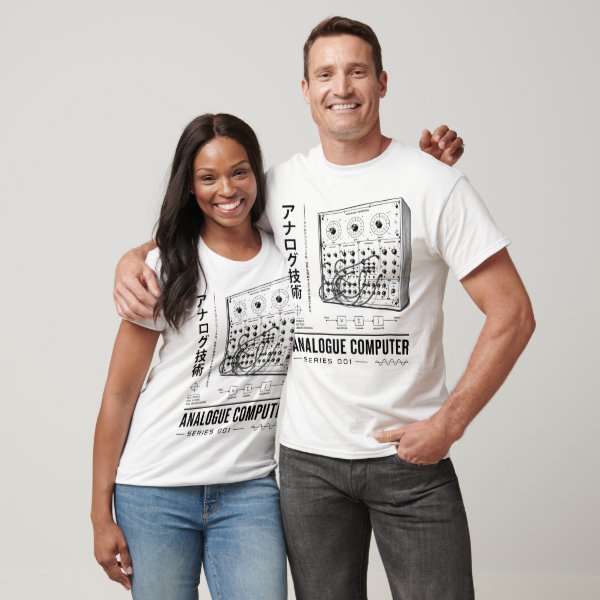
And for readers who appreciate the aesthetic of exposed logic, visible signal paths, and mid-century machine design, the Analogue Computer Series 001 design captures the same engineering character that made GENIAC memorable in the first place.
Featured Product
Analogue Computer Series 001 T-Shirt
The phrase “reason in syllogisms” belonged to a time when computing was visible, tactile, and mechanical. The Analogue Systems 01 retrocomputing themed t-shirt celebrates that era of electric brains, logic circuits, switches, and learning machines, when reasoning could be traced through wires and confirmed by the glow of a lamp.
Disclosure: this is a commercial product link to an external Zazzle store associated with philreichert.org. Purchases are handled by Zazzle.
Writer's Notes
What I enjoy about this piece is that it approaches GENIAC from memory rather than specification. Most computing history is written backwards from technical achievement, but this article starts with half-remembered lights, switches, and the strange feeling that a machine was somehow “thinking” in front of you. I think that matters. The most interesting part of GENIAC was never its computational power. It was the visibility of the logic itself. You could physically trace the reasoning process through wires and contacts. Modern computing has largely hidden that layer from view. GENIAC sat in an awkward but fascinating middle ground between educational toy, public spectacle, and genuine introduction to machine reasoning.
Reader Guide
The following material expands on the terminology, historical context, technical concepts, and related reading connected to this article.
Journey Map - GENIAC Analogue Computer Kit
This article sits within the GENIAC Analogue Computer Kit topic cluster. The sequence below moves from discovery and explanation through historical advertising culture and into broader reflections on computing, learning and the changing relationship between humans and machines.
Reading context: This journey combines historical reconstruction, vintage advertising, analogue computing concepts and reflective essays about digital culture. Most readers will move through the sequence gradually rather than in a single sitting. The complete journey takes approximately 45–90 minutes.
- Foundations and Discovery
- Remember a Kit Computer from the 1950s?
- What Is the GENIAC Computer?
- Why Was the GENIAC Computer Created?
- Advertising, Imagination and Electric Brains
- How the GENIAC Computer Was Marketed to Learners
- The GENIAC “Electronic Brain” Explained
- Was GENIAC a Computer or a Toy?
- Reflections on Computing Culture
- Why GENIAC Still Matters
- Why Did We Stop Teaching This?
- The Decline of Hobbyist Computing Culture
Glossary
- GENIAC
- GENIAC was a 1950s educational construction kit that used switches, wires, a battery, and bulbs to demonstrate logic and machine reasoning. In this article, it is identified as the likely “kit computer” remembered by readers who recall a hands-on electric brain.
- Electric brain
- “Electric brain” was a mid-century phrase for machines that appeared to calculate or reason. The article uses the term to capture both the excitement and exaggeration surrounding early computing culture, when a glowing bulb could feel like a machine reaching a conclusion.
- Rotary switch
- A rotary switch is a circular selector that changes electrical connections when turned. In GENIAC, these switches were central because they let one dial redirect several logic paths at once, giving the kit its distinctive hands-on character.
- Logic circuit
- A logic circuit is an arrangement of electrical paths that produces an output based on set conditions. In the article, GENIAC’s logic circuits explain how simple wiring could create answers such as YES, NO, SAFE, or DANGER.
- Binary reasoning
- Binary reasoning uses two-state choices, such as on or off, yes or no, and one or zero. GENIAC made this idea visible by turning abstract logic into physical switch positions and glowing lamps.
- Machine reasoning
- Machine reasoning means using a machine to follow structured rules and produce a conclusion. The article treats GENIAC as an early public encounter with this idea, not because it understood anything, but because it made rule-based thinking visible.
Frequently asked questions
What was the 1950s kit computer with lights, wires, and rotating switches?
The half-remembered 1950s kit computer was most likely the GENIAC Electric Brain Construction Kit, an educational logic kit that used wires, rotary switches, a battery, and small bulbs to demonstrate reasoning and calculation.
Was GENIAC a real computer or just a toy?
GENIAC was not a computer in the modern electronic sense, but it was more than a simple toy. It was an educational construction kit that modelled logic, arithmetic, decision-making, and machine reasoning through physical circuits.
How did the GENIAC Electric Brain Construction Kit work?
GENIAC worked by routing current from a battery through wires and rotary switches. Depending on how the switches were set, current reached different bulbs, which acted as visible answers to logic, arithmetic, or decision problems.
Why do people still remember GENIAC decades later?
People still remember GENIAC because it made machine reasoning visible. Users could build circuits by hand, turn switches, and watch bulbs light as answers, creating a memorable sense that logic and intelligence could be physically assembled and traced.
Related articles…


Source Note
This article draws on GENIAC manual and advertising material from the 1950s, especially the way those sources described reasoning, circuits, switches, and “electric brain” learning. The aim is interpretive rather than academic: to explain how mid-century learners were invited to understand machine logic through visible parts and practical experiments.
Disclosure
This page presents a curated exploration of the GENIAC analogue computer kit and its associated materials. Content reflects the author’s interpretation of historical sources, including instructional manuals, advertisements, and related artefacts. The GENIAC system is discussed as an educational and conceptual model for understanding logic, circuits, and early computing ideas, rather than as a complete or authoritative account of computing history. References to “thinking machines” and reasoning systems follow the language and framing of the original material and are included for historical context. Readers seeking formal technical, historical, or academic treatment of computing should consult primary literature, scholarly sources, and specialist texts.