The Death of the Intelligent Hobbyist
◆ Revised

When Ordinary Readers Were Invited Inside Machines
There was a time when publishers assumed ordinary people could handle complexity.
Not engineers. Not specialists. Ordinary readers.
Teenagers building radios in bedrooms. Fathers covering kitchen tables with wires and screws. Families willing to tolerate confusion because learning how something worked still carried social value.
GENIAC emerged from that world.
The 1950s “electric brain” kit was not sold as passive entertainment. It asked readers to assemble logic machines from switches, wires, bulbs, and rotating contacts. Some projects were simple alarms and signalling systems. Others moved into binary arithmetic, machine reasoning, code translation, and game-playing circuits.
What makes GENIAC remarkable is not simply that it existed. It is that publishers believed there was a broad audience for it.
The kit assumed curiosity could survive friction.
The Lost Value of Productive Friction
A modern device succeeds when it disappears into convenience. GENIAC did the opposite. It spread its logic physically across a board so the learner could trace every connection. If a machine failed, the reader was expected to stop, think, and diagnose the mistake.
The manual even says so directly: “TAKE YOUR TIME and think.”
That sentence feels strangely out of place now.
Modern consumer technology removes resistance wherever possible. Interfaces flatten complexity into gestures. Hardware is sealed shut. Software hides its underlying structure. The ideal user experience is immediate, invisible, and frictionless.
There are obvious advantages to this. More people can use powerful technology than at any previous moment in history. A phone can now perform tasks that would have seemed absurdly futuristic when GENIAC was released.
But convenience changes the relationship between people and machines.
The Narrowing of the Intelligent Hobbyist
The intelligent hobbyist once occupied a large middle ground between expert and consumer. This person did not necessarily possess formal qualifications. They simply believed systems were understandable enough to investigate.
That middle ground has narrowed.
Today, technical literacy increasingly concentrates inside professional specialisations while the broader public interacts with polished surfaces they cannot meaningfully inspect or repair. Many people can operate sophisticated systems while remaining disconnected from how those systems function.
GENIAC exposed the opposite philosophy.
Readers approaching GENIAC Analog Computer Kit today often expect something primitive and toy-like. Instead, they encounter a strange educational object that treats symbolic logic as a hands-on activity. A switch position becomes a logical condition. A bulb becomes an answer state. Reasoning itself becomes physical.
That physicality is the important part.
Why Slow Machines Can Teach Fast Ideas
The kit was slow, awkward, and limited. It was not a modern automatic computer. Many of its “thinking machines” required manual switching and careful setup. Yet the slowness was educational because it forced the learner to notice what fast machines normally conceal.
Projects escalated from simple electrical circuits into increasingly abstract ideas. GENIAC Project List: Building Thinking Machines and Circuits shows this progression clearly. The learner moved from alarms and signalling systems into arithmetic logic, comparison systems, binary translation, machine reasoning, and primitive strategic games.
In other words, GENIAC was not really teaching electronics.
It was teaching structured thinking.
From Shared Curiosity to Sealed Convenience
This is why the decline of the intelligent hobbyist matters beyond nostalgia. A culture that no longer expects ordinary people to understand systems eventually produces consumers who treat technology as something mystical, corporate, and untouchable.
The irony is that educational resources are now everywhere. Tutorials, open-source software, simulators, and technical communities are vastly more accessible than in the 1950s. Yet abundance alone does not create participatory culture.
Culture depends on expectation.
Mid-century hobbyist culture assumed people could rise toward complexity. Modern technology increasingly assumes complexity should be hidden from people entirely.
That shift changes behaviour.
The old hobbyist learned through resistance. A wire went to the wrong terminal. A diagram made no sense at first glance. A machine failed and demanded investigation. Frustration was not evidence the product had failed. Frustration was part of the educational process.
Why Visible Logic Still Has Emotional Weight
Now, many systems are designed specifically to prevent inspection. Devices are glued shut. Repair becomes proprietary. Interfaces become abstracted from mechanism. The user is guided away from the machine rather than toward it.
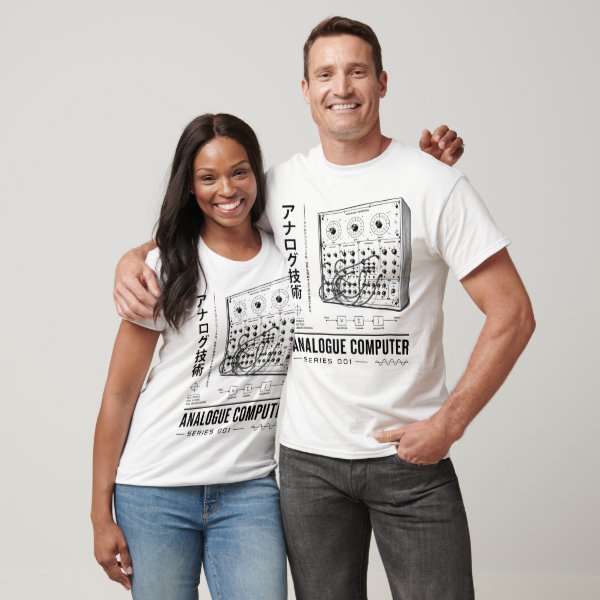
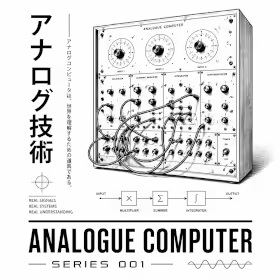
This is why the visual language of old computing still carries emotional weight. Visible circuits, labelled switches, signal paths, and exposed logic diagrams suggest a world where systems could still be followed by eye. Even modern pieces such as Analogue Computer T-Shirt: Series 001 Design resonate because they preserve that older confidence that machines should remain legible.
The intelligent hobbyist has not vanished completely. Maker spaces, repair communities, vintage computing groups, and technically curious amateurs still exist. But they now feel like countercultures instead of the obvious future.
GENIAC reminds us that another relationship with technology once existed.
One where ordinary people were invited inside the machine itself.
And perhaps the real loss is not technical skill alone, but cultural confidence in the idea that ordinary curiosity is still worth the effort.
Featured Product
Analogue Computer Series 001 T-Shirt
The phrase “reason in syllogisms” belonged to a time when computing was visible, tactile, and mechanical. The Analogue Systems 01 retrocomputing themed t-shirt celebrates that era of electric brains, logic circuits, switches, and learning machines, when reasoning could be traced through wires and confirmed by the glow of a lamp.
Disclosure: this is a commercial product link to an external Zazzle store associated with philreichert.org. Purchases are handled by Zazzle.
Writer's Notes
I think the most interesting tension in this piece is that it is not really mourning old technology. It is mourning an older relationship with technology. GENIAC itself was awkward, limited, and in many ways impractical, yet the kit carried a strange confidence that ordinary people could sit with difficulty long enough to understand something abstract. That assumption feels historically important to me. A lot of the surrounding GENIAC articles focus on circuits, projects, or machine reasoning, but this one keeps drifting back toward culture and behaviour. The detail that stays with me is not the switches or bulbs. It is the idea that frustration once had educational status instead of being treated as a design failure. That feels like a much larger story than one construction kit.
Reader Guide
The following material expands on the terminology, historical context, technical concepts, and related reading connected to this article.
Journey Map - GENIAC Analogue Computer Kit
This article sits within the GENIAC Analogue Computer Kit topic cluster. The sequence below moves from discovery and explanation through historical advertising culture and into broader reflections on computing, learning and the changing relationship between humans and machines.
Reading context: This journey combines historical reconstruction, vintage advertising, analogue computing concepts and reflective essays about digital culture. Most readers will move through the sequence gradually rather than in a single sitting. The complete journey takes approximately 45–90 minutes.
- Foundations and Discovery
- Remember a Kit Computer from the 1950s?
- What Is the GENIAC Computer?
- Why Was the GENIAC Computer Created?
- Advertising, Imagination and Electric Brains
- How the GENIAC Computer Was Marketed to Learners
- The GENIAC “Electronic Brain” Explained
- Was GENIAC a Computer or a Toy?
- Reflections on Computing Culture
- Why GENIAC Still Matters
- Why Did We Stop Teaching This?
- The Decline of Hobbyist Computing Culture
Glossary
- Intelligent Hobbyist
- A technically curious amateur who learns by opening, building, repairing, and experimenting rather than merely consuming finished products. In this article, the intelligent hobbyist represents a lost middle ground between expert engineer and passive user.
- Electric Brain
- A mid-century phrase for machines that appeared to calculate, reason, or make decisions using electrical circuits. GENIAC used the phrase to make logic feel dramatic and tangible, turning abstract thought into switches, bulbs, and visible pathways.
- Symbolic Logic
- A formal way of representing reasoning through symbols, conditions, and relationships. In the article, symbolic logic becomes something a reader could physically handle, where a switch position might stand for a premise and a glowing bulb for an answer.
- Binary Arithmetic
- Calculation using only two digits, 0 and 1, which suits machines built around on and off states. GENIAC used binary ideas to show how simple electrical conditions could become mathematical reasoning.
- Friction
- The difficulty, delay, confusion, or effort involved in learning how something works. Here, friction is not treated as a flaw, but as the very condition that helped hobbyists build understanding.
- Technical Literacy
- The ability to understand, question, repair, or adapt the systems one uses. The article argues that technical literacy has narrowed as modern devices have become more sealed, convenient, and difficult to inspect.
Frequently asked questions
What was the intelligent hobbyist?
The intelligent hobbyist was the technically curious amateur who wanted to understand how machines worked, even without being a professional engineer. This figure sat between expert and consumer, learning through manuals, kits, diagrams, repairs, and patient experimentation.
Why does GENIAC matter to hobbyist culture?
GENIAC matters because it shows a period when publishers assumed ordinary readers could handle symbolic logic, circuits, and machine reasoning. The kit treated complexity as something readers could approach through hands-on learning rather than something to hide.
Did modern technology cause the decline of the intelligent hobbyist?
Modern technology helped narrow the space for the intelligent hobbyist by making devices smoother, sealed, and harder to inspect or repair. The problem is not that people became less curious, but that many consumer systems now discourage direct understanding.
What was lost when technology became more convenient?
Convenience made powerful tools easier to use, but it also reduced the need to understand their inner workings. What was lost was a broader participatory culture where ordinary people were encouraged to trace circuits, repair devices, tolerate confusion, and learn from friction.
Connected Threads
- The Miscellaneum 005 – GENIAC Analogue Computer Kit - This article was featured in The Miscellaneum Issue 005, a themed exploration of visible machine logic, analogue computing, hobbyist computer culture, and the educational history of the electric brain.
Related articles…


Source Note
This article draws on GENIAC manual and advertising material from the 1950s, especially the way those sources described reasoning, circuits, switches, and “electric brain” learning. The aim is interpretive rather than academic: to explain how mid-century learners were invited to understand machine logic through visible parts and practical experiments.
Disclosure
This page presents a curated exploration of the GENIAC analogue computer kit and its associated materials. Content reflects the author’s interpretation of historical sources, including instructional manuals, advertisements, and related artefacts. The GENIAC system is discussed as an educational and conceptual model for understanding logic, circuits, and early computing ideas, rather than as a complete or authoritative account of computing history. References to “thinking machines” and reasoning systems follow the language and framing of the original material and are included for historical context. Readers seeking formal technical, historical, or academic treatment of computing should consult primary literature, scholarly sources, and specialist texts.