4 Things GENIAC Got Wrong About Computers
◆ Revised

Introduction
The GENIAC is one of those rare historical machines that manages to be both insightful and fundamentally mistaken at the same time.
In the 1950s, this cardboard-and-switches “electric brain” promised ordinary people a glimpse into machine intelligence. It could solve logic problems, perform arithmetic, play simplified games, and simulate reasoning through visible electrical pathways. For many readers opening the manual for the first time, it must have felt astonishingly close to real thinking.
But the GENIAC also reveals something important about the early computing era: nobody fully knew what computers were going to become.
The kit captured certain truths about logic brilliantly. At the same time, it locked itself into assumptions that history eventually discarded. That tension is exactly why the GENIAC remains more interesting than many later educational kits.
It is not simply an early computer. It is a snapshot of computing before the future settled into place.
1. It Treated Wiring as the Heart of Computing
The GENIAC assumed that changing a computer’s behaviour meant physically changing the machine itself.
To create a new function, you rewired circuits, moved jumpers, changed switch positions, or rebuilt electrical pathways. In GENIAC-world, programming looked closer to telephone exchange maintenance than modern software development.
That was understandable in the early 1950s. Some real machines still depended heavily on plugboards and manual configuration. But the industry was already shifting toward stored-program computing, where instructions existed inside memory rather than inside hardware layouts.
The future belonged to software.
The GENIAC largely missed that transition.
This becomes obvious while reading through the projects in GENIAC Project List: Building Thinking Machines and Circuits. The machines become increasingly ambitious, yet nearly all intelligence still depends on physical configuration rather than reusable instruction systems.
Ironically, this limitation is part of the kit’s modern appeal. The GENIAC lets you physically see logic happening in front of you. Modern computing rarely offers that experience anymore.
2. It Confused Logic With Intelligence
The GENIAC constantly described itself using the language of “thinking machines” and “electric brains”. That reflected genuine excitement in mid-century computing culture. Formal logic, symbolic reasoning, and cybernetics all seemed to point toward machine intelligence.
But the GENIAC often blurred the line between logical procedure and actual understanding.
A circuit can produce correct answers without comprehending anything. The machine does not know why a conclusion is true. It simply follows predetermined electrical paths.
That distinction matters more than the advertising admitted.
Articles like Why Early Computers Were Built Around Logic and Machine Reasoning and the Age of Syllogisms show how strongly the era believed intelligence might emerge from formal reasoning structures alone.
The GENIAC absorbed that optimism completely.
What makes the kit fascinating now is that it preserves an early misunderstanding that modern AI discussions still struggle with: the assumption that convincing outputs automatically imply understanding.
3. It Underestimated the Importance of Memory
Modern computers are not merely logic machines. They are memory machines.
Memory allows software to persist, compare states, preserve instructions, and build complexity over time. Without memory, a machine can demonstrate logic. With memory, it becomes far more flexible.
The GENIAC barely entered this territory.
Most GENIAC circuits are static systems. Once wired, they produce predictable outputs from fixed arrangements. The user remains deeply involved in configuring the machine itself. Even the manual acknowledges that the system could reason and calculate “automatically” while still depending heavily on human setup and operation. :contentReference[oaicite:0]{index=0}
That limitation matters historically because stored memory became one of the defining breakthroughs of modern computing.
The GENIAC teaches logical structure extremely well. Computational flexibility, far less successfully.
4. It Assumed Computers Would Stay Visible
The GENIAC believed computation should be physically understandable.
You could trace the wires. You could follow the switches. You could literally watch decisions unfold through glowing bulbs and electrical contacts. The entire educational philosophy depended on visibility.
That assumption turned out to be spectacularly wrong.
Modern computing became increasingly abstract and invisible. Operating systems buried hardware. Software buried machine logic. Networks buried location. Cloud systems buried infrastructure entirely.
The average user now interacts with computation almost entirely through surfaces.
The GENIAC imagined a future where machine reasoning would remain tangible. Instead, computing disappeared beneath layers of abstraction most people never see.
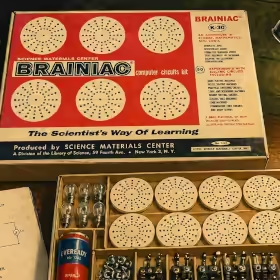
Oddly enough, this failure may now be part of the kit’s enduring appeal. Projects like GENIAC Journal: Hands-On Analogue Computer Kit (1950s) continue attracting readers precisely because the GENIAC exposes something modern systems conceal: the physical structure of decision-making itself.
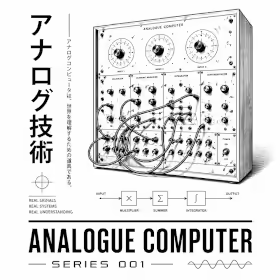
That tactile visibility also explains why retro-computing aesthetics continue resurfacing in objects like the Analogue Computer Series 001 Design. People are responding not just to nostalgia, but to understandable systems.
The GENIAC got several major things wrong about where computing was heading.
But in the process, it preserved something modern computing largely lost: the ability to see thought structures operating in the open.
Featured Product
Analogue Computer Series 001 T-Shirt
The phrase “reason in syllogisms” belonged to a time when computing was visible, tactile, and mechanical. The Analogue Systems 01 retrocomputing themed t-shirt celebrates that era of electric brains, logic circuits, switches, and learning machines, when reasoning could be traced through wires and confirmed by the glow of a lamp.
Disclosure: this is a commercial product link to an external Zazzle store associated with philreichert.org. Purchases are handled by Zazzle.

Writer's Notes
I think this article works because it refuses to treat the GENIAC as a simple ancestor of the modern computer. There is a tendency in technology writing to flatten history into a neat progression where every old machine becomes an early version of what eventually “won”. The GENIAC does not fit comfortably into that story. Some of its assumptions about computing were genuinely wrong, yet those wrong turns are exactly what make the kit revealing. I am especially fascinated by the idea that the GENIAC assumed computation would remain visible and physically understandable. In a strange way, it preserved a more human-scale relationship with logic than many modern systems allow. The machine feels optimistic, slightly confused, and oddly honest all at once.
Reader Guide
The following material expands on the terminology, historical context, technical concepts, and related reading connected to this article.
Journey Map - GENIAC Analogue Computer Kit
This article sits within the GENIAC Analogue Computer Kit topic cluster. The sequence below moves from discovery and explanation through historical advertising culture and into broader reflections on computing, learning and the changing relationship between humans and machines.
Reading context: This journey combines historical reconstruction, vintage advertising, analogue computing concepts and reflective essays about digital culture. Most readers will move through the sequence gradually rather than in a single sitting. The complete journey takes approximately 45–90 minutes.
- Foundations and Discovery
- Remember a Kit Computer from the 1950s?
- What Is the GENIAC Computer?
- Why Was the GENIAC Computer Created?
- Advertising, Imagination and Electric Brains
- How the GENIAC Computer Was Marketed to Learners
- The GENIAC “Electronic Brain” Explained
- Was GENIAC a Computer or a Toy?
- Reflections on Computing Culture
- Why GENIAC Still Matters
- Why Did We Stop Teaching This?
- The Decline of Hobbyist Computing Culture
Glossary
- Stored-program computing
- A computing approach where instructions are held in memory instead of being physically rewired into the machine. In this article, it marks the turning point the GENIAC largely missed. This idea transformed computers from specialised electrical systems into flexible machines capable of running many different kinds of software.
- Symbolic reasoning
- The use of formal symbols and logical rules to imitate reasoning processes. The article discusses how the GENIAC reflected an era when many researchers believed intelligence itself might emerge from structured logic. It is a reminder that early AI dreams often began with switches and diagrams rather than silicon chips.
- Plugboard
- A panel where wires or plugs are manually connected to change how a machine behaves. The GENIAC inherited this hands-on style of operation from earlier computing systems. Before software became dominant, changing a machine often meant physically rebuilding part of it.
- Computational abstraction
- The process of hiding lower-level machine details beneath simpler interfaces and software layers. The article contrasts the visible logic of the GENIAC with modern systems where most computation is hidden from users. Today, people interact with icons and screens while the real machinery stays out of sight.
- Cybernetics
- A mid-20th century field focused on systems, control, communication, and feedback in machines and living organisms. The article references the cultural atmosphere that shaped the GENIAC’s “electric brain” identity. Cybernetics helped convince many people that thinking itself might eventually be engineered.
- Machine reasoning
- The idea that machines can follow logical structures to produce valid conclusions. In the article, the GENIAC demonstrates reasoning mechanically through electrical pathways rather than understanding. The fascination comes from watching intelligence appear to emerge from something so simple and physical.
Frequently asked questions
What did the GENIAC get wrong about computers?
The GENIAC misunderstood several directions modern computing would take. It treated wiring as central to programming, confused logical operation with intelligence, underestimated the importance of memory, and assumed computers would remain physically visible and understandable.
Why did the GENIAC treat wiring like programming?
The GENIAC came from an era when some computing systems still relied on plugboards, switches, and physical configuration. It reflected that older model, even as the future of computing was moving toward stored programs, software, and reusable instructions held in memory.
Did the GENIAC actually think like an electric brain?
No. The GENIAC could simulate reasoning by following fixed electrical pathways, but it did not understand problems or think in a human sense. Its apparent intelligence came from the way its circuits were designed and configured.
Why is the GENIAC still interesting if it got things wrong?
The GENIAC remains interesting because its mistakes reveal how uncertain the future of computing once was. It preserved a visible, hands-on model of logic at a time when computers were becoming increasingly abstract, software-driven, and hidden from ordinary view.
Related articles…


Source Note
This article draws on GENIAC manual and advertising material from the 1950s, especially the way those sources described reasoning, circuits, switches, and “electric brain” learning. The aim is interpretive rather than academic: to explain how mid-century learners were invited to understand machine logic through visible parts and practical experiments.
Disclosure
This page presents a curated exploration of the GENIAC analogue computer kit and its associated materials. Content reflects the author’s interpretation of historical sources, including instructional manuals, advertisements, and related artefacts. The GENIAC system is discussed as an educational and conceptual model for understanding logic, circuits, and early computing ideas, rather than as a complete or authoritative account of computing history. References to “thinking machines” and reasoning systems follow the language and framing of the original material and are included for historical context. Readers seeking formal technical, historical, or academic treatment of computing should consult primary literature, scholarly sources, and specialist texts.