What Is the GENIAC Analogue Computer?
◆ Revised

Introduction
Most people who first encounter the GENIAC assume it was a toy pretending to be a computer. A collection of wires, switches, flashlight bulbs, nuts, bolts, and cardboard-like discs hardly resembles what we now think of as advanced technology.
But the GENIAC explains computing more honestly than many modern computers do.
Nothing is hidden. Every logical path is exposed in front of the user. Every answer depends on a physical route through switches and wiring that can literally be traced by hand. In an age where most computation disappears inside sealed chips and invisible software, the GENIAC feels strangely direct.
That directness is why the machine still matters.
A hands-on machine for reasoning
The GENIAC was a 1950s educational construction kit designed by Edmund C. Berkeley. Its name stood for “Genius Almost-Automatic Computer,” a phrase that perfectly captured the era’s fascination with “electric brains” and machine intelligence.
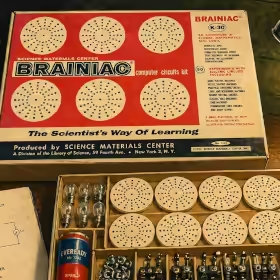
The kit allowed users to build small reasoning and calculation machines using batteries, wires, rotary switches, jumpers, and miniature light bulbs. Instead of typing commands into software, the user physically assembled logical systems.
One circuit might act as a burglar alarm. Another could perform arithmetic. Others translated binary numbers, encoded messages, compared values, or played games such as Nim and tic-tac-toe.
The important point is that the GENIAC did not hide the process. The logic was the machine.
Readers wanting a broader overview of the system itself should start with GENIAC Journal: Hands-On Analogue Computer Kit (1950s) and GENIAC Analog Computer Kit. Both show how these simple parts combined into a complete educational system for machine reasoning.
Why the GENIAC looked futuristic
To understand the GENIAC properly, it helps to remember when it appeared. During the 1950s, computers were still mysterious and inaccessible to most people. Large calculating systems existed in universities, corporations, and military facilities, but ordinary readers rarely saw them directly.
The GENIAC translated that emerging world into something physical and approachable.
That did not mean the marketing was restrained. Terms such as “electric brain” encouraged readers to imagine machines with almost human intelligence. In reality, the GENIAC was a structured logic device rather than a genuinely autonomous computer.
Yet dismissing it as mere hype misses the larger point.
The GENIAC demonstrated something profound for its time: reasoning could be represented mechanically. A logical decision could become a physical pathway. A problem could become a switch arrangement. Modern computing still rests on that same idea.
How GENIAC Sparked the Electric Brain Revolution explores this atmosphere in greater detail, particularly the period’s growing belief that logic and machines might reshape everyday life.
The real educational breakthrough
The GENIAC’s greatest strength was not raw capability. It was visibility.
Modern computers are extraordinarily powerful but conceptually opaque. Most users cannot explain what actually happens between pressing a key and receiving an answer.
The GENIAC forced users to engage directly with process.
If a circuit failed, you traced the wiring. If a reasoning machine produced the wrong output, you inspected the switch positions and logical branches. Every mistake was visible, physical, and understandable.
That transparency gave the machine an educational power that still feels surprisingly modern.
The projects inside the manual were carefully structured to build computational thinking step by step. Early circuits handled simple switching tasks such as hall lights and alarms. Later projects moved into arithmetic, binary translation, logical deduction, coding systems, and game strategy.
GENIAC Project List: Building Thinking Machines and Circuits shows how ambitious this progression really was. The kit quietly trained readers to think in systems, states, and logical relationships.
In hindsight, the GENIAC feels less like a toy and more like an unusually transparent introduction to computational thinking itself.
The awkwardness is part of the story
One reason the GENIAC remains interesting is that it preserved the contradictions of early computing culture instead of smoothing them away.
The machine was educational but heavily marketed. It was technically limited yet presented with enormous optimism. It encouraged serious logical thinking while also packaging that thinking as entertainment.
Even the physical design reflected this tension. The glowing bulbs and exposed wiring looked dramatic and futuristic, but the user still had to manually configure many operations by turning switches and following procedures.
That awkward halfway point is historically revealing. The GENIAC emerged during the moment when society first started imagining intelligent machines, long before personal computers became ordinary household objects.
Articles such as Why Early Computers Were Built Around Logic and Machine Reasoning and the Age of Syllogisms place the GENIAC inside this broader shift toward formalised machine reasoning.
Why the GENIAC still resonates
The GENIAC survives because it offers something modern technology rarely does: visible thinking.
A modern smartphone is incomparably more powerful, but its processes are hidden beneath layers of abstraction. The GENIAC exposed its structure openly. Logic became something you could inspect, manipulate, and physically understand.
That visibility gives the machine a strange emotional quality today. It represents a period when people expected the future of computing to remain understandable to ordinary users.
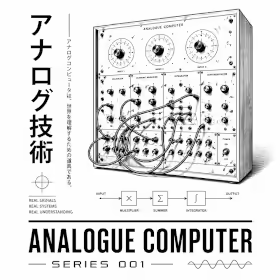
That same visual appeal continues to influence modern analogue-computing aesthetics, including the Analogue Computer Series 001 Design, which draws directly from mid-century instrumentation and exposed signal-path design.
Ultimately, the GENIAC matters not because it perfectly predicted modern computers, but because it preserved an older idea of computing itself. One where logic was physical, systems were visible, and reasoning could be watched happening in real time through switches, wires, and glowing lamps.
Featured Product
Analogue Computer Series 001 T-Shirt
The phrase “reason in syllogisms” belonged to a time when computing was visible, tactile, and mechanical. The Analogue Systems 01 retrocomputing themed t-shirt celebrates that era of electric brains, logic circuits, switches, and learning machines, when reasoning could be traced through wires and confirmed by the glow of a lamp.
Disclosure: this is a commercial product link to an external Zazzle store associated with philreichert.org. Purchases are handled by Zazzle.

Writer's Notes
What stayed with me while working on this piece was how physically understandable the GENIAC feels compared with modern computing. You can follow the reasoning path with your eyes. A switch changes position, a bulb lights, a logical branch closes somewhere on the board. There is very little abstraction hiding the process. I think that is why the machine still has cultural weight beyond simple nostalgia. The article works best when it leans into that tension between the grand “electric brain” marketing language and the very tangible reality of bolts, jumpers, and flashlight batteries. It captures a moment when people genuinely believed the future of machine intelligence should remain visible and explainable to ordinary users.
Reader Guide
The following material expands on the terminology, historical context, technical concepts, and related reading connected to this article.
Journey Map - GENIAC Analogue Computer Kit
This article sits within the GENIAC Analogue Computer Kit topic cluster. The sequence below moves from discovery and explanation through historical advertising culture and into broader reflections on computing, learning and the changing relationship between humans and machines.
Reading context: This journey combines historical reconstruction, vintage advertising, analogue computing concepts and reflective essays about digital culture. Most readers will move through the sequence gradually rather than in a single sitting. The complete journey takes approximately 45–90 minutes.
- Foundations and Discovery
- Remember a Kit Computer from the 1950s?
- What Is the GENIAC Computer?
- Why Was the GENIAC Computer Created?
- Advertising, Imagination and Electric Brains
- How the GENIAC Computer Was Marketed to Learners
- The GENIAC “Electronic Brain” Explained
- Was GENIAC a Computer or a Toy?
- Reflections on Computing Culture
- Why GENIAC Still Matters
- Why Did We Stop Teaching This?
- The Decline of Hobbyist Computing Culture
Glossary
- GENIAC
- A 1950s educational construction kit whose name stood for “Genius Almost-Automatic Computer.” In this article, the GENIAC is treated as a visible reasoning machine, a kit where switches, wires, and bulbs made computational logic feel physical and traceable.
- Electric brain
- A mid-century phrase for machines that appeared to calculate, reason, or make decisions. The article uses the term to show the excitement and exaggeration around early computing, when even simple logic circuits could feel like a glimpse of mechanical intelligence.
- Machine reasoning
- The use of a machine to follow logical rules and produce a conclusion from given inputs. In the GENIAC, this reasoning was not hidden in software. It was built from switch positions, wiring paths, and lamps that showed the result.
- Binary translation
- The conversion between ordinary decimal numbers and binary numbers made from ones and zeroes. The article mentions it because GENIAC projects used lamps and switches to make this abstract computer language visible to learners.
- Logical path
- The route a signal follows through a circuit according to switch settings and wiring. In this article, the logical path is central to the GENIAC’s appeal because readers could literally trace how a decision reached its answer.
- Computational thinking
- A way of solving problems by breaking them into states, rules, inputs, and outputs. The article presents the GENIAC as an early hands-on lesson in this kind of thinking, long before personal computers became common.
Frequently asked questions
Was the GENIAC really a computer or more of an educational kit?
The GENIAC was best understood as an educational construction kit for building small logic and reasoning machines. It was not a modern general-purpose computer, but it used switches, circuits, and indicator lamps to demonstrate real principles of computation.
Why was the GENIAC called an electric brain?
The term electric brain reflected 1950s enthusiasm for machines that could calculate, reason, and follow logical rules. In the GENIAC, that reasoning was represented through physical circuits rather than hidden software.
What could the GENIAC actually do?
Depending on how it was wired, the GENIAC could model burglar alarms, arithmetic machines, binary translators, coding devices, comparison circuits, and simple game-playing machines such as Nim and tic-tac-toe.
Why is the GENIAC still interesting today?
The GENIAC remains interesting because it made computing visible. Its exposed switches, wires, and bulbs allowed users to trace logical decisions physically, offering a clear contrast to the hidden processes of modern digital devices.
Connected Threads
- The Miscellaneum 005 – GENIAC Analogue Computer Kit - This article was featured in The Miscellaneum Issue 005, a themed exploration of visible machine logic, analogue computing, hobbyist computer culture, and the educational history of the electric brain.
Related articles…


Source Note
This article draws on GENIAC manual and advertising material from the 1950s, especially the way those sources described reasoning, circuits, switches, and “electric brain” learning. The aim is interpretive rather than academic: to explain how mid-century learners were invited to understand machine logic through visible parts and practical experiments.
Disclosure
This page presents a curated exploration of the GENIAC analogue computer kit and its associated materials. Content reflects the author’s interpretation of historical sources, including instructional manuals, advertisements, and related artefacts. The GENIAC system is discussed as an educational and conceptual model for understanding logic, circuits, and early computing ideas, rather than as a complete or authoritative account of computing history. References to “thinking machines” and reasoning systems follow the language and framing of the original material and are included for historical context. Readers seeking formal technical, historical, or academic treatment of computing should consult primary literature, scholarly sources, and specialist texts.