Why Was the GENIAC Computer Created in the 1950s?
◆ Revised

Introduction
Long before personal computers appeared on office desks or inside homes, the idea of the computer had already escaped into popular culture. In the 1950s, newspapers described “electronic brains” that could reason, calculate, and make decisions faster than humans. To the public, these machines sounded extraordinary, slightly intimidating, and almost impossible to understand.
The GENIAC was created because somebody recognised a problem early. People were becoming fascinated by computing without having any practical way to experience how it worked.
That gap between imagination and understanding is where the GENIAC belongs.
The machine age had become visible
By the middle of the twentieth century, computing had started to symbolise the future itself. Large electronic systems such as ENIAC and UNIVAC appeared in magazines and news reports as machines capable of transforming government, science, and industry.
Yet almost nobody had direct access to one.
Real computers were expensive, physically enormous, and usually hidden inside universities, military projects, or corporate research departments. The average reader could admire them from a distance but rarely understand the logic underneath.
The GENIAC was designed to bring that hidden logic into public view.
Rather than concealing its operation, the kit exposed it through switches, wiring, bulbs, and visible pathways. Users could physically build circuits that demonstrated decision making, arithmetic, comparison, and logical reasoning.
That educational purpose sits at the centre of the GENIAC story. The machine was not intended to compete with industrial computers. It was intended to teach people how machine reasoning worked.
Readers looking for a broader introduction to the system itself should continue into What Is GENIAC?, which explains how the kit translated computational thinking into a hands-on construction project.
The GENIAC taught logic, not just electronics
What makes the GENIAC especially interesting is that it reflects how people in the 1950s understood intelligence itself. Computing culture at the time treated logic as the foundation of reasoning.
If a machine could follow structured rules, compare conditions, or process symbolic relationships, then perhaps thinking could be mechanised. That idea now feels surprisingly modern.
The GENIAC manual reveals this mindset very clearly. Early projects begin with simple circuits and switching systems, but the exercises quickly become more ambitious. Users move into arithmetic machines, code translators, comparison systems, and reasoning devices.
The progression matters. The kit was trying to train a way of thinking, not merely teach electrical assembly.
There is something oddly impressive about that ambition. A child could begin by wiring a simple light circuit and eventually arrive at a machine that appeared to “reason” through logical conditions.
GENIAC Project List: Building Thinking Machines and Circuits shows how deliberately the projects escalated from basic electrical demonstrations into increasingly abstract forms of machine logic.
The kit was educational, but also theatrical
The GENIAC was also a product of a very specific cultural moment. The 1950s loved scientific optimism. Radio kits, chemistry sets, model engines, and electronics projects were marketed as gateways into the modern world. Parents believed technical literacy represented opportunity and progress.
The GENIAC fit neatly into that environment, but it added something unusual. It turned computing into a performance.
Lights illuminated answers. Switches represented decisions. Machines appeared to “reason” in front of the user. Even the language surrounding the kit leaned heavily into the drama of “electric brains” and mechanical intelligence.
Some of the claims now sound exaggerated. That tension is part of what makes the GENIAC interesting. The marketing occasionally raced ahead of the technology, but the educational intent underneath was genuine.
The creators understood something important. People were fascinated by computers long before they truly understood them.
How GENIAC Sparked the Electric Brain Revolution explores how these ideas connected to the wider excitement surrounding automation, machine reasoning, and early information processing.
Why the GENIAC still matters
The GENIAC now looks primitive beside modern computing devices, but its underlying question remains current.
Can reasoning be broken into systems, structures, and repeatable rules?
That question did not disappear. It evolved into software engineering, artificial intelligence, algorithmic modelling, and machine learning.
The GENIAC matters because it captured the moment when computing stopped being purely industrial and started becoming cultural. It gave ordinary people a way to physically engage with the logic behind the machine age.
That is why collectors, historians, and analogue computing enthusiasts still find the kit compelling today. The switches and glowing bulbs are more than nostalgic hardware. They are visible traces of a period when society first tried to domesticate the idea of machine intelligence.
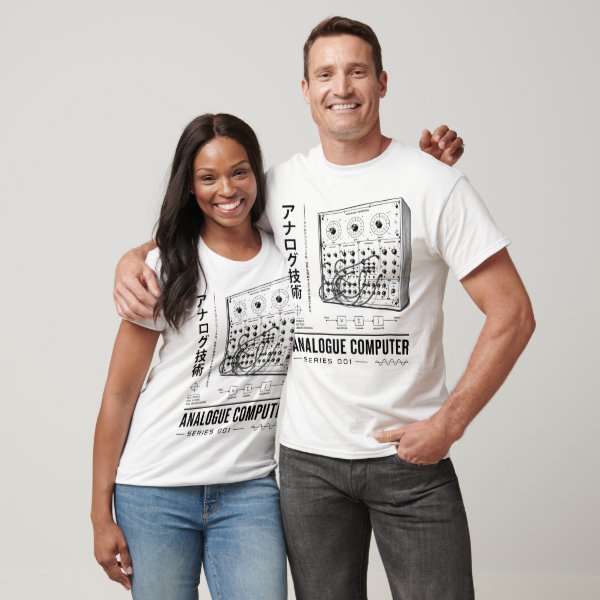
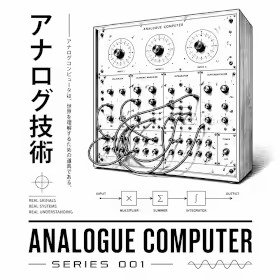
For readers drawn to the visual language of circuits, switches, and visible systems, the Analogue Computer Series 001 Design carries that same mid-century computing aesthetic into modern form.
Featured Product
Analogue Computer Series 001 T-Shirt
The phrase “reason in syllogisms” belonged to a time when computing was visible, tactile, and mechanical. The Analogue Systems 01 retrocomputing themed t-shirt celebrates that era of electric brains, logic circuits, switches, and learning machines, when reasoning could be traced through wires and confirmed by the glow of a lamp.
Disclosure: this is a commercial product link to an external Zazzle store associated with philreichert.org. Purchases are handled by Zazzle.
Writer's Notes
What stays with me about the GENIAC is not really the hardware. It is the strange cultural moment sitting underneath it. You can feel a society trying to make sense of computers before computers became ordinary objects. The article works best when it shows that tension directly. The GENIAC was educational, certainly, but it was also theatre. Glowing bulbs and switch paths stood in for ideas that most people could not yet see inside universities or government labs. I think that is what makes this piece distinct within the GENIAC series. It is less about the machine itself and more about the public imagination forming around machine reasoning. The kit almost feels like an attempt to domesticate the future before the future properly arrived.
Reader Guide
The following material expands on the terminology, historical context, technical concepts, and related reading connected to this article.
Journey Map - GENIAC Analogue Computer Kit
This article sits within the GENIAC Analogue Computer Kit topic cluster. The sequence below moves from discovery and explanation through historical advertising culture and into broader reflections on computing, learning and the changing relationship between humans and machines.
Reading context: This journey combines historical reconstruction, vintage advertising, analogue computing concepts and reflective essays about digital culture. Most readers will move through the sequence gradually rather than in a single sitting. The complete journey takes approximately 45–90 minutes.
- Foundations and Discovery
- Remember a Kit Computer from the 1950s?
- What Is the GENIAC Computer?
- Why Was the GENIAC Computer Created?
- Advertising, Imagination and Electric Brains
- How the GENIAC Computer Was Marketed to Learners
- The GENIAC “Electronic Brain” Explained
- Was GENIAC a Computer or a Toy?
- Reflections on Computing Culture
- Why GENIAC Still Matters
- Why Did We Stop Teaching This?
- The Decline of Hobbyist Computing Culture
Glossary
- GENIAC
- A 1950s educational construction kit that used switches, wires, bulbs, and circuits to demonstrate machine reasoning. In this article, GENIAC is presented as a bridge between public curiosity about computers and the practical experience of building simple logic machines.
- Electric Brain
- A popular mid-century phrase for a machine that seemed able to calculate, reason, or make decisions. The article uses the term to show how early computers entered public imagination before most people understood what they actually did.
- Machine Reasoning
- The process of using rules, conditions, and logical steps to produce a machine-made answer. In the GENIAC context, machine reasoning becomes something visible, where a path through switches could end in a glowing bulb.
- Logic Circuit
- A circuit arranged so that its output depends on specific conditions or switch positions. In this article, logic circuits are the working language of GENIAC, turning abstract ideas about decision-making into something a learner could wire by hand.
- Symbolic Relationships
- Rule-based connections between ideas, categories, or signs. The article uses this idea to explain why GENIAC was more than an electronics toy: it showed how machines could model relationships, not just move current.
- Analogue Computing
- Computing that represents problems through physical systems rather than software running on a digital processor. Here, analogue computing gives GENIAC its tactile appeal, with reasoning made visible through hardware you could touch.
Frequently asked questions
Why was the GENIAC computer created in the 1950s?
The GENIAC was created to make the new idea of computing understandable and accessible. In the 1950s, large electronic computers were expensive, remote, and mysterious to most people, so GENIAC translated machine reasoning into a hands-on educational kit using switches, wires, bulbs, and visible logic circuits.
Was GENIAC a real computer or an educational kit?
GENIAC was primarily an educational construction kit rather than a general-purpose electronic computer. It did not operate like a room-sized digital computer, but it demonstrated important computing ideas such as logic, switching, comparison, arithmetic, coding, and rule-based reasoning.
Why was GENIAC described as an electric brain?
GENIAC was described as an electric brain because mid-century computing culture often used that phrase for machines that appeared to reason or calculate automatically. The term captured public fascination with machine intelligence, even though GENIAC worked through simple visible switching circuits rather than modern electronic processing.
What made GENIAC important to early computing education?
GENIAC was important because it allowed ordinary learners to physically build and test logic machines at a time when real computers were inaccessible. It helped turn abstract ideas about machine reasoning into visible, hands-on experiments, bridging the gap between public curiosity and practical understanding.
Related articles…


Source Note
This article draws on GENIAC manual and advertising material from the 1950s, especially the way those sources described reasoning, circuits, switches, and “electric brain” learning. The aim is interpretive rather than academic: to explain how mid-century learners were invited to understand machine logic through visible parts and practical experiments.
Disclosure
This page presents a curated exploration of the GENIAC analogue computer kit and its associated materials. Content reflects the author’s interpretation of historical sources, including instructional manuals, advertisements, and related artefacts. The GENIAC system is discussed as an educational and conceptual model for understanding logic, circuits, and early computing ideas, rather than as a complete or authoritative account of computing history. References to “thinking machines” and reasoning systems follow the language and framing of the original material and are included for historical context. Readers seeking formal technical, historical, or academic treatment of computing should consult primary literature, scholarly sources, and specialist texts.