Was the GENIAC a Real Computer or Just a Toy?
◆ Revised

Why GENIAC Still Challenges the Word Computer
One of the strangest things about the GENIAC is that it still unsettles modern assumptions about what a computer actually is.
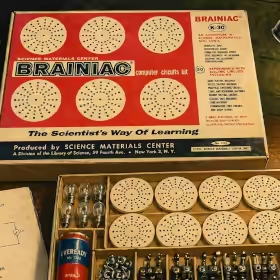
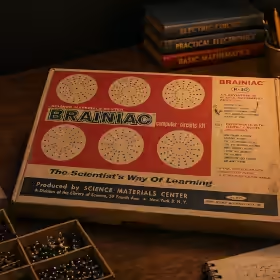
Most people picture screens, processors, memory chips, and software. The GENIAC had none of those things. It was a board full of switches, wires, bulbs, nuts, bolts, and a flashlight battery. Yet this odd little 1950s machine could add numbers, compare values, solve logic problems, encode messages, and play mathematical games.
That creates an awkward question.
Was the GENIAC a real computer, or simply a clever educational toy pretending to be one?
The uncomfortable answer is that it was both. That tension is exactly why the GENIAC remains interesting.
A Toy That Embodied Real Computational Logic
The kit appeared during a period when society was still trying to understand what “electronic brains” might become. Mid-century advertisements promised machines that could reason, calculate, and imitate thought itself. Much of that language was theatrical hype. But unlike many science toys of the era, the GENIAC genuinely demonstrated computational logic in physical form.
It did not merely talk about reasoning. It embodied it.
The GENIAC worked by letting users wire together different switching circuits. Inputs were represented by switch positions. Logical rules existed in the wiring itself. Outputs appeared as illuminated bulbs. Depending on how the machine was configured, it could behave as an adding machine, a comparison system, a code device, a reasoning circuit, or a game-playing machine.
Readers exploring GENIAC Project List: Building Thinking Machines and Circuits quickly notice that the projects progress from simple electrical switching into arithmetic, coding, binary logic, and structured reasoning. The educational progression was deliberate. The machine was teaching computational thinking one circuit at a time.
That places the GENIAC in a very different category from novelty gadgets or decorative “science toys”. The machine genuinely performed logical operations according to predefined electrical rules. In practical terms, it really was doing computation.
Where the GENIAC Stops Being a Modern Computer
But there is an equally important limitation that enthusiasts sometimes avoid discussing.
The GENIAC was not a modern computer.
It had no stored program. No electronic memory in the modern sense. No autonomous execution. The user manually configured switches and often rewired circuits between problems. The “program” existed physically in the layout of the machine rather than electronically in software.
In blunt terms, the GENIAC could teach computational thinking, but it could not compete with true electronic computers of the period.
Ironically, that limitation is part of what makes it valuable today.
Why Visible Logic Still Matters Today
Modern computing systems hide almost everything. Computation happens invisibly behind polished interfaces. The GENIAC exposed the structure openly. You could literally follow a reasoning path through the wiring.
That transparency gives the machine an unusual educational power even now. Readers moving into Why Early Computers Were Built Around Logic or Machine Reasoning and the Age of Syllogisms discover that early computing culture treated formal logic as the foundation of machine intelligence. The GENIAC sits directly inside that historical moment.
It also explains why the machine still attracts collectors, retro-computing enthusiasts, and analogue technology fans. The exposed terminals, visible signal paths, and circular switch assemblies possess a kind of mechanical honesty that modern devices rarely show. The logic is visible. The machine reveals itself.
That visual language has even started resurfacing in contemporary design culture. Pieces like the Analogue Computer Series 001 Design draw directly from the aesthetics of visible circuitry and structured signal flow that machines like the GENIAC made iconic.
A Real Logic Machine Wearing Toy Clothes
So was the GENIAC a real computer or just a toy?
The best answer is that it was a genuine logic demonstrator packaged as an educational toy. It could perform real computational operations, but it did so manually, visibly, and with fixed wiring rather than hidden software.
And perhaps that is why the machine still feels surprisingly modern.
At a time when computing has become almost completely invisible, the GENIAC reminds us that reasoning can still be touched, traced, and understood.
Featured Product
Analogue Computer Series 001 T-Shirt
The phrase “reason in syllogisms” belonged to a time when computing was visible, tactile, and mechanical. The Analogue Systems 01 retrocomputing themed t-shirt celebrates that era of electric brains, logic circuits, switches, and learning machines, when reasoning could be traced through wires and confirmed by the glow of a lamp.
Disclosure: this is a commercial product link to an external Zazzle store associated with philreichert.org. Purchases are handled by Zazzle.

Writer's Notes
I think the most revealing thing about the GENIAC is how quickly modern readers dismiss it once they realise it has no processor, no software, and no screen. That reaction says more about our current assumptions than it does about the machine itself. What I particularly like here is the tension between educational theatre and genuine computational logic. The GENIAC absolutely leaned into the “electric brain” mythology of the 1950s, yet underneath the marketing there is still a real machine performing structured reasoning through physical circuits. That contradiction fascinates me. The machine is simultaneously primitive and intellectually ambitious. It also exposes something slightly uncomfortable about modern computing: our systems are far more powerful now, but often far less understandable.
Reader Guide
The following material expands on the terminology, historical context, technical concepts, and related reading connected to this article.
Journey Map - GENIAC Analogue Computer Kit
This article sits within the GENIAC Analogue Computer Kit topic cluster. The sequence below moves from discovery and explanation through historical advertising culture and into broader reflections on computing, learning and the changing relationship between humans and machines.
Reading context: This journey combines historical reconstruction, vintage advertising, analogue computing concepts and reflective essays about digital culture. Most readers will move through the sequence gradually rather than in a single sitting. The complete journey takes approximately 45–90 minutes.
- Foundations and Discovery
- Remember a Kit Computer from the 1950s?
- What Is the GENIAC Computer?
- Why Was the GENIAC Computer Created?
- Advertising, Imagination and Electric Brains
- How the GENIAC Computer Was Marketed to Learners
- The GENIAC “Electronic Brain” Explained
- Was GENIAC a Computer or a Toy?
- Reflections on Computing Culture
- Why GENIAC Still Matters
- Why Did We Stop Teaching This?
- The Decline of Hobbyist Computing Culture
Glossary
- Logic demonstrator
- A machine or device built to show how logical operations work. In this article, the GENIAC is described as a logic demonstrator because it made reasoning visible through switches, wiring, and glowing bulbs rather than hidden software.
- Stored program
- A method where a computer keeps its instructions in memory and runs them automatically. The GENIAC lacked this feature, which is why it was not a modern computer even though it could perform real logic.
- Fixed wiring
- A physical arrangement of wires that determines what a machine can do. In the GENIAC, the wiring acted like the program, turning abstract rules into something the reader could trace with their eyes.
- Computational thinking
- A way of breaking problems into steps, rules, conditions, and outputs. The article uses the GENIAC as an example of computational thinking made tangible, where a problem becomes a circuit and an answer becomes a light.
- Machine reasoning
- The use of mechanical or electrical systems to follow logical rules and produce conclusions. The GENIAC did not understand ideas like a person, but it showed how reasoning could be represented physically.
- Signal flow
- The path an electrical signal takes through a circuit. In the article, signal flow helps explain the appeal of the GENIAC: its logic was not hidden inside a chip, but laid out where the builder could follow it.
Frequently asked questions
Was the GENIAC a real computer?
The GENIAC was a real logic demonstrator rather than a modern stored-program computer. It could perform genuine computational operations using switches, wiring, and bulbs, but it required manual setup and physical circuit configuration.
Why is the GENIAC sometimes described as a toy?
The GENIAC is sometimes described as a toy because it was sold as an educational kit and used playful projects, puzzles, and games. However, it was more than a novelty because its circuits genuinely demonstrated arithmetic, logic, coding, comparison, and reasoning.
How did the GENIAC perform computation without software?
The GENIAC performed computation through fixed wiring and switch positions. The wiring acted like the program, the switches supplied inputs, and the bulbs displayed outputs, making logic visible as a physical circuit.
Why does the GENIAC still matter today?
The GENIAC still matters because it makes computational reasoning visible and understandable. Unlike modern devices that hide computation behind screens and software, the GENIAC exposes logic as something that can be traced, touched, and learned.
Related articles…


Source Note
This article draws on GENIAC manual and advertising material from the 1950s, especially the way those sources described reasoning, circuits, switches, and “electric brain” learning. The aim is interpretive rather than academic: to explain how mid-century learners were invited to understand machine logic through visible parts and practical experiments.
Disclosure
This page presents a curated exploration of the GENIAC analogue computer kit and its associated materials. Content reflects the author’s interpretation of historical sources, including instructional manuals, advertisements, and related artefacts. The GENIAC system is discussed as an educational and conceptual model for understanding logic, circuits, and early computing ideas, rather than as a complete or authoritative account of computing history. References to “thinking machines” and reasoning systems follow the language and framing of the original material and are included for historical context. Readers seeking formal technical, historical, or academic treatment of computing should consult primary literature, scholarly sources, and specialist texts.