The GENIAC Approach: Learning with Analogue Circuits
◆ Revised
Introduction
The GENIAC approach connected two ideas that were not usually placed together in the 1950s: abstract machine reasoning and direct physical play. The kit was not presented as a finished computer to admire from a distance. It was presented as something to assemble, test, alter, and understand through the behaviour of circuits.
That relationship sits at the centre of its advertising. GENIAC made computation approachable by reducing it to visible parts: switches, wires, bulbs, batteries, contacts, and diagrams. The promise was not that a small cardboard-and-wire kit could rival a laboratory computer. The promise was that a learner could grasp the principles of reasoning machines by making a simple one work.
In that sense, the advertisement was selling more than parts. It was selling a method of understanding. The learner would not simply read about logic. They would build a circuit, turn a switch, watch a light respond, and then connect that response back to an idea.
This article sits within the broader GENIAC Journal, which gathers the kit, its advertisements, and its surrounding ideas into a single topic series. That journal treats GENIAC as more than a novelty. It frames the kit as a practical entry point into reasoning machines, where the language of “electric brains” becomes visible through small, repeatable acts of construction.
This framing is expanded in the GENIAC Journal: Hands-On Analogue Computer Kit (1950s), where the kit is treated as a complete system rather than a single advertisement. The journal gathers manuals, diagrams, and examples to show how the same small set of components could be reconfigured into many different reasoning machines.
Learning by Building the Path of Reason
The GENIAC advertisement treats understanding as something produced through handling. It argues that machines which reason are best learned through contact with their working parts. A person who wires a circuit is not merely following instructions. They are tracing the path by which an input becomes an output.
This is the key relationship: GENIAC translated abstract logic into visible analogue behaviour. A decision became a switch position. A result became light. A rule became a pathway through wire and contact. The learner sees that a machine did not “think” in a mysterious way. It produced a result because its parts had been arranged to make that result possible.
The learner sees that a machine did not “think” in a mysterious way.
The earlier GENIAC Analog Computer Kit article introduces the kit as a general retrocomputing object, including its public-facing question of whether a person could “think faster than this machine.” This present article narrows that view. It looks less at the headline claim and more at the learning method beneath it: the way the advertisement turns curiosity into a practical circuit-building exercise.
The advertisement also made the scale feel human. Large computers of the period were remote, expensive, and institutionally controlled. GENIAC moved the conversation to the desk, the classroom, and the hobby table. It suggested that the principles behind “electric brains” could be brought down to a level where they could be touched.
The Circuit as a Visible Thinking Process
The mechanism of learning in GENIAC is simple: physical construction makes logic observable. The kit turns reasoning into a sequence of actions. The user sets a switch, completes or interrupts a circuit, and observes whether the bulb lights.
Each component has a teaching role. The battery provides the source of current. The wire carries the possibility of action. The switch creates a choice. The bulb shows the outcome. None of these parts is decorative. Each one explains a portion of the process.
This makes the circuit a kind of diagram that also works. It is not only a representation of logic. It is logic made physical. A learner can follow the current and see how a rule has been embodied in the machine. If the wiring is wrong, the result is wrong. If the wiring is correct, the machine behaves as expected.
That feedback loop is powerful. It teaches that reasoning machines depend on structure. The output is not magic. It is the consequence of arrangement.
This idea is explored in more detail in The GENIAC Approach: Learning with Analogue Circuits, which focuses on how these visible cause-and-effect relationships made logic easier to grasp. By turning abstract rules into physical actions, the kit transformed learning into a process of observation and adjustment.
The Quiet Challenge to Passive Instruction
The GENIAC advertisement also carries an implication about education. It suggests that explanation alone is not enough. Words and pictures may introduce an idea, but they do not replace the experience of making the idea operate.
This gives the kit a different tone from a simple toy advertisement. It does not only promise amusement. It promises earned understanding. The user must assemble, test, adjust, and think. The pleasure comes from seeing a machine obey a rule that the user has physically built into it.
There is also a useful tension here. GENIAC made complex ideas appear simple, but it did not remove the work. Its simplicity was an entrance, not an escape. The kit gave learners a manageable set of parts, then asked them to reason carefully about how those parts should connect.
That makes the advertising unusually honest. It reduces the distance between learner and machine, but it does not pretend that computation is effortless. The user still has to do the thinking required to make the machine think.
From Kit Assembly to Computational Imagination
The wider application of the GENIAC approach is that it trained people to imagine computation as design. Once a learner understood that a circuit could represent a rule, the kit became more than a set of examples. It became an invitation to invent new arrangements.
This is where the advertisement moves beyond product description. GENIAC was not limited to one finished function. It could be rewired into different machines for arithmetic, comparison, signalling, games, and logic puzzles. The same basic materials could express different forms of reasoning.
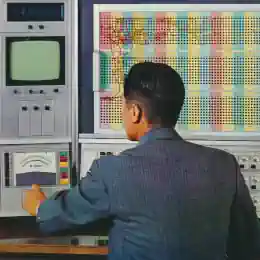
The larger analogue computing tradition can be seen in machines such as the Hitachi 505 Analog Hybrid Computer, where physical signals, patching, and continuous behaviour were used for more advanced modelling work. GENIAC belongs at the educational end of that spectrum. It does not solve industrial problems, but it teaches the same broad lesson: computation can be explored through physical arrangement, live response, and visible change.
That flexibility mattered. It placed the learner in the role of designer rather than passive operator. The user was not only asking, “What does this machine do?” They were invited to ask, “What kind of machine could I make next?”
In a modern setting, that idea still feels familiar. Good educational technology does not merely display answers. It gives the learner a way to model relationships. GENIAC did this with analogue circuits, long before software became the ordinary medium for such experiments.
Applications Implied by the GENIAC Kit
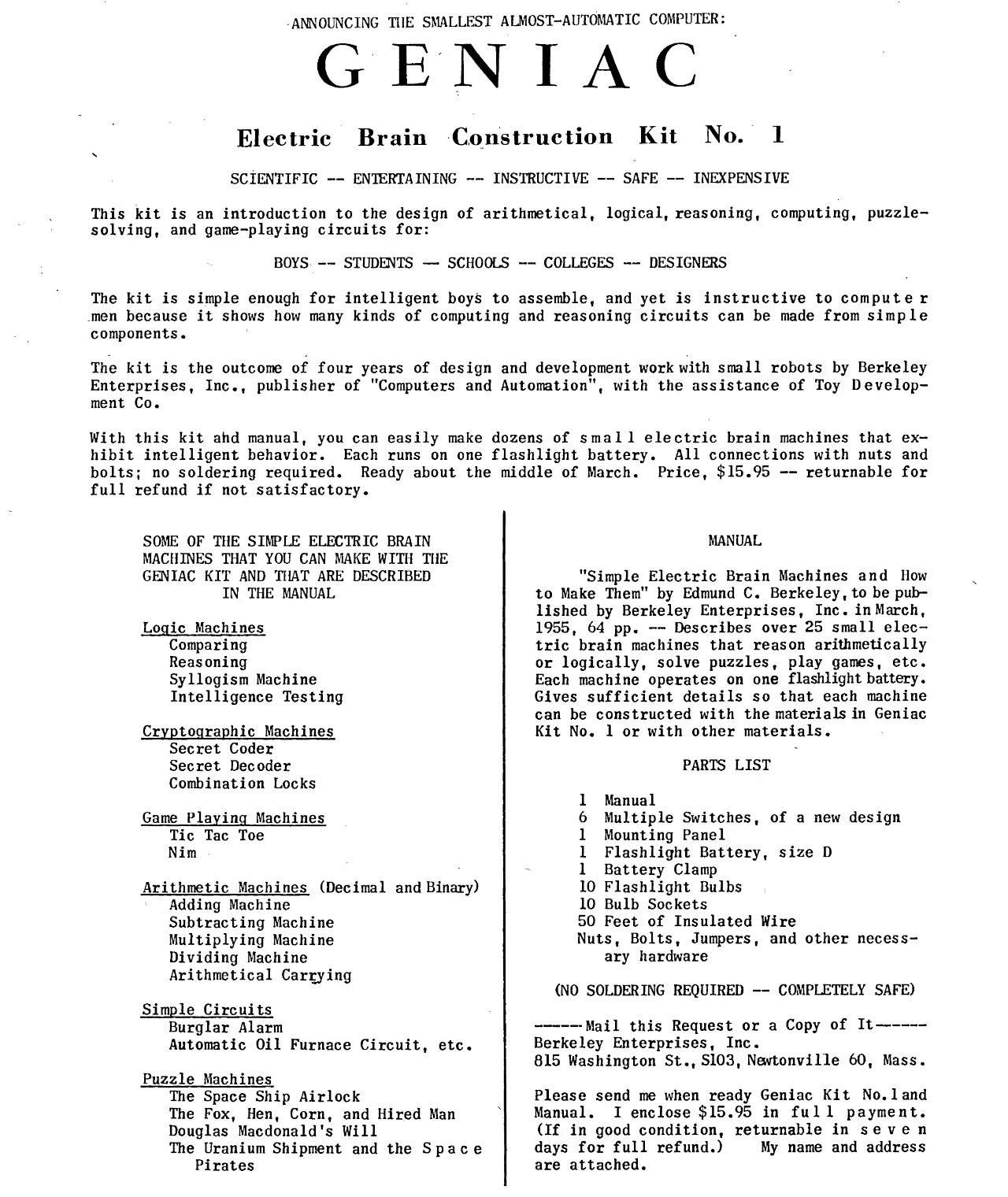
The GENIAC was presented as a general-purpose thinking machine. Its manual outlined a range of applications built from the same underlying circuit logic.
- Logic Machines — comparison, reasoning, syllogisms, intelligence testing
- Cryptographic Devices — secret coders, decoders, combination systems
- Game Systems — tic-tac-toe, Nim, and rule-based play
- Arithmetic Machines — addition, subtraction, multiplication, division, carry logic
- Control Circuits — burglar alarms and automated switching
- Puzzle Machines — structured problems and scenario logic
The machine did not change. Only the wiring did.
The Next Question Hidden in the Advertisement
The GENIAC advertisement reveals a clear teaching philosophy: computation becomes understandable when it is slowed down and made visible. The kit’s switches, wires, and bulbs turn abstract reasoning into a sequence of physical causes and effects.
Seen through its advertising, GENIAC was not only a low-cost educational kit. It was a proposal about how people learn difficult ideas. Build the pathway. Test the result. Change the wiring. Understand the rule.
The next related question is the illusion of simplicity. GENIAC made computing look approachable by reducing it to minimal components, but those components still carried complex ideas. That tension makes the advertisement valuable. It shows how early computing was translated for public understanding, and how much had to be simplified before the “electric brain” could become something a learner might build at home.
Featured Product
Analogue Computer Series 001 T-Shirt
Inspired by early analogue computing kits and circuit logic, this design translates the GENIAC concept into a wearable form. Part of the Analogue Computer Series

Author's Notes
What draws me to this advertisement is how direct it is. It does not try to impress with scale or technical authority. Instead, it places a small set of components in front of the reader and makes a simple claim: you can build a machine that reasons. That shift is subtle but powerful. The idea of an “electric brain” becomes something you can assemble at a desk, not something locked away in a laboratory.
I am also struck by the way the advertisement handles limitation. It openly states that the machines cannot run automatically, yet can still calculate and reason. That distinction feels honest and deliberate. It reveals that the value of the kit is not in automation, but in understanding the pathway from input to output. The detail that the kit could produce many different machines from the same parts is equally important. It reframes the product as a system rather than a single device.
Reading it now, I see a clear line to how we approach learning and systems design today. There is an invitation in the text to experiment, to build something small, observe its behaviour, and then extend it. That mindset still holds. Whether working with code or circuits, the process is the same: construct, test, refine. The advertisement reminds me that the most effective way to understand a system is still to make one.
Glossary
- Electric Brain
- A mid-century phrase used to describe a machine that could appear to reason, calculate, or make logical decisions.
- Genius Almost-Automatic Computer
- The phrase behind the name GENIAC, describing a kit that could model reasoning and calculation without being fully automatic.
- Multiple Switches
- Switch assemblies that could change several electrical paths at once, allowing one movement to control multiple parts of a circuit.
- Flashlight Bulbs
- Small bulbs used in the kit to signal answers and make circuit results visible to the learner.
- Circuit Diagram
- A simplified drawing showing how batteries, wires, switches, and lights are connected so a machine can perform its intended operation.
Frequently asked questions
What did “electric brain” mean in the GENIAC advertisement?
Electric brain was a mid century phrase for a machine that could appear to reason or calculate. In the GENIAC advertisement, it made computing feel understandable, dramatic, and accessible through a hands on construction kit.
Why was GENIAC described as almost automatic?
GENIAC stood for Genius Almost Automatic Computer. The phrase acknowledged that the machine did not run fully on its own, but could still demonstrate logical reasoning and calculation once the user arranged the switches and circuits.
What were multiple switches in the GENIAC kit?
Multiple switches were rotary switch assemblies that could change several electrical paths at the same time. They allowed one physical movement to represent a logical decision across multiple parts of a circuit.
What is a circuit diagram in the GENIAC material?
A circuit diagram is a simplified drawing that shows how batteries, wires, switches, and lights are connected. In the GENIAC material, these diagrams translate reasoning problems into visible electrical pathways.
Connected Threads
- GENIAC Project List: Building Thinking Machines and Circuits - This article frames the GENIAC projects as a hands-on learning system, reinforcing how physical circuits support understanding through building, testing, and observation.
Related articles…

References
- Computers and Automation March, 1955 , page 2 (retrieved 2026-04-27)
Disclosure
This page presents a curated exploration of the GENIAC analogue computer kit and its associated materials. Content reflects the author’s interpretation of historical sources, including instructional manuals, advertisements, and related artefacts. The GENIAC system is discussed as an educational and conceptual model for understanding logic, circuits, and early computing ideas, rather than as a complete or authoritative account of computing history. References to “thinking machines” and reasoning systems follow the language and framing of the original material and are included for historical context. Readers seeking formal technical, historical, or academic treatment of computing should consult primary literature, scholarly sources, and specialist texts.