5 Interesting Facts about the GENIAC Computer

Introduction
Most people imagine early computers as giant government machines hidden behind glass walls, humming away while men in white shirts fed them punch cards. The GENIAC breaks that image completely. It was a cheap tabletop construction kit made from cardboard panels, bolts, flashlight bulbs, wires, and rotary switches. Yet in the 1950s it confidently claimed to teach machine reasoning, logic, and “electric brain” thinking to ordinary people.
That confidence is what makes the GENIAC fascinating. It was educational, ambitious, slightly theatrical, and occasionally exaggerated. It also captured a moment when society genuinely believed logic machines might reshape civilisation.
If you want a broader introduction to the kit itself, What Is GENIAC? gives a useful overview of how the system worked and why it mattered. But the stranger and more revealing story sits inside the details.
1. The GENIAC was not really a computer
This is the first thing worth saying plainly.
The GENIAC was marketed as an “electric brain,” but it was not a stored-program electronic computer in the modern sense. It had no processor, no memory, and no ability to execute software dynamically. Most of the “thinking” came from the way the switches and circuits were physically wired together.
That sounds disappointing until you realise what the kit was actually teaching.
The GENIAC introduced people to logical structure itself. If one switch is turned on and another is turned off, a different outcome appears. A glowing bulb becomes a visible answer. A circuit path becomes a reasoning chain.
Modern computers hide most of their logic deep inside silicon. The GENIAC left the logic exposed on the tabletop where you could trace it with your finger.
2. The manual quietly transforms the reader into a systems thinker
The early projects in the GENIAC manual seem harmless enough. Flashlights. Doorbells. Burglar alarms. Household-style electrical circuits.
Then the manual starts escalating.
Suddenly the user is building arithmetic machines, binary translators, code systems, logical deduction circuits, and game-playing devices. One machine compares numbers. Another reasons about pilot classifications. Another plays Nim. Another translates decimal numbers into binary notation.
The cleverness lies in the sequencing. The reader is slowly guided from ordinary electrical switching into symbolic reasoning without fully noticing the transition.
GENIAC Project List: Building Thinking Machines and Circuits is especially revealing because it shows how carefully the projects were arranged. The manual was less a toy instruction booklet and more a disguised educational ladder into computational thinking.
3. The GENIAC reflects the 1950s obsession with logic
Today’s AI culture talks constantly about machine learning and neural networks. The 1950s had a different obsession entirely: formal logic.
At the time, many engineers genuinely believed intelligence itself might eventually be reduced to structured symbolic reasoning. Syllogisms, deduction systems, and formal truth relationships were treated as the foundations of machine thought.
The GENIAC belongs directly to that world.
Its circuits do not attempt creativity or intuition. They imitate structured decision-making. Inputs go in. Rules are applied. Conclusions emerge.
Machine Reasoning and the Age of Syllogisms explores this mindset in greater depth, and reading it now feels strangely familiar. The technology has changed dramatically, but the old dream of mechanised reasoning never really disappeared.
4. The hardware was crude, visible, and strangely beautiful
Part of the GENIAC’s enduring appeal comes from how physically honest it was.
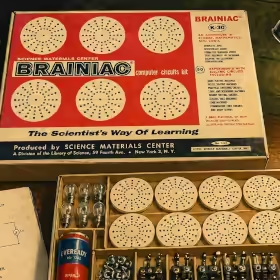
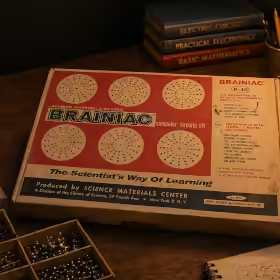
The switches were layered rotating discs. Connections were made using nuts, bolts, jumper contacts, and lengths of wire. Small flashlight bulbs acted as outputs. Nothing was miniaturised or hidden.
Modern devices conceal their complexity behind polished surfaces. The GENIAC did the opposite. Its operation was exposed.
That visibility still resonates with collectors, electronics hobbyists, and people drawn to analogue systems. There is satisfaction in being able to see how an idea physically travels through a machine.
GENIAC Kit Parts List and Modern Rebuild Guide captures this aspect well because it reveals how little hardware was required to produce surprisingly sophisticated logical behaviour.
It also explains why mid-century computing aesthetics continue finding modern audiences. Signal paths, switches, labelled circuits, and visible logic still communicate clarity in ways modern black-box technology often does not.
That same attraction quietly sits behind projects like the Analogue Computer Series 001 Design. The appeal is not merely retro styling. It is the visual language of systems you can actually follow.
5. The GENIAC was selling access to the future
This may be the most important fact of all.
In the 1950s, most people would never see a real computer in person. Computing still belonged to laboratories, universities, militaries, and corporations. The GENIAC changed that relationship by offering ordinary people a way to participate directly in the coming machine age.
That was the real product being sold.
The buyer was not simply purchasing a box of switches and bulbs. They were buying entry into a new intellectual world. The kit invited readers to think like engineers, reason like logicians, and experiment like early computer pioneers.
Some of the marketing language was undeniably overblown. The GENIAC could not truly “think” in any human sense. But the ambition underneath the exaggeration was genuine. The kit attempted to make computational ideas understandable before the computer revolution had properly arrived.
Seen from today, the GENIAC feels less like a primitive computer and more like an artefact from the exact moment society first began teaching ordinary people how to think computationally.
That is far more interesting than simply being an old electronics kit.
Featured Product
Analogue Computer Series 001 T-Shirt
The phrase “reason in syllogisms” belonged to a time when computing was visible, tactile, and mechanical. The Analogue Systems 01 retrocomputing themed t-shirt celebrates that era of electric brains, logic circuits, switches, and learning machines, when reasoning could be traced through wires and confirmed by the glow of a lamp.
Disclosure: this is a commercial product link to an external Zazzle store associated with philreichert.org. Purchases are handled by Zazzle.

Writer's Notes
What I like about this piece is that it quietly shifts the GENIAC away from being a novelty object and back toward what it was really trying to do: teach ordinary people how to think structurally. A lot of vintage computing writing gets trapped in nostalgia or technical trivia. Here, the more interesting tension is cultural. The kit was crude, occasionally overhyped, and nowhere near a real computer, yet it still carried serious intellectual ambition. I think that contradiction matters. The sections on visible logic and the progression inside the manual especially stayed with me, because they reveal a period when computational thinking was still something you could physically see, wire together, and reason through by hand on a kitchen table.
Glossary
- Electric Brain
- A popular 1950s term for machines that appeared to calculate or reason automatically. In this article, the phrase reflects the excitement surrounding early computing culture, when even simple switch-based kits like the GENIAC seemed to hint at machine intelligence.
- Binary Notation
- A number system using only 0 and 1 instead of the usual ten digits. The GENIAC used binary logic because electrical systems naturally fit “on” and “off” states, making abstract mathematics visible through glowing bulbs and physical switches.
- Symbolic Reasoning
- A method of solving problems through formal rules and logical relationships rather than intuition. The article connects this idea to the GENIAC’s circuits, which could imitate structured decision-making long before modern artificial intelligence systems appeared.
- Computational Thinking
- A way of approaching problems by breaking them into rules, conditions, and logical sequences. The GENIAC introduced this style of thinking to ordinary people using simple hands-on experiments instead of hidden electronics or programming languages.
- Syllogism
- A formal logical structure where conclusions follow from stated premises. During the 1950s, syllogisms fascinated computing researchers because they suggested that reasoning itself might be expressed mechanically through circuits and logical operations.
- Analogue System
- A physical system where operations are represented through visible mechanical or electrical behaviour rather than digital code. The GENIAC feels tangible because its logic paths, switches, and signals can be directly seen and followed by the user.
Frequently asked questions
Was the GENIAC really a computer?
The GENIAC was not a computer in the modern stored-program sense. It had no processor, memory, or software. Its value was that it used switches, bulbs, and wiring to demonstrate logical structure, decision paths, and basic computational thinking.
Why was the GENIAC called an electric brain?
The term electric brain reflected 1950s enthusiasm for machines that appeared to reason or calculate. The GENIAC did not think like a person, but its circuits could model simple logical decisions, arithmetic, binary translation, and game-playing behaviour.
What made the GENIAC educational?
The GENIAC was educational because it made logic visible. Users physically wired circuits, turned switches, and watched bulbs light as outputs. This helped explain how inputs, rules, and outcomes could be arranged into a working reasoning machine.
Why is the GENIAC still interesting today?
The GENIAC remains interesting because it shows how early computing ideas were introduced to ordinary people before home computers existed. It is a tactile example of visible logic, hands-on learning, and the cultural excitement around machine reasoning in the 1950s.
Related articles…


Source Note
This article draws on GENIAC manual and advertising material from the 1950s, especially the way those sources described reasoning, circuits, switches, and “electric brain” learning. The aim is interpretive rather than academic: to explain how mid-century learners were invited to understand machine logic through visible parts and practical experiments.
Disclosure
This page presents a curated exploration of the GENIAC analogue computer kit and its associated materials. Content reflects the author’s interpretation of historical sources, including instructional manuals, advertisements, and related artefacts. The GENIAC system is discussed as an educational and conceptual model for understanding logic, circuits, and early computing ideas, rather than as a complete or authoritative account of computing history. References to “thinking machines” and reasoning systems follow the language and framing of the original material and are included for historical context. Readers seeking formal technical, historical, or academic treatment of computing should consult primary literature, scholarly sources, and specialist texts.