What Could You Build with the GENIAC Computer?

Introduction
One of the strangest things about the GENIAC is that people keep calling it a “computer kit” and then seem disappointed when they discover it cannot really compute like a modern computer.
That reaction misses the point.
The GENIAC was not trying to predict laptops or smartphones. It was trying to make logic visible. In some ways, that ambition now feels more interesting than the machines that eventually replaced it.
In the 1950s, computers were distant industrial devices hidden inside laboratories, military projects, and universities. Most people would never see one. The GENIAC changed that by shrinking machine reasoning into a box of switches, bulbs, wires, and cardboard discs that could sit on a dining room table.
The machine did not think. It did something more theatrical.
Lights switched on. Decisions emerged. Inputs produced outcomes. A carefully wired circuit suddenly behaved like a tiny “electric brain”.
That illusion was the achievement.
Not One Machine, But Many
The GENIAC was never a single fixed device. It was a configurable system that could be rewired into dozens of different machines.
The kit included switches, bulbs, wire, connectors, and a manual filled with projects ranging from simple electrical demonstrations to surprisingly ambitious logic systems. As explained in What Is GENIAC?, the entire concept revolved around using visible circuits to model reasoning, calculation, and decision-making.
Some projects were practical household systems. Builders could wire burglar alarms, doorbells, hall lighting controls, porch light switches, and signaling circuits. These examples grounded the machine in familiar electrical behaviour while quietly teaching switching logic.
Then the manual began escalating.
There were adding machines, multiplying machines, binary translators, comparison circuits, and primitive reasoning systems. None of these machines stored programs or executed instructions dynamically, but they demonstrated something profound for the era: logical operations could be mechanised.
That idea no longer feels shocking because modern software buried the mechanics underneath interfaces and abstraction. The GENIAC exposed the machinery directly. You could see the decision happen.
The Machine Was Teaching Logic
The GENIAC manual often feels less like a toy handbook and more like an introduction to formal reasoning disguised as entertainment.
Many circuits existed purely to evaluate conditions. One machine compared values. Another tested relationships. Others simulated deduction through carefully arranged switching paths.
As explored in Why Early Computers Were Built Around Logic, mid-century computing culture treated logic almost as a physical science. The GENIAC inherited that worldview completely. The machine assumed that reasoning could be broken down into explicit structures and represented electrically.
Sometimes the marketing exaggerated wildly. The phrase “electric brain” appeared everywhere. Advertisements implied startling levels of intelligence and capability. Modern readers may smile at the hype, but the exaggeration reveals something historically important. People were genuinely trying to imagine what machine intelligence might become long before modern artificial intelligence existed.
The GENIAC sat directly inside that cultural moment. It was not the future itself. It was a public rehearsal for the future.
Games, Codes, and Visible Thinking
The most memorable GENIAC projects were often the playful ones because they gave the machine personality.
You could build a machine that played Nim. Another played Tit-Tat-Toe. Others encoded secret messages, translated binary numbers, or evaluated puzzle conditions. The projects gradually increased in sophistication, creating the feeling that the builder was constructing progressively more intelligent systems.
GENIAC Project List: Building Thinking Machines and Circuits is worth exploring because it shows how deliberately the original manual escalated from simple switching exercises into machines that appeared to reason.
That appearance mattered.
The GENIAC did not hide its processes behind software. You could trace the path of the decision through wires and contacts with your finger. A modern computer feels powerful because its internal behaviour is invisible. The GENIAC felt powerful because its internal behaviour was exposed.
That transparency still gives the machine an unusual appeal today. The glowing bulbs, exposed pathways, and mechanical switching logic remain deeply satisfying in a way modern electronics rarely are.
The Real Legacy of the GENIAC
The GENIAC was limited, awkward, occasionally overhyped, and nowhere near the capabilities implied by some of its advertisements.
But none of that diminishes what it actually accomplished.
The machine introduced ordinary people to the idea that reasoning itself could be structured, mapped, and mechanised. It transformed computing from a sealed institutional mystery into something understandable through physical experimentation.
That is why the GENIAC still matters historically.
It did not predict the future perfectly. It revealed how people of the 1950s imagined the future. That distinction makes the kit far more interesting than a simple retro toy.
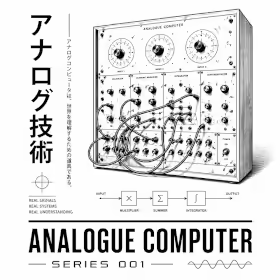
Even its visual language still resonates. The exposed signal paths and structured circuitry behind the GENIAC continue to influence retro computing culture and projects like the Analogue Computer Series 001 Design, which draws directly from the aesthetics of visible machine logic.
For a collection of switches, bulbs, and cardboard discs, the GENIAC managed to do something surprisingly ambitious.
It taught people that a machine could follow rules, evaluate conditions, imitate reasoning, and make decisions visible.
That was enough to change how many people imagined computers forever.
Featured Product
Analogue Computer Series 001 T-Shirt
The phrase “reason in syllogisms” belonged to a time when computing was visible, tactile, and mechanical. The Analogue Systems 01 retrocomputing themed t-shirt celebrates that era of electric brains, logic circuits, switches, and learning machines, when reasoning could be traced through wires and confirmed by the glow of a lamp.
Disclosure: this is a commercial product link to an external Zazzle store associated with philreichert.org. Purchases are handled by Zazzle.

Writer's Notes
What I like about this piece is that it finally forces the GENIAC to stop being treated as a vague “electric brain” curiosity and instead asks the practical question: what could the thing actually do? Once you start looking at the project list closely, the machine becomes far more revealing. You realise the kit was less interested in computation itself than in making logical structure visible to ordinary people. There is something oddly honest about that. A burglar alarm, a binary translator, a machine that plays Nim, a coded signalling system. None of these are impressive by modern standards, but together they expose how the 1950s imagined intelligence as wiring, switches, and conditional paths. I think that physical transparency is part of why the GENIAC still feels strangely alive.
Glossary
- Electric brain
- A popular 1950s term for machines that appeared to reason or calculate automatically. In this article, the phrase reflects how the GENIAC was marketed to the public. The expression sounds dramatic today, but it captures a moment when glowing bulbs and switches genuinely felt futuristic.
- Binary translator
- A circuit that converts numbers between binary and decimal form. The GENIAC included projects like this to teach how computers handled information using simple on and off states. Watching a machine represent numbers through lights gave people a direct view into early computational thinking.
- Switching logic
- A method of controlling outcomes through combinations of electrical switch positions. In the GENIAC, switches acted like decisions or conditions. Something as ordinary as a doorbell or burglar alarm became a lesson in machine reasoning once the wiring was understood.
- Machine reasoning
- The idea that a machine can follow formal rules to reach conclusions. The article discusses how the GENIAC simulated reasoning through visible circuits rather than hidden software. This fascinated many mid-century readers because it made logic feel physical and observable.
- Configurable system
- A device that can be rearranged to perform many different functions. The GENIAC was not one fixed machine but a kit that could become alarms, games, calculators, or code systems depending on how it was wired. That flexibility made it feel less like a toy and more like a small experimental laboratory.
- Visible logic
- A way of presenting reasoning so the decision path can be physically seen and traced. In the GENIAC, bulbs lighting up and switches changing position revealed how conclusions were reached. Unlike modern computers, very little was hidden from the builder.
Frequently asked questions
What could you actually build with the GENIAC computer?
With the GENIAC computer, builders could make simple electrical control circuits, burglar alarms, doorbells, arithmetic machines, binary translators, code machines, puzzle machines, and game-playing circuits such as Nim and Tit-Tat-Toe.
Was the GENIAC a real computer?
The GENIAC was not a computer in the modern stored-program sense. It was a configurable educational logic kit that used switches, bulbs, wires, and circuits to demonstrate reasoning, calculation, and decision-making.
Why did the GENIAC seem like an electric brain?
The GENIAC seemed like an electric brain because it could be wired so that different switch settings produced specific logical outcomes. To the user, the glowing bulbs made the machine appear to reason, even though it was following fixed electrical paths.
Why is the GENIAC still interesting today?
The GENIAC remains interesting because it made machine logic visible. Its exposed switches, wires, and bulbs show how mid-century learners encountered computing as a physical system rather than as hidden software.
Related articles…



Source Note
This article draws on GENIAC manual and advertising material from the 1950s, especially the way those sources described reasoning, circuits, switches, and “electric brain” learning. The aim is interpretive rather than academic: to explain how mid-century learners were invited to understand machine logic through visible parts and practical experiments.
Disclosure
This page presents a curated exploration of the GENIAC analogue computer kit and its associated materials. Content reflects the author’s interpretation of historical sources, including instructional manuals, advertisements, and related artefacts. The GENIAC system is discussed as an educational and conceptual model for understanding logic, circuits, and early computing ideas, rather than as a complete or authoritative account of computing history. References to “thinking machines” and reasoning systems follow the language and framing of the original material and are included for historical context. Readers seeking formal technical, historical, or academic treatment of computing should consult primary literature, scholarly sources, and specialist texts.