4 Things That Made the GENIAC Ahead of Its Time

Introduction
Most people imagine the future of computing as sleek machines sealed inside metal boxes. The GENIAC went in the opposite direction. It exposed the wiring, the switches, the mistakes, and the logic itself. In the mid-1950s, that was a surprisingly radical idea.
The GENIAC was not powerful. It was not automatic in the modern sense. It could not compete with industrial computers even in its own era. Yet it anticipated several ideas that later became central to personal computing, educational technology, and modern maker culture. That is why the little “electric brain” kit still feels oddly contemporary today.
If you are unfamiliar with the system itself, the GENIAC Analog Computer Kit provides the broader overview. But understanding why the machine mattered requires looking past the advertising language and into what the kit was actually teaching people to do.
1. It Turned Logic Into Something Physical
One of the GENIAC’s strangest qualities was its refusal to hide computation. Modern devices bury logic inside silicon and software layers. The GENIAC dragged it out into the open and mounted it on a board.
A switch position represented a condition. A wire represented a relationship. A glowing bulb represented an answer. The machine did not “simulate” reasoning in an abstract way. It showed how reasoning itself could emerge from physical structure.
That mattered because the 1950s were increasingly fascinated by machine reasoning. Computers were no longer discussed only as calculators, but as systems capable of formal logic and decision making. The language sounds theatrical now, yet the intellectual foundations were real. Machine Reasoning and the Age of Syllogisms explores how deeply this style of thinking shaped early computing culture.
The GENIAC translated those ideas into something ordinary people could wire together at a kitchen table. That was the breakthrough. It made logic feel touchable.
2. It Understood That Learning Required Interaction
The educational philosophy behind the GENIAC was ahead of its time. Instead of teaching computing through passive explanation, it forced users to experiment.
You built a circuit. You tested it. It failed. You rewired it. Then suddenly a bulb lit and the machine “reasoned” correctly.
That feedback loop now feels familiar because modern coding education, electronics kits, and maker platforms all rely on it. In the 1950s, it was unusual. Many educational products still treated the learner as an observer rather than a participant.
The GENIAC assumed people learned technical systems best by manipulating them directly. Frankly, it was right.
The progression of projects inside the manual reveals how ambitious this teaching model actually was. GENIAC Project List: Building Thinking Machines and Circuits shows how the circuits move from simple switching exercises into arithmetic machines, binary translators, coding systems, and even game-playing logic.
The user was quietly being trained to think structurally. Not just to memorise facts, but to understand systems.
3. It Predicted Reconfigurable Consumer Computing
The GENIAC was not sold as one fixed-purpose machine. It was sold as a reusable system.
That distinction matters more than it first appears.
The same collection of switches, bulbs, and connectors could become a burglar alarm, a binary adding machine, a reasoning device, or a code translator. The hardware stayed largely the same. The behaviour changed through configuration.
Today this feels obvious because we live in a world filled with programmable devices. In 1955, most consumer products were static objects with a single permanent purpose.
The GENIAC quietly proposed another idea: one machine capable of becoming many different machines depending on how it was wired.
That is much closer to modern computing philosophy than many people realise. The machine was primitive. The idea behind it was not.
4. It Introduced Binary Thinking to Hobbyists
The GENIAC manual introduced binary arithmetic not as an academic novelty, but as a practical language for machine logic.
This was a serious conceptual leap for a hobby kit aimed partly at teenagers and curious adults. Users were expected to understand that computing systems could represent information through stable electrical states such as on and off.
The machine included binary translators, binary arithmetic systems, comparison circuits, and coding devices. It treated computational thinking as something learnable rather than mystical.
There is something refreshingly unsanitised about this approach. The kit did not reduce computing to vague “science fun.” It expected effort from the user.
And yes, the experience could be awkward. Wiring errors were common. The machine was partly manual. Some of the “electric brain” marketing language bordered on hype. But that tension is part of what makes the GENIAC historically fascinating. It existed at the exact moment computing was shifting from industrial mystery to public imagination.
The Real Legacy of the GENIAC
The GENIAC was not ahead of its time because it predicted laptops or smartphones. It was ahead of its time because it recognised that computing would eventually become personal, interactive, modular, and educational.
More importantly, it understood something modern technology culture occasionally forgets: people trust systems more when they can see how those systems work.
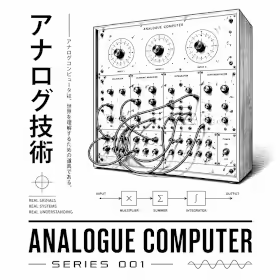
That visible signal path still carries emotional and aesthetic power today. It explains why mid-century computing hardware continues to attract collectors, designers, and enthusiasts. Even the clean instrumentation-inspired graphics of the Analogue Computer Series 001 Design draw from that same fascination with visible systems and traceable logic.
If you want to go deeper into the strange world of educational electric brains, GENIAC Journal: Hands-On Analogue Computer Kit (1950s) is the natural next stop. The further you go into these machines, the clearer it becomes that early computing history was far messier, more experimental, and more imaginative than modern mythology usually admits.
Featured Product
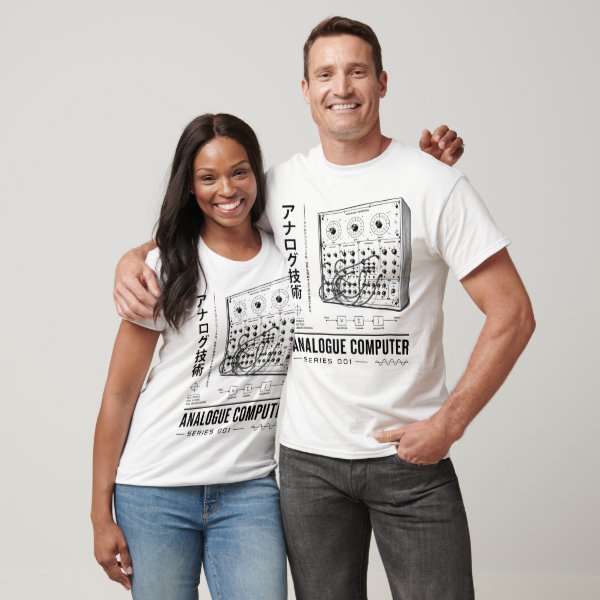
Analogue Computer Series 001 T-Shirt
The phrase “reason in syllogisms” belonged to a time when computing was visible, tactile, and mechanical. The Analogue Systems 01 retrocomputing themed t-shirt celebrates that era of electric brains, logic circuits, switches, and learning machines, when reasoning could be traced through wires and confirmed by the glow of a lamp.
Disclosure: this is a commercial product link to an external Zazzle store associated with philreichert.org. Purchases are handled by Zazzle.
Writer's Notes
What I like about this particular GENIAC article is that it shifts attention away from nostalgia and toward systems thinking. A lot of writing about vintage computing gets trapped in aesthetics, old adverts, or “look how primitive this was” commentary. The more interesting detail to me is that the GENIAC quietly anticipated several habits that now feel completely normal in computing culture: modularity, visible logic, hands-on experimentation, and reconfigurable machines. There is also a tension I enjoy in the article between the machine’s obvious limitations and the sophistication of the educational thinking behind it. In some ways the hardware was crude. The ideas were not. That distinction matters more than people sometimes realise.
Glossary
- Electric Brain
- A mid-century term for a machine that could calculate, reason, or make decisions through circuits. In this article, it captures the 1950s excitement around machines that seemed to think, even when their behaviour came from carefully arranged switches and wires.
- Machine Reasoning
- The use of mechanical or electrical systems to follow logical rules and produce conclusions. The article uses the term to explain why GENIAC mattered: it made reasoning visible, turning abstract logic into something a learner could wire by hand.
- Binary Logic
- A system based on two possible states, such as on and off, true and false, or 1 and 0. GENIAC used this idea to teach how simple electrical states could represent information and support calculation.
- Reconfigurable System
- A system that can be rearranged to perform different tasks without replacing all its parts. In the article, GENIAC is treated as reconfigurable because the same switches, bulbs, and wires could become many different reasoning or computing machines.
- Signal Path
- The route an electrical signal follows through a circuit. Here it becomes more than a technical detail: the visible signal path is part of GENIAC’s charm, showing learners exactly how a decision moved through the machine.
Frequently asked questions
Why was the GENIAC considered ahead of its time?
The GENIAC anticipated several ideas that later became central to modern computing culture, including modular hardware, hands-on learning, binary logic, and reconfigurable systems. Although simple and partly manual, it encouraged users to think structurally about machine reasoning and computation.
How did the GENIAC teach people about computing?
The GENIAC taught computing through direct experimentation. Users physically wired circuits, tested logical conditions, built arithmetic machines, and explored binary operations using switches, bulbs, and connectors rather than abstract theory alone.
Did the GENIAC use real binary logic like early computers?
Yes. The GENIAC included binary translators, binary arithmetic systems, comparison circuits, and coding machines that introduced users to the same underlying binary principles used in many early electronic computers.
What makes the GENIAC historically important today?
The GENIAC is historically important because it made machine reasoning and computational thinking accessible to hobbyists and learners during the 1950s. It demonstrated that computing could become personal, educational, interactive, and modular long before home computers existed.
Related articles…


Source Note
This article draws on GENIAC manual and advertising material from the 1950s, especially the way those sources described reasoning, circuits, switches, and “electric brain” learning. The aim is interpretive rather than academic: to explain how mid-century learners were invited to understand machine logic through visible parts and practical experiments.
Disclosure
This page presents a curated exploration of the GENIAC analogue computer kit and its associated materials. Content reflects the author’s interpretation of historical sources, including instructional manuals, advertisements, and related artefacts. The GENIAC system is discussed as an educational and conceptual model for understanding logic, circuits, and early computing ideas, rather than as a complete or authoritative account of computing history. References to “thinking machines” and reasoning systems follow the language and framing of the original material and are included for historical context. Readers seeking formal technical, historical, or academic treatment of computing should consult primary literature, scholarly sources, and specialist texts.