Can the Commodore 64 be the MIDI hub of a music workstation?
◆ Revised

The usual story is that the Commodore 64 was a wonderful sound computer, but not really a MIDI music workstation.
In our earlier article, How Sound Chips Turned 8-Bit Machines into Instruments, we looked at how machines such as the Commodore 64 became musical instruments in their own right. The SID chip made that connection obvious: the C64 could make remarkable music because the synthesizer was already inside the computer.
But look at the back of a C64 and something equally important is missing. There is no MIDI socket. No reassuring five-pin DIN connector marked MIDI IN or MIDI OUT. Nothing suggests that this inexpensive home computer might also be capable of sitting at the centre of a synthesizer setup, controlling instruments costing considerably more than the computer itself.
So history remembers the C64 for SID music, games and demos, while a few years later the Atari ST became famous as the musician's computer. That seems perfectly reasonable—until you look at what musicians could actually buy for the C64 in the middle of the 1980s.
Because the surprising part is not that the C64 could theoretically have been a MIDI workstation. People were already using it as one.
By 1984 you could buy a commercial MIDI interface for the Commodore 64. You could buy sequencing software. By 1985 you could buy notation software that drove external MIDI instruments. And in January 1986, Compute! magazine connected a Commodore 64 to a Casio CZ-101 synthesizer through a Passport Designs MIDI interface and tested the resulting system as a real music-production environment.
This was not a laboratory experiment, a modern hobbyist modification or something somebody finally worked out forty years later.
You could buy it.
The capability the C64 is remembered for not having
MIDI itself was still young. The standard emerged at the beginning of the 1980s and provided electronic instruments with a common language for exchanging events such as notes, velocity, program changes and timing information.
For a computer, this was not an impossibly demanding workload. MIDI did not require the C64 to record sixteen channels of digital audio or calculate virtual synthesizers. The external synthesizers produced the sound. The computer's job was to remember events, organise them, edit them and send instructions at the correct time.
Those are exactly the sorts of things a general-purpose microcomputer is good at.
The C64 already had a processor, programmable interfaces, 64 KB of RAM, mass storage through the 1541 disk drive, a keyboard, a display and, unusually, a capable synthesizer of its own in the SID chip.
What it did not have was the small piece of hardware that turned MIDI from a theoretical capability into something you could simply plug in.
That distinction matters enormously.
Passport was selling the missing piece in 1984
Passport Designs was not some modern retrocomputing enthusiast discovering an undocumented trick. It was producing commercial MIDI hardware and software while MIDI itself was still new.
In September 1984, Electronics & Music Maker reviewed Passport's MIDI/4 system for the Apple II and Commodore 64. Passport supplied the necessary MIDI interface for the C64 at a quoted US price of $195, with the MIDI/4 sequencing software costing another $99.[1]
A contemporary MIDI survey described the Commodore interface as providing MIDI In, MIDI Out and drum-sync connections. Used with MIDI/4, the software could record performance information including pitch, duration, velocity, pitch bend, program changes and aftertouch. Tracks could use any of MIDI's sixteen channels, and performances could be saved, looped and transposed.[2]
Read that again in the context of 1984.
This is a Commodore 64 being offered a commercial interface capable of receiving and transmitting MIDI, paired with software designed to record and manipulate actual musical performances.
That is not merely a computer making SID noises.
It is a sequencer.
And Passport was not alone
Even in 1984 the Passport solution was not the only indication that musicians were trying to turn inexpensive home computers into studio controllers.
The same contemporary survey described a Siel MIDI/Computer interface, originally designed by Jellinghaus Music Systems, providing two MIDI outputs, MIDI Thru and clock facilities. A Commodore 64 version was expected to support both real-time and step-time sequencing software. Its UK price was listed at approximately £99.[2]
That begins to change the historical picture.
The C64 was not technologically incapable of MIDI. A small specialist market had already recognised that it was perfectly capable of doing the job.
The problem was that MIDI remained an accessory.
The hidden cost of the missing socket
The phrase "cheap Commodore 64 MIDI workstation" therefore needs an asterisk.
The computer itself might have been inexpensive, but the moment you wanted MIDI you entered a specialist market.
Passport's 1984 prices meant approximately $294 for the MIDI interface and MIDI/4 software before buying a synthesizer, monitor, disk drive or anything else.[1][2]
By late 1985, Electronics & Music Maker was reviewing The Music Shop for MIDI for the C64 at £80 and warning that Passport's required MIDI interface would put the purchaser "the wrong side of £110". The magazine also noted that interfaces from several other manufacturers might be compatible, but advised readers to check before buying.[3]
That last detail may be more important than it appears.
If MIDI is built into the computer, a software developer can assume that every owner possesses it.
If MIDI requires a £100-plus specialist interface, the potential software market becomes only a fraction of the C64 installed base. Developers have to decide which interface to support. Retailers have to stock specialised hardware. Customers have to discover that it exists, determine compatibility and spend a significant amount of money before loading the software.
A missing socket therefore does more than remove a connector.
It can remove an entire software ecosystem.
Then Compute! actually tried it
The most striking evidence comes from January 1986.
Compute! magazine published a review titled Casio CZ-101 Music Synthesizer, The Music Shop for MIDI, And MIDI/4 Plus For Commodore 64 by assistant editor Philip I. Nelson.[4]
The magazine did not merely speculate about whether MIDI ought to work on the Commodore.
Its reviewers connected a Casio CZ-101 digital synthesizer to a Commodore 64 through a Passport Designs MIDI interface and tested two Passport software packages: The Music Shop for MIDI and MIDI/4 Plus.[4]
The first provided a graphical music-composition environment. Notes could be entered from the synthesizer keyboard as well as through the computer, while the Casio produced the actual sound rather than relying upon the SID chip.
MIDI/4 Plus went considerably further.
Compute! described it as a real-time digital recorder with editing facilities. A musician could play a performance on the synthesizer, record it into the C64's memory, then record additional parts while listening to those already stored. MIDI information preserved aspects of the performance rather than simply storing a static score.[4]
The prices printed with the review[4] are equally revealing:
- Casio CZ-101 synthesizer: $499
- Passport MIDI Interface for Commodore 64: $129.95
- The Music Shop for MIDI: $99.95
- MIDI/4 Plus: $99.95
This was a purchasable 1986 system.
Put a C64, disk drive and Passport interface beside a CZ-101 and the humble Commodore could record MIDI performances, arrange them, play external synthesizer sounds and act as the coordinating computer in an electronic studio.
It was much closer to the workstation concept than its later reputation suggests.
Readers apparently noticed
There is an even better historical footnote.
A later issue of Compute! printed a reader's response to the January review. The reader said the article had inspired him to buy the same C64/Casio system. He also reported being able to access more of the CZ-101's capabilities than the original reviewer had managed, including multiple timbres and polyphonic operation through MIDI.[5]
That small letter is valuable evidence because it moves the system beyond a magazine test bench.
Someone read about it, bought it and used it.
The C64 MIDI workstation existed in the ordinary consumer world.
So why don't we remember the C64 this way?
Because capability and identity are not the same thing.
The Commodore 64 was capable of functioning as a MIDI controller, sequencer and composition machine, but nothing about the standard machine announced that capability.
The MIDI owner first needed to know that an interface existed. Then they needed to find one. Then they needed compatible software. Then they needed the disk drive and, of course, a MIDI instrument.
For most C64 owners, MIDI was therefore invisible.
Software followed the size of the accessible market. Games had millions of potential customers. SID music software could run on every C64 ever sold. MIDI applications addressed the much smaller group of owners who had deliberately crossed the hardware barrier.
The computer could perform the task.
The ecosystem prevented the task from becoming normal.
The Atari ST shows what one connector can change
Then consider what happened when Atari launched the ST family.
MIDI In and MIDI Out were built into the computer. Contemporary Atari material was already drawing attention to this fact in 1985, and by March 1986 Antic described the ST as one of the first personal computers with MIDI built in and demonstrated programming its MIDI port directly.[6][7]
The conceptual difference is enormous.
An ST owner did not have to decide to turn the computer into a MIDI machine.
It already was one.
A developer writing music software for the ST could reasonably assume that every customer's computer possessed the necessary physical interface. A musician could connect a MIDI cable without identifying and purchasing a third-party cartridge first.
That certainty encourages software.
Software attracts musicians.
Musicians create a market.
The market attracts more software.
Eventually the machine acquires an identity: the Atari ST is a music computer.
The C64 experienced almost the reverse process. Its lack of an integrated MIDI interface made MIDI peripheral, and because MIDI remained peripheral, relatively few owners discovered just how competent the machine could be at it.
The $2 plug that might have changed the C64
It is tempting to reduce the whole story to a provocative question:
What if Commodore had spent another couple of dollars and put MIDI sockets on the C64?
The "$2" should not be taken as a literal historical bill-of-materials calculation. A proper MIDI interface requires more than the physical DIN connector itself. But as a design counterfactual it exposes something important.
The gulf between "C64 with no MIDI" and "C64 music workstation" was not a lack of computational imagination.
The required systems were being sold.
Passport had the interface.
Passport had the software.
Siel and others were exploring the same territory.
Electronics & Music Maker was reviewing it.
Compute! plugged a Casio CZ-101 into a C64 and demonstrated that the concept worked.
The pieces were there.
What the ordinary Commodore owner did not have was the socket.
A different history hiding in plain sight
This makes the Commodore 64's music history more interesting than the familiar SID story alone.
SID deserves its reputation. It gave programmers a remarkable built-in synthesizer and ultimately produced an entire musical culture.
But the same machine had another possible identity sitting just outside its case.
With a MIDI interface attached, the C64 could become the central controller of a modular electronic studio. It could record performance data, sequence external instruments, organise compositions and combine its own SID voice with synthesizers costing many times the price of the computer.
People were doing exactly that by the middle of the 1980s.
The surprising question is therefore no longer:
Could somebody somehow turn a C64 into a MIDI workstation?
We know the answer. They did.
The better question is:
How different would the C64's history have looked if Commodore had made that capability visible to every owner?
Perhaps the great missed feature of the Commodore 64 was not another sound channel, more memory or a faster disk drive.
Perhaps it was simply two little five-pin sockets on the back.
That also leaves us with an interesting distinction. The C64 could make music through its own SID chip, or it could use MIDI to control an entirely different world of electronic instruments. The two technologies are often discussed together, but they solve fundamentally different problems. Continue with SID vs MIDI: Two Ways Computers Make Music, where we pull those two approaches apart and look at what each one actually contributes to computer music.
Featured Product
Analogue Computer Series 001 T-Shirt
The Analogue Computer Series 001 t-shirt celebrates the hands-on character of earlier computing, when making something meant understanding the machine, its connections and its limitations. Inspired by mid-century analogue computing panels, signal paths and visible logic, the design shares something with the 1986 Commodore 64 music workstation: technology assembled, connected and experimented with by its user rather than hidden behind an invisible production environment.

Writer's Notes
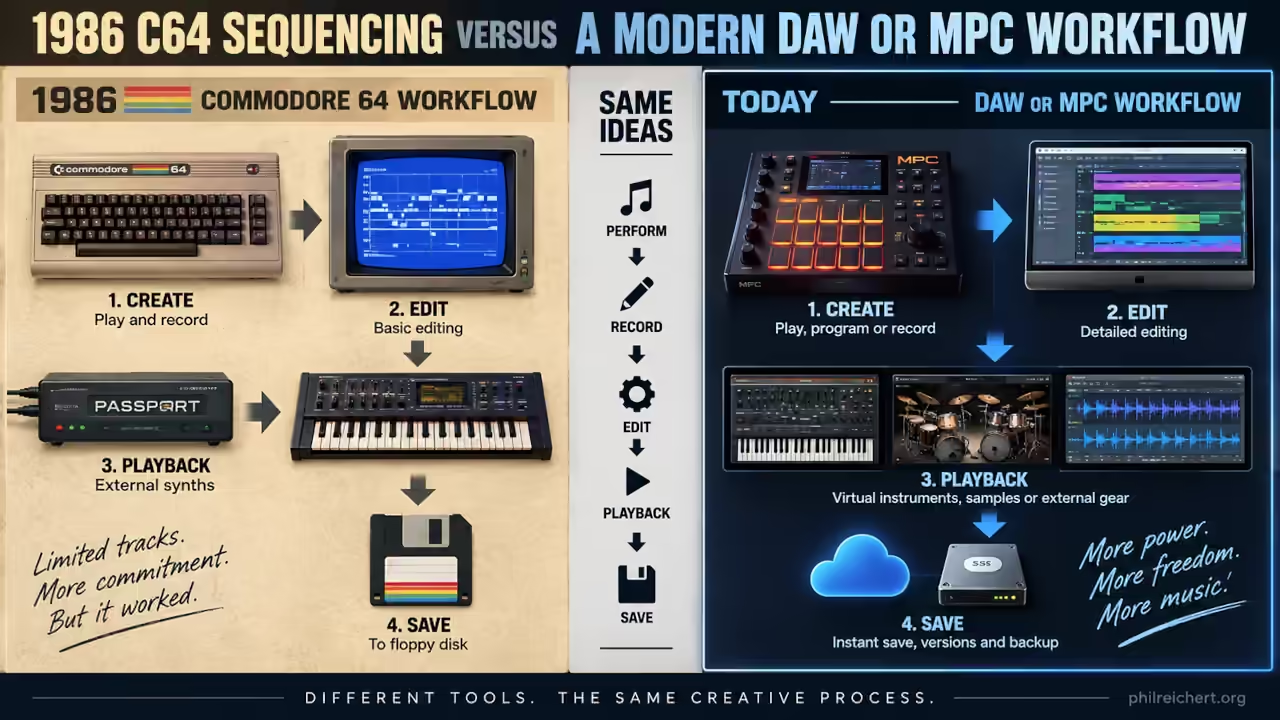
From C64 Sequencer to Modern MPC
The tools have changed enormously, but the basic sequencing workflow is surprisingly familiar. This comparison shows how creating, editing, playing back and saving a sequence on a 1986 Commodore 64 relates to the same creative process on a modern MPC or DAW.
Reader Guide
The following material expands on the terminology, historical context, technical concepts, and related reading connected to this article.
Glossary
Some of the terms used in this article have specialised, historical or technical meanings. This glossary provides additional context for selected terms and ideas.
- MIDI
- A digital communications standard from the early 1980s that sends musical performance data (note on/off, velocity, program changes, timing and controller messages) between instruments and computers; crucially it transmits event instructions rather than audio, so a small computer can control expensive external synthesizers without generating the sound itself.
- five‑pin DIN connector
- A circular 5‑pin electrical socket common on consumer audio and instrument gear of the 1970s–80s, used by the MIDI specification for physical In/Out/Thru connections; including this single inexpensive connector on a computer made MIDI obvious and immediately usable to owners and developers, whereas its absence pushed MIDI into a specialist, add‑on market.
- SID chip
- The MOS Technology 6581/8580 Sound Interface Device built into the Commodore 64 that provided three-channel programmable synthesis with filters and envelope control; its unusual sonic character powered games, demos and an independent musical culture, but it produced on‑board sounds rather than serving as a controller for external MIDI instruments.
- sequencer
- Software or hardware that records, edits and plays back timed musical events (notes, durations, velocities, program/midi-controller changes), either in real time or step‑time; sequencers turn a computer into a compositional and arranging tool by storing performance data on tracks and sending it to external synthesizers at the right moments.
- Passport Designs
- An early commercial company that sold MIDI interfaces and music software for home computers in the mid‑1980s, providing one of the first off‑the‑shelf ways to connect a Commodore 64 to external synthesizers; its products demonstrate that a playable C64‑based studio existed as a bought, supported system rather than merely a later hobbyist hack.
Frequently asked questions
Curious about something you’ve just read? These frequently asked questions explore some of the key ideas, details and questions surrounding the topic.
Could a Commodore 64 function as a MIDI music workstation in 1986?
Yes — by the mid-1980s commercial MIDI interfaces and software allowed a C64 to act as a sequencer, controller and composition machine that could record performance data, edit parts and drive external synthesizers.
What hardware and software enabled MIDI on the C64?
Third‑party MIDI interfaces from companies like Passport Designs and Siel, paired with software such as Passport's MIDI/4, MIDI/4 Plus and The Music Shop for MIDI, let the C64 send and receive MIDI data and manage sequencing and notation.
Why didn't the C64 become known as a musicians' computer like the Atari ST?
Because MIDI required an external, relatively expensive interface on the C64, the installed‑base of users with MIDI was small and developers could not assume every owner had the hardware, whereas Atari STs shipped with built‑in MIDI sockets so software and a musical ecosystem grew quickly.
How much did a usable C64‑based MIDI setup cost around 1986?
A contemporaneous example listed a Casio CZ‑101 at $499, a Passport MIDI interface at $129.95 and software titles around $99.95 each, meaning assembling a practical MIDI system required several hundred dollars more beyond the C64 and disk drive.
Related articles…


References and Further Reading
- David Ellis, "Passport MIDI/4 Software", Electronics & Music Maker, September 1984. Contemporary review of Passport's Apple II and Commodore 64 MIDI hardware/software system; quotes the MIDI interface at $195 and MIDI/4 software at $99.
- "MIDI and the Micro", Electronics & Music Maker, June 1984. Survey of contemporary microcomputer MIDI systems, including the Passport Commodore 64 interface and MIDI/4 software, and the Siel/Jellinghaus MIDI/Computer interface.
- Ian Waugh, "Window Shopping – The Music Shop for MIDI", Electronics & Music Maker, November 1985. Review of the Commodore 64 version of The Music Shop for MIDI, including discussion of the separately purchased Passport interface and compatibility with alternative interfaces.
- Philip I. Nelson, "Casio CZ-101 Music Synthesizer, The Music Shop For MIDI, And MIDI/4 Plus For Commodore 64", Compute!, Issue 68, January 1986. Practical test of the Casio CZ-101 connected to a Commodore 64 through the Passport Designs MIDI interface.
- "Correction For Casio Review", Compute!, 1986. Reader response reporting the purchase and use of the system described in the January review and describing additional CZ-101 MIDI capabilities.
- Atari Explorer, February 1985. Contemporary discussion of MIDI support in Atari's forthcoming ST computer family.
- Tom Jeffries, "MIDI Driver", Antic, March 1986. Programming article demonstrating direct use of the Atari ST's built-in MIDI interface.
Disclosure
This article was prepared using a combination of original research, published sources, archival material, and digital research and writing tools, including the use of large language model tools. Sources are referenced where appropriate. The author reviews and edits the article and may make ongoing editorial updates. Any commercial relationships, affiliate links, sponsorships, or other material interests relevant to the article are disclosed separately where applicable.