Using the M5Stack Cardputer to Augment Vintage Electronics

There is something slightly magical about encountering a piece of vintage electronics that still works exactly as its designers intended. A cassette deck pulls its heads into position, a synthesizer waits for a keypress, a floppy drive chatters through a seek, or an electromechanical device announces a change of state with a reassuring clunk. These machines were built to operate, not to explain themselves. Yet anyone arriving here from the M5Stack Cardputer Newsletter will already have met a remarkably capable little computer that invites experimentation. Put the two ideas together and an intriguing question emerges: instead of replacing vintage electronics with modern technology, what if we used the Cardputer to help the old machine tell us what it is doing?
Digital Layer
The M5Stack Cardputer is particularly interesting because it packages many of the ingredients of a small instrumentation computer into something that can sit comfortably beside an old piece of equipment. It has a display, keyboard, storage, wireless connectivity and an ESP32-S3 processor, together with expansion possibilities for connecting external electronics. That combination makes it possible to imagine the Cardputer not simply as another microcontroller development board, but as a removable digital layer that can be placed around equipment designed decades before such capabilities were practical.
The distinction matters. Retrofitting modern electronics often means replacing something: an old controller is removed, a mechanism is bypassed or a modern computer takes over the function of the original circuitry. Augmentation starts from a different proposition. The vintage machine remains the machine. The Cardputer observes it, records information about it and, where useful, provides capabilities alongside it. We are not trying to turn a 1978 cassette deck into a 2026 cassette deck. We are asking what becomes possible when a 1978 cassette deck gains access to a 2026 observer.
Start Listening
Note: The practical interface will differ enormously between machines, and observing a signal safely may require isolation, level conversion or specialist knowledge of the equipment concerned.
The obvious temptation is to begin with control. Connect a few interfaces, simulate the transport buttons and proudly operate PLAY from a web browser. That would certainly be entertaining, but it skips over what may be the more interesting opportunity. Before commanding an old machine, we can listen to it. Vintage electronics contain electrical signals representing real physical events: switches change state, motors start, solenoids energise, counters pulse, voltages rise and fall, sensors respond and control circuits decide what should happen next.
A Cardputer connected through appropriately designed sensing and isolation circuitry could monitor selected signals without needing to assume control of them. Its display might show that the capstan motor is running, the play solenoid is energised and the counter is receiving pulses. Add suitable sensors and the same screen might report tape speed, motor current or audio level. What was once an opaque sequence of mechanical noises and electrical events becomes observable behaviour.
That is already augmentation. The machine has acquired an instrument panel its designers never provided, while its original operation remains fundamentally unchanged.
Useful Telemetry
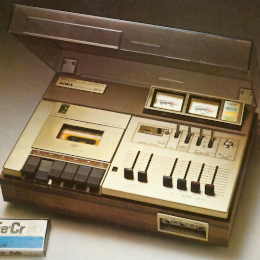
Consider an ordinary vintage cassette deck. When PLAY is pressed, several things have to happen correctly and in sequence. Mechanical parts move, the tape begins travelling, the motor encounters a load and the audio path becomes active. To the listener the result is binary: either the tape plays or it does not. To an observer collecting telemetry, however, the event contains considerably more information.
The Cardputer could record how long the transport takes to engage, whether motor current changes during operation, how quickly tape speed stabilises and whether a solenoid reliably reaches the expected state. A fault that appears to be intermittent might suddenly leave a pattern in the data. Perhaps startup is gradually taking longer. Perhaps current consumption rises after twenty minutes. Perhaps speed stability deteriorates only after the mechanism becomes warm. These are observations that a technician could make with conventional test equipment, but continuous monitoring gives them a history.
This turns the Cardputer into something more interesting than a digital meter. It becomes a small historian of machine behaviour.
Machine Baselines
Recording a machine once is interesting. Recording it over time is useful. A healthy cassette deck establishes its own baseline: how quickly the transport engages, how much current the motor draws, how stable the tape speed becomes and in what order important events occur. Repeat those measurements months later and small changes begin to mean something.
That matters because old machinery rarely announces its decline all at once. Belts stretch. Lubricants stiffen. Contacts oxidise. Mechanical resistance increases. The deck may still play perfectly well while taking a little longer to start or drawing a little more current. Telemetry turns those small changes into a history. Instead of waiting for a fault, we can watch the machine slowly move away from its own known-good behaviour.
Now the idea becomes much larger than cassette decks. A reel-to-reel recorder has motors and transport states. A floppy drive has seeks, speeds and timings. Synthesizers, drum machines, printers, plotters and arcade hardware all produce signals that describe what they are doing. The details change from machine to machine, as do the electrical and safety requirements, but the principle survives: identify meaningful signals, observe them safely and let changes over time tell the story.
Behavioural Preservation
And that history may itself be worth keeping.
We are already good at preserving the things around old technology. We scan manuals, photograph circuit boards, archive software, save schematics and digitise recordings. Yet a perfectly preserved service manual cannot show us exactly how a surviving machine behaved on an ordinary Tuesday afternoon in 2026.
Telemetry can. It can record how long a mechanism took to engage, how its components operated in sequence, how quickly speed stabilised or what happened electrically when STOP became PLAY. Collected over time, those measurements become something different from documentation. They become a record of an operating machine.
This suggests a useful extension to technological preservation. We can preserve what a machine is. We can preserve what it produces. Perhaps we should also preserve evidence of how it behaves.
Active Assistance
Once the Cardputer can recognise that behaviour, it no longer has to remain a passive observer. It can begin helping. It might count operating hours, maintain a service history, flag a measurement drifting outside its normal range or guide a technician through a repeatable test. Wireless connectivity could carry those records elsewhere while the vintage machine itself remains largely untouched.
Control comes later, and now it has a purpose. With suitable isolation and interface circuitry, the Cardputer could simulate a switch, operate a relay, start a recording or repeatedly exercise a transport while measuring the result. Instead of bolting modern features onto an old machine simply because we can, each new capability grows from something we have already learned about how that machine works.
That gives us a much more interesting path to augmentation: observe, record, understand, assist, then control. The Cardputer does not begin by taking over the machine. It earns its way in.
New Interfaces
Eventually the boundary between old and new becomes wonderfully peculiar. A machine designed before Wi-Fi existed might expose operating data over a network. A cassette deck could maintain a digital service history. A floppy drive could graph seek behaviour. A synthesizer could acquire an interface for parameters its designers expected users to manipulate only from a front panel. An electromechanical machine could effectively gain an API without surrendering the mechanism that makes it historically interesting.
This is where the Cardputer format becomes appealing. It is small enough not to dominate the project, capable enough to provide a useful interface and general enough to move between experiments. The same Cardputer that monitors a cassette deck this month might interrogate a synthesizer next month. Instead of permanently modernising every object, we can build a reusable instrument for conversing with many of them.
Keep Character
So, can the M5Stack Cardputer meaningfully augment vintage electronics? The compelling answer is yes, but perhaps not for the reason first imagined. Remote control is the conspicuous trick; observation is the deeper opportunity. By giving old machines a way to expose their internal behaviour, we can understand them better, diagnose them more intelligently, record aspects of their operation that preservation normally overlooks and only then add carefully chosen modern capabilities. The aim is not to make vintage equipment behave like new equipment. It is to let modern computing illuminate what was already there.
That same philosophy becomes even more intriguing when the vintage device is already programmable or musical. Old synthesizers provide a particularly fertile example because their original sound-generating hardware can remain untouched while modern tools transform how we communicate with it. That is the next step in this exploration: Programming Old Synthesizers with Modern Tools.
Writer's Notes
Reader Guide
The following material expands on the terminology, historical context, technical concepts, and related reading connected to this article.
Glossary
Some of the terms used in this article have specialised, historical or technical meanings. This glossary provides additional context for selected terms and ideas.
- M5Stack Cardputer
- A compact, purpose-built handheld computer module that combines a screen, keyboard, storage, wireless connectivity and expansion headers so it can act as a portable instrumentation platform; used here as a removable ‘digital layer’ that observes, records and interacts with older electronics without permanently altering them.
- ESP32-S3
- A low‑cost system‑on‑chip microcontroller from Espressif that integrates Wi‑Fi and Bluetooth with enough processing power and input/output lines to run user interfaces, log data and talk to sensors and external circuitry in small embedded devices such as the Cardputer.
- capstan motor
- The small, precision-driven roller in tape transports that pulls tape past the heads at a controlled speed; its behaviour (speed, current draw and stability) is crucial to audio fidelity and is therefore a key observable when diagnosing or logging the health of a cassette mechanism.
- solenoid
- An electromechanical actuator consisting of a coil and movable plunger that converts an electrical pulse into a linear mechanical action—commonly used to operate play/stop shutters, tape latches or relays in vintage machines—and whose energisation is easily detected electrically to indicate discrete mechanical states.
- telemetry
- The practice of continuously measuring and recording a machine’s electrical and mechanical signals (such as motor current, switch states and speed) to build time‑series histories and baselines; telemetry turns intermittent symptoms into diagnosable trends and creates preservable records of how a device actually behaved in use.
Frequently asked questions
Curious about something you’ve just read? These frequently asked questions explore some of the key ideas, details and questions surrounding the topic.
What is the M5Stack Cardputer and why is it useful with vintage electronics?
The Cardputer is a compact instrumentation computer that includes a display, keyboard, storage, wireless connectivity and an ESP32-S3 processor with expansion options, allowing it to sit beside older equipment as a removable digital layer that observes, records and provides interfaces without replacing original circuitry.
How can the Cardputer observe a vintage machine without taking control of it?
By connecting through appropriately designed sensing and isolation circuitry the Cardputer can monitor selected signals (for example motor running, solenoid state or counter pulses) and display or record them, while safety may require isolation, level conversion or specialist knowledge; control can be added later with careful isolation.
What kinds of telemetry can be collected and how does that help diagnose problems?
Telemetry can include timings such as transport engage time, motor current, tape speed stability and solenoid states or event sequences, and continuous monitoring turns small changes into a history that can reveal intermittent faults or gradual degradation that wouldn't be obvious from a single manual test.
In what ways does the Cardputer contribute to preservation and later augmentation?
It records how a machine behaves over time—creating a history of operating characteristics that complements manuals and schematics—while also enabling functions like counting hours, maintaining service history, flagging drift, guiding tests and eventually providing carefully isolated control, following the progression: observe, record, understand, assist, then control.
Related articles…


References and Further Reading
The following sources provide additional technical background and practical examples related to the ideas explored in this article.
- Start with the hardware: M5Stack Cardputer ADV Documentation. The official guide to the little computer at the centre of this article. Of particular interest are its HY2.0-4P connector and 14-pin EXT expansion bus, which provide the practical starting points for connecting sensors and interface circuitry to vintage equipment. [retrieved 2026-09-06]
- See the idea in action: Building a Cassette Deck Controller to Save a Locked-Out Car Stereo, Hackaday. A wonderfully relevant real-world project in which a microcontroller interacts with the motors, sensors, buttons and display of an existing cassette mechanism. It is not the Cardputer project proposed here, but it shows just how much an old machine can reveal once a modern computer begins listening to it. [retrieved 2026-09-06]
Disclosure
This article was prepared using a combination of original research, published sources, archival material, and digital research and writing tools, including the use of large language model tools. Sources are referenced where appropriate. The author reviews and edits the article and may make ongoing editorial updates. Any commercial relationships, affiliate links, sponsorships, or other material interests relevant to the article are disclosed separately where applicable.