Old Synthesizers are Become Programmable Again

The Machine We Thought Was Finished
There is something wonderfully final about an old synthesizer. Once the manufacturer stops issuing updates, the service network disappears and replacement parts begin migrating from repair shops to eBay, the instrument seems complete. You can repair it, restore it and perhaps work around its limitations, but the machine itself is what it is.
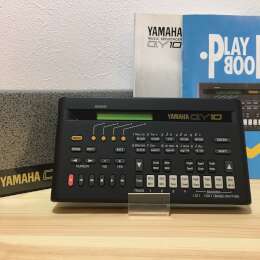
That sense of finality extends across vintage electronic instruments. My Yamaha QY10 music sequencer, for example, remains a remarkably capable little MIDI workstation more than three decades after its introduction. Its capabilities, however, appear fixed by the hardware and software Yamaha designed for it. We normally accept those limitations as part of owning an old machine.
That assumption is becoming less certain.
The electronics inside a vintage synthesizer, drum machine or sequencer may remain perfectly serviceable decades after manufacture. Oscillators still oscillate, filters still filter, keyboards still scan and MIDI ports continue passing data. Yet the digital systems controlling those functions can become increasingly awkward historical artefacts, constrained by processors, firmware and interfaces designed for another era.
Changing that behaviour has traditionally required an unusual conjunction of skills: electronics, embedded programming, obsolete processors, assembly language, digital logic and enough knowledge of the original machine to recognise whether a modification is actually working correctly.
Many vintage instruments are therefore theoretically programmable, but not very programmable in practice. The intriguing question is whether that distinction is beginning to disappear.
A recent project involving one of the most famous drum machines ever made suggests that it might be.
Somebody Reprogrammed the TR-808
In 2026, SuperOS-808 provided a striking example of what is becoming possible. Developed by Bjorn Lustic, the open-source project provides alternative firmware for the Roland TR-808 and documents the use of the Claude AI coding agent during development.
This is not a case of feeding a forty-year-old Roland ROM into an AI and asking it to “add MIDI”. SuperOS-808 instead runs on modern replacement processor hardware built around an AT90USB1286 microcontroller. This takes the place of the original processor responsible for much of the TR-808's digital control behaviour.
That distinction matters. The project is not somehow teaching the original processor an entirely new repertoire of tricks. It replaces part of the instrument's digital intelligence with modern hardware that can be programmed using contemporary development tools.
The result can do considerably more than the original machine. SuperOS extends patterns to 64 steps and adds probability, ratchets, polymetric instrument lengths, swing, alternative playback directions and pattern manipulation. Its MIDI support includes drum notes, program changes, clock synchronisation and velocity-controlled accent, while a SysEx-based editor provides further control.
Yet SuperOS does not simply turn the TR-808 into an unrelated modern drum machine. The original controls remain central to the experience, with new functions layered onto the existing interface. Compatible hardware can even emulate the behaviour of the original processor.
A machine designed at the beginning of the 1980s has therefore acquired something remarkable in 2026: an active firmware-development environment. That is the interesting part.
Replace the Brain, Keep the Instrument
The architecture of the TR-808 helps explain why this is possible. Its processor is not, by itself, responsible for the famous 808 sound. Much of that character comes from the electronic voice circuits, while the processor reads controls, manages patterns and timing, and triggers the appropriate voices.
Conceptually, the chain looks something like this:
controls → processor → sequencer and control logic → trigger signals → sound circuitry → audio
If a modern processor can correctly occupy the old processor's place in that chain, the distinctive sound-generating electronics do not necessarily need to change. The machine can retain the circuitry that gives it its character while gaining a new digital control system.
A vintage instrument therefore contains two rather different kinds of heritage: the physical circuitry responsible for producing and shaping sound, and the computational behaviour governing how the musician interacts with it. The former may age rather gracefully; the latter can potentially be replaced, emulated or extended.
The analogue circuitry does not become obsolete merely because its original digital controller does.
We Could Do This Before AI
None of this began with AI. Musicians, programmers and electronics enthusiasts have been modifying instruments for decades, adding MIDI, replacing processors, rewriting firmware and reverse-engineering hardware long after manufacturers stopped supporting it.
The Usual Suspects project [4] demonstrates just how far that work can go. Its developers reverse-engineered the Motorola DSP56300 family used in several well-known digital synthesizers, allowing original synthesizer firmware to run on an emulated version of the processor. The result is not merely a modern plugin designed to sound similar to the old hardware; the original firmware is running again inside a recreated digital environment.
A more recent Ensoniq SD-1/32 project [5] pushes the idea in another direction. Using the synthesizer already emulated within MAME, its developers have packaged the emulated instrument as VST3 and Audio Unit plugins for modern music software. More significantly for our story, the project credits contemporary AI coding tools with helping musicians without conventional programming backgrounds undertake the development. Here the old synthesizer is not being given a replacement processor; instead, its preserved digital machine is being carried forward into a new software environment. It is an intriguing example of the expertise boundary beginning to move.
That is an extraordinary achievement, but it also illustrates the old barrier. Reconstructing an unfamiliar processor and making decades-old firmware behave correctly required considerable specialist knowledge, experimentation and time. It was possible, but it was not an undertaking available to the average synthesizer enthusiast.
AI changes that equation rather than inventing it. It can help more people navigate old documentation, unfamiliar code and reverse-engineered systems. The important change may therefore be less about making the impossible possible, and more about making the previously formidable practical.
From Possible to Practical
That distinction becomes clearer if we separate what has already been demonstrated from what AI is making more practical, and what remains largely speculative.
Already Demonstrated
- Replacement processors and controller boards
- Open-source synthesizer firmware
- Processor and instrument emulation
- MIDI retrofits
- Modern storage replacements
- Computer and web-based editors
Increasingly Practical
- AI-assisted modification of existing source code
- Rapid exploration of unfamiliar firmware projects
- Assistance interpreting processor documentation
- Automated generation of tests and utilities
- Help porting software between modern microcontrollers
- AI-assisted analysis of reverse-engineered code
Still More Speculative
- An AI progressively reconstructing an undocumented synthesizer from its ROM, schematics and observations
- Automated creation of replacement firmware for obscure instruments
- Large-scale revival of electronic instruments whose original development environments have disappeared
The distinction is important. There is already ample evidence that vintage hardware can be reimplemented and extended. The interesting question is how much easier AI tools might make the journey from surviving documentation to working hardware.
What Do You Actually Give the AI?
This is perhaps the most useful way of understanding AI-assisted hardware development.
Imagine that you own an old drum machine and would like to add MIDI note input. You do not ideally begin with:
“Here is the firmware. Add MIDI.”
Instead, you gradually assemble an engineering dossier.
That might include:
- Existing source code
- The replacement microcontroller documentation
- The original service manual
- Schematics
- Pin assignments
- Descriptions of original behaviour
- MIDI specifications
- Compiler configuration
- Known hardware quirks
- Test results from the real instrument
Then the work can be broken into bounded problems.
Find the existing routine responsible for triggering the bass drum. Determine how instruments are represented internally. Add a MIDI parser. Map MIDI note 36 to the bass drum. Translate velocity into the machine's accent behaviour. Compile it. Investigate the errors. Check that the existing sequencer still works.
An AI coding agent can navigate files, propose changes, generate code, explain unfamiliar sections and help diagnose problems.
Then comes the important bit.
Put it in the machine and see what actually happens.
The Bench Still Gets the Final Vote
There is a wonderfully physical limit to all this artificial intelligence.
The machine is sitting on the bench.
Code compiling successfully does not mean that the synthesizer works. An emulator behaving correctly does not guarantee that forty-year-old electronics will respond identically. Timing matters. Voltage levels matter. Component tolerances matter. Undocumented behaviour matters.
The practical development cycle may look less like “AI writes firmware” and more like this:
AI reads schematic → human checks PCB → AI proposes interpretation → human probes pin → oscilloscope contradicts assumption → human reports result → AI revises code → firmware is compiled → machine is tested → ears decide whether it is useful.
That final loop is what makes this engineering rather than merely software generation.
The future AI-assisted synthesizer hacker is still likely to have some reassuringly traditional equipment nearby: a multimeter, oscilloscope, logic analyser, programmer, MIDI monitor and eventually a pair of ears.
The AI can propose what the machine ought to do.
The machine demonstrates what it actually does.
A ROM File Is Something Else Entirely
Now consider the less fortunate vintage instrument.
There is no open-source replacement firmware. Nobody has documented its internal architecture. The manufacturer's source code disappeared decades ago. All that survives is a service manual and a binary dump from a ROM.
This is a much more difficult proposition.
The ROM contains executable machine code, not a conveniently labelled project explaining that one function scans the keyboard and another updates the display. Someone first needs to understand the processor architecture, disassemble the code, reconstruct memory maps, identify hardware registers and determine which routines perform meaningful functions.
This is reverse engineering rather than ordinary software development.
AI may become extremely useful here too. A capable agent could help annotate disassembled code, identify repeated structures, correlate addresses against schematics, generate small test programs and maintain an increasingly detailed model of how the machine operates.
But plausible-looking analysis is not enough. A mistaken assumption about a hardware register or timing loop could propagate through hundreds of apparently sensible conclusions.
The further we travel from well-documented source code towards undocumented binary archaeology, the more important physical verification becomes.
AI-Mediated Hardware Archaeology
There may be a useful name for this emerging activity: AI-mediated hardware archaeology.
It is the use of machine reasoning and coding tools to help reconstruct the operation of obsolete electronic systems from surviving source code, ROM images, schematics, service documentation and observations of physical hardware.
Hardware archaeology itself is not new. Enthusiasts have been reconstructing forgotten machines for decades.
What changes is the possibility of placing an increasingly capable reasoning assistant between the enthusiast and an extinct technical ecosystem.
An engineer investigating a 1987 processor may previously have needed to become familiar with its instruction set, development environment, memory architecture and peculiarities before even approaching the instrument that contains it.
A future workflow might instead allow the enthusiast and AI to learn that machine together.
That does not remove expertise. It changes where expertise becomes necessary.
AI Moves the Expertise Boundary
Suppose modifying an obscure synthesizer once required someone who understood electronics, embedded C, assembly language, MIDI, digital logic, compiler toolchains and reverse engineering.
There are people with that combination of abilities.
There just aren't very many of them.
AI does not make those disciplines disappear. Instead, it may allow an enthusiast with strong knowledge in two or three areas to operate productively across several others.
The required skill begins to shift.
You still need to understand the machine. You need to locate trustworthy documentation. You need to describe the behaviour you want. You need enough technical judgement to recognise when generated code or analysis is implausible. And you need to be capable of testing the result.
But perhaps you no longer need ten years of embedded programming experience before you can meaningfully participate.
That is a much more consequential proposition than simply saying that AI writes code faster.
It enlarges the population of people who can attempt the project.
What Might Be Hiding in Your Old Synth?
The most interesting consequence may therefore concern instruments considerably less famous than a TR-808.
Consider what may already be sitting in cupboards, studios and second-hand shops:
- A 1980s analogue polysynth whose voices remain healthy but whose ageing digital processor controls the keyboard, patches and modulation.
- An early MIDI synthesizer with a distinctive sound engine trapped behind primitive patch storage and an awkward interface.
- A 1990s ROMpler containing hundreds of usable waveforms navigated through a two-line LCD.
- An old sampler dependent upon floppy disks, SCSI drives or obsolete removable media.
- A rack effects processor with excellent algorithms but almost no convenient way to edit them.
- A home keyboard whose inexpensive reputation has prevented anyone from investigating what its hardware might actually be capable of.
Those machines were originally judged as finished commercial products.
Perhaps some should instead be regarded as partially documented hardware platforms whose development stopped.
The $100 Synthesizer in the Attic
Imagine an unfashionable synthesizer from 1991.
It sells for $100 because almost nobody particularly wants one. The keyboard is good. Its converters work. Its sound ROM contains hundreds of useful waveforms. The machine has an identifiable processor and the service manual survives online. Somewhere, somebody has already dumped its firmware.
Today it is merely obsolete.
But those are also the ingredients of a future open-source instrument.
One enthusiast annotates part of the firmware. Another identifies the display routines. Somebody constructs an emulator. A replacement processor prototype appears. An AI coding agent helps port the reconstructed behaviour to modern hardware.
Eventually the machine boots from a replacement controller.
Then somebody adds USB MIDI.
Someone else adds a modern patch librarian.
A diagnostic screen appears for technicians. Then extra modulation routings. Then new sequencing functions.
None of this is guaranteed to happen to any particular synthesizer, and the sequence is illustrative rather than predictive.
But it demonstrates how the economic threshold changes.
A manufacturer would never restart a development team for an obscure instrument with 200 surviving enthusiasts.
Two hundred enthusiasts might not need a manufacturer anymore.
Could Your Vintage Synth Become Programmable Again?
A useful first approximation is to ask how much of the machine remains understandable.
- Is a service manual available?
- Can the main processor or microcontroller be identified?
- Does useful documentation for that processor survive?
- Can the original firmware or ROM be accessed?
- Are the interesting sound-generating circuits reasonably separate from the control processor?
- Is there enough community interest for several people to document and test the machine?
This is not a scientific score, but it provides a useful way of thinking about hackability.
Five or six favourable answers suggest a fascinating candidate for investigation.
Three or four suggest that considerable work may be required but that the problem is approachable.
Zero or one means that you may shortly become acquainted with hardware archaeology in its more traditional form.
The Interesting Machines May Not Be the Famous Ones
A Roland TR-808 hardly needs artificial intelligence to persuade enthusiasts that it deserves preservation. Famous instruments attract collectors, specialist repairers, modification kits and developers precisely because they are famous.
The more intriguing possibility concerns everything else.
There are countless synthesizers, drum machines, samplers, effects processors, sequencers and digital mixers occupying the uncomfortable territory between desirable classic and electronic waste.
Some were commercially unsuccessful. Others were merely unfashionable. Some contain interesting synthesis engines trapped behind dreadful interfaces. Others have perfectly usable keyboards and analogue circuitry controlled by digital systems that have aged badly.
Historically, the small audience for such equipment worked against it. Reverse-engineering an obscure synthesizer might consume hundreds of hours while benefiting perhaps a few dozen owners.
AI-assisted development changes that calculation.
The future breakthrough may not be another modification for an instrument worth thousands of dollars. It might be somebody deciding that the forgotten keyboard behind the Christmas decorations has an interesting sound engine and an accessible processor bus.
A GitHub repository appears.
Someone scans the service manual.
Another owner dumps the ROM.
A replacement processor is adapted from an inexpensive microcontroller board.
An AI agent helps make sense of the growing collection of information.
And an instrument whose development supposedly ended in 1993 begins acquiring software again.
From Preservation to Enhancement
Initially, such projects may simply keep machines working.
A replacement processor might reproduce the original behaviour because an unobtainable component has failed. A modern storage adapter might replace an obsolete floppy drive. A new display controller might substitute for an unavailable LCD.
But once a machine has been sufficiently understood to reproduce its original behaviour, another question inevitably appears.
What else can it do?
MIDI can be added to pre-MIDI equipment. Patch memories can become larger. Synchronisation can become easier. Editing can move to a computer or web interface. Diagnostic modes can be added for technicians. Calibration routines can become automated. Old storage systems can be replaced by contemporary media.
And then things become more adventurous.
New modulation routings, alternative sequencers, probability, generative functions, different tuning systems or completely new performance modes might be possible without changing the circuitry responsible for the instrument's fundamental sound.
At that point we have moved beyond repair.
We are developing the instrument again.
Should We Preserve the Limitations?
This creates a preservation problem worth thinking about.
Some limitations are part of what makes an old instrument interesting. A restricted sequencer can force a particular way of composing. A tiny display encourages a different relationship with sound than a modern computer editor. Limited memory makes musicians commit to decisions.
Other limitations are considerably less romantic.
A manufacturer may have installed a small amount of memory because memory was expensive. A processor may have been selected because it met a 1980s price target. MIDI may be absent simply because the instrument predates the standard. A frustrating menu might reflect nothing more profound than the number of buttons the manufacturer could afford.
If modern replacement hardware removes those constraints, which ones should we retain?
There are at least three defensible approaches.
- Conservation - Reproduce the original machine and its behaviour as faithfully as possible.
- Restomod - Preserve the essential experience while quietly adding conveniences such as MIDI, modern storage, diagnostics or an editor.
- Reimagination - Treat the surviving hardware as a platform: retain the interesting circuitry, but allow contemporary software to discover what else the instrument can become.
None is inherently correct.
Indeed, replacement processors may eventually allow owners to choose between them simply by loading different firmware.
A New Life for Obsolete Electronics
Synthesizers are merely an unusually entertaining example of a much larger idea.
Old laboratory equipment, cameras, hi-fi components, industrial controllers and other electronic devices often contain perfectly serviceable physical machinery attached to digital control systems that are increasingly difficult to maintain.
Cheap microcontrollers have already made replacement control systems more practical. Open-source development allows the work of one enthusiast to become the starting point for another. Digital archives preserve manuals and schematics that once would have disappeared into filing cabinets.
AI coding and reasoning tools add another ingredient: an increasingly capable intermediary between all that documentation and the person trying to make sense of it.
None of these things guarantees that an obsolete machine can be resurrected. Custom integrated circuits may remain impossible to reproduce economically. Documentation can be missing or wrong. Proprietary or protected systems may resist modification. Some hardware is simply too obscure to attract anyone sufficiently determined to investigate it.
But the threshold is moving.
That gives apparently obsolete electronics an interesting new form of option value. Keeping an old instrument no longer preserves only the machine that it was.
In some cases, it preserves hardware that a future enthusiast may learn how to program again.
Programmable Again
Strictly speaking, these machines were always programmable. Someone programmed them in the first place.
What disappeared was practical access to that programming. Development systems vanished, source code was lost, engineers moved on and processors became obsolete. Reconstructing an old machine eventually required such specialised knowledge that only the most determined enthusiasts were likely to attempt it.
Replacement processors, inexpensive development hardware, open-source communities and AI-assisted programming are beginning to attack those barriers from different directions. The important development is therefore not that an AI can program a Roland TR-808, but that a machine whose commercial development ended more than forty years ago can once again participate in an active software-development process.
Somewhere in an attic is almost certainly an unloved keyboard whose greatest contribution to music has not happened yet. Its manufacturer may have forgotten it, its original programmers may have retired, and its current owner may regard it mainly as something inconveniently large sitting behind the Christmas decorations.
Yet its service manual, firmware and surviving electronics may one day make it more programmable at forty years old than it was when new. Perhaps we should stop assuming that the capabilities of an electronic instrument were permanently determined on the day it left the factory.
And the same idea extends beyond synthesizers. Modern programmable devices such as the M5Stack Cardputer show just how inexpensive and accessible small computers, microcontrollers, communications hardware and open development tools have become. Put that new generation of hardware beside an old machine, and the possibilities begin to multiply: monitoring it, communicating with it, diagnosing it and, eventually, perhaps controlling it.
That is where this story becomes larger than vintage synthesizers. The next interesting machine may not be something we buy as a replacement for the old one. It may be a small programmable computer that helps us understand what the old one can still become.
The dusty synthesizer in the attic may be worth keeping. We may not yet know what it can do.

Writer's Notes
Reader Guide
The following material expands on the terminology, historical context, technical concepts, and related reading connected to this article.
Glossary
Some of the terms used in this article have specialised, historical or technical meanings. This glossary provides additional context for selected terms and ideas.
- Roland TR-808
- A seminal early-1980s drum machine whose analogue voice circuits (the actual sound generators) and simple digital control made it both distinctive and durable; its culturally iconic sounds — especially the booming bass drum and crisp cowbell — come from analogue circuitry, which is why replacing only the digital controller can change behaviour without losing the characteristic audio.
- AT90USB1286
- A contemporary AVR-family microcontroller commonly used as a drop-in replacement processor in hobbyist and retrofit projects; it provides modern development toolchains, more memory and USB connectivity compared with many vintage CPUs, making it easier to write, compile and upload alternative firmware that can occupy the original processor's role.
- SysEx
- Short for System Exclusive, a category of MIDI messages reserved for device-specific data; manufacturers use SysEx to transfer bulk information such as patch dumps, parameter backups or firmware updates, so a SysEx-based editor can read and write deep device settings that standard MIDI note messages do not address.
- ROMpler
- A type of sampler-like instrument that produces sound by playing back prerecorded waveforms stored in read-only memory (ROM) rather than generating tones via synthesis algorithms; common in the late 1980s and 1990s, ROMplers can contain hundreds of useful timbres but are constrained by fixed sample sets and often clumsy onboard editors, making their ROM images valuable for emulation and revival.
- AI-mediated hardware archaeology
- The emerging practice of using machine reasoning and coding agents to reconstruct how obsolete electronic systems work from surviving ROM images, schematics, service manuals and tests; it speeds tasks such as annotating disassembly, correlating code with hardware registers and suggesting tests, while still relying on physical verification to avoid plausible but incorrect conclusions.
Frequently asked questions
Curious about something you’ve just read? These frequently asked questions explore some of the key ideas, details and questions surrounding the topic.
What is SuperOS-808 and what did it add to the TR-808?
SuperOS-808 is an open-source replacement firmware project (developed in 2026 by Bjorn Lustic) that runs on modern processor hardware in place of the TR-808's original CPU; it extends patterns to 64 steps and adds features like probability, ratchets, polymetric lengths, swing, alternative playback directions, MIDI (drum notes, program changes, clock sync, velocity-controlled accent), and a SysEx editor plus firmware update facilities while keeping the original controls central.
How can replacing the processor change functionality without altering the classic sound?
Because the distinctive sound largely comes from the instrument's analogue voice circuits, a modern processor can be substituted to occupy the original processor's role in reading controls and triggering those voices, enabling new computational behaviour while leaving the physical sound-generating electronics intact.
What does 'AI-mediated hardware archaeology' mean and what are its limits?
It describes using AI reasoning and coding tools to reconstruct obsolete electronic systems from surviving source code, ROMs, schematics and observations, helping annotate disassembly, identify structures and generate tests, but its conclusions still require physical verification because timing, voltages, undocumented behaviour and mistaken assumptions can invalidate plausible-looking analyses.
How can I tell if a vintage synthesizer is a good candidate for reprogramming or modification?
Useful indicators include whether a service manual exists, the main processor can be identified, documentation for that processor survives, the original firmware or ROM can be accessed, the sound-generating circuits are reasonably separate from the control processor, and there is enough community interest to document and test the machine; five or six positive answers suggest a strong candidate.
Related articles…


References and Further Reading
- SuperOS-808: Open-Source Firmware for the Roland TR-808, Synth Anatomy [retrieved 2026-09-05]
- Yamaha DX7 Firmware ROM Annotated Disassembly, ajxs, GitHub [retrieved 2026-09-05]
- Yamaha DX9/7 Alternative Firmware, ajxs, GitHub [retrieved 2026-09-05].
- The Usual Suspects website [retrieved 2026-09-05]
- MAME-emulated Ensoniq SD-1/32 into VST3/AU plugins, sojusrecords GitHub [retrieved 2026-09-05]
Disclosure
This article was prepared using a combination of original research, published sources, archival material, and digital research and writing tools, including the use of large language model tools. Sources are referenced where appropriate. The author reviews and edits the article and may make ongoing editorial updates. Any commercial relationships, affiliate links, sponsorships, or other material interests relevant to the article are disclosed separately where applicable.