M5Stack Cardputer Newsletter - June 2026 Edition

Introduction
The M5Stack Cardputer ecosystem continues to mature in 2026. What began as a quirky ESP32-S3 pocket computer has evolved into a serious platform for portable IoT, field data collection, LoRa mesh communications, education, retro computing and embedded development. The biggest story this month is not new hardware—it's the growing software ecosystem and the emergence of the Cardputer ADV as the preferred platform for new projects.
News and Announcements
Cardputer ADV gaining momentum
The newer Cardputer ADV variant is increasingly becoming the reference platform for firmware developers. It adds useful hardware improvements including a 14-pin expansion header and 3.5 mm audio output while retaining the original credit-card-sized form factor.
Official Meshtastic support expands
M5Stack is now actively promoting the Cardputer Mesh Kit, which combines the Cardputer ADV with a LoRa module and ships ready for Meshtastic mesh networking. This represents one of the first "official" non-development use cases supported directly by M5Stack.
Firmware ecosystem continues to grow
Community firmware releases accelerated during May and June 2026, with new launcher updates, gaming projects, Meshtastic builds, utilities and experimental applications appearing regularly in the M5 Launcher catalog.
Cardputer family expanding
M5Stack has announced additional Cardputer-family products, including the Linux-based CardputerZero, signalling that the company sees the Cardputer concept as a long-term product line rather than a one-off novelty.
Trends and Highlights
Trend #1 — LoRa and Mesh Networking
The biggest trend in 2026 is the migration toward Meshtastic and off-grid communications. The Cardputer's built-in keyboard makes it particularly attractive as a standalone messaging terminal compared with smartphone-only LoRa devices.
Trend #2 — Portable Field Tools
Users are increasingly building dedicated handheld devices rather than general-purpose gadgets. Examples include environmental monitors, inspection tools, data loggers and field-service utilities.
Trend #3 — Education and Learning
The combination of ESP32-S3 hardware, MicroPython support and the visual UIFlow environment continues to make the Cardputer attractive for STEM learning.
Trend #4 — Custom Firmware Distribution
More developers are packaging complete firmware images that can be installed through launchers rather than requiring users to compile software. This lowers the barrier to entry for non-programmers.
Trend #5 — Retro Computing Culture
The Cardputer has developed a strong "pocket computer" identity. Projects inspired by BASIC computers, Lisp machines, text terminals and handheld organisers remain surprisingly popular.
Feature Discussion
The Cardputer Is Becoming the "Swiss Army Knife" of ESP32 Devices
The most interesting development in 2026 is that the Cardputer is no longer viewed as a single-purpose gadget.
Instead, owners increasingly treat it as a reusable hardware platform:
- Field notebook today
- LoRa communicator tomorrow
- Sensor logger next week
- Retro game console on the weekend
- Portable controller for robots or home automation projects
The combination of:
- Built-in keyboard
- Battery
- Screen
- Wi-Fi
- Bluetooth
- SD card
- ESP32-S3 processing
means a project can move from concept to handheld prototype in hours rather than days. That convenience is arguably the Cardputer's greatest feature.
For makers who already own ESP32 boards, the Cardputer increasingly fills the niche once occupied by PDAs, Palms and Psion organisers: a small programmable computer you can actually carry around and use.
Top Five Cardputer Projects
1. Portable Site Inspection Logger
Perfect for construction, utilities and field audits.
- Capture observations
- Timestamp entries
- Store records on SD card
- Export CSV reports later
This is probably the most immediately useful project for someone in quality management.
2. Meshtastic Field Communications
Use the keyboard and screen as a standalone messaging device for:
- Hiking
- Events
- Remote work sites
- Emergency preparedness
3. Pocket Home-Automation Controller
Control:
- Home Assistant
- MQTT devices
- Smart lighting
- Weather stations
The Cardputer becomes a dedicated handheld dashboard.
4. Retro BASIC Computer
Create a modern version of a 1980s pocket computer.
Features:
- BASIC interpreter
- SD-card programs
- Text adventures
- Educational programming
This remains one of the most charming uses of the platform.
5. Personal Digital Notebook
A distraction-free writing machine.
Use it for:
- Meeting notes
- Project ideas
- Field observations
- Daily journals
The small keyboard encourages concise writing and surprisingly focused thinking.
Interesting Links
- Official M5Stack Cardputer Documentation - Useful for firmware flashing, development guides and hardware references.
- Community Firmware Launcher Catalog - One of the best places to discover new Cardputer applications and firmware releases.
- Awesome M5Stack Cardputer - A curated collection of software, tools, projects and learning resources.
Meshtastic Special Editorial
The Unexpected Rise of the People's Mesh Network
If the M5Stack Cardputer story of 2026 is "the return of the pocket computer," then the Meshtastic story is arguably "the return of citizen communications."
Meshtastic began as a niche open-source project allowing inexpensive LoRa radios to exchange text messages without cellular networks or the internet. In just a few years it has grown into a global ecosystem of devices, communities, maps, repeaters, software tools and regional networks.
What makes Meshtastic interesting is not the technology itself. LoRa has existed for years.
The interesting part is that ordinary people are beginning to deploy communication infrastructure for themselves.
The Historical Parallel
The closest historical comparison may not be smartphones.
It may be amateur radio in the 1920s.
In the early wireless era, enthusiasts built their own stations, experimented with antennas and created communities before commercial broadcasting became dominant.
Meshtastic feels remarkably similar.
Instead of vacuum tubes and Morse code:
- ESP32 microcontrollers
- LoRa radios
- Solar-powered repeaters
- Open-source firmware
- Community-maintained networks
The spirit is surprisingly familiar.
Why Cardputer Owners Should Pay Attention
Many Meshtastic devices have no keyboard.
They connect to a phone.
The Cardputer changes that.
The Cardputer ADV with a Meshtastic radio module effectively becomes a self-contained communications terminal:
- Dedicated keyboard
- Dedicated screen
- No phone required
- Extremely low power
- Pocket-sized
For many users it is the first Meshtastic device that feels like a complete communication appliance rather than a development board.
What Is Actually Happening in 2026?
Three developments stand out.
1. The Ecosystem Is Professionalising
In 2024, most users were assembling boards and antennas.
In 2026, ready-to-use devices, solar repeaters, portable trackers and commercial support services are becoming common. The ecosystem now supports many different hardware platforms and deployment models.
2. Infrastructure-Free Communications Is Becoming Mainstream
Interest is expanding beyond makers.
The user base increasingly includes:
- Hikers
- Four-wheel-drive enthusiasts
- Event organisers
- Emergency preparedness groups
- Search-and-rescue volunteers
- Community resilience advocates
The attraction is simple: communication that continues to function when conventional infrastructure is unavailable.
3. Real Research Is Appearing
Universities are beginning to study Meshtastic deployments for smart campuses, environmental monitoring and emergency communications. Researchers are publishing performance analyses and deployment guidance rather than treating mesh networking as purely experimental.
The Limits Nobody Talks About
Meshtastic is impressive, but it is not magic. Common misconceptions include:
- ❌ It is not a replacement for the internet.
- ❌ It is not suitable for voice calls.
- ❌ It is not ideal for large amounts of data.
- ❌ It does not automatically work everywhere.
Mesh networks become more effective when more nodes participate. Terrain, antenna placement and network density remain important factors. Large networks can also encounter congestion challenges as node counts increase.
The reality is both more limited and more interesting:
Meshtastic is a messaging and telemetry network.
Think:
- Text messages
- Position reports
- Sensor readings
- Status updates
Not:
- YouTube
- Netflix
- Zoom meetings
Editor's Forecast — June 2027
One year from now I expect three things:
Prediction 1: Dedicated Meshtastic handheld communicators will become a recognised product category.
Prediction 2: More local community meshes will appear in major cities, supported by fixed solar-powered relay nodes.
Prediction 3: The Cardputer ADV will become one of the most popular "all-in-one" Meshtastic terminals because it already solves the hardest problem: providing a keyboard, display and battery in a tiny package.
"small radios connect to each other forming a mesh"
Final Reflection
The most interesting question about Meshtastic is not whether it will replace mobile phones.
It won't.
The interesting question is whether, twenty years from now, communities will regard independent mesh communications in the same way we now regard community radio, local volunteer emergency services, or neighbourhood preparedness groups.
The technology is already here.
The experiment is whether enough people decide to participate.
Cardputer ADV Programming Special
The Pocket Computer We Were Promised
The most overlooked aspect of the Cardputer ADV is not the hardware.
It is that the Cardputer ADV is arguably the closest thing available in 2026 to the programmable pocket computers imagined in science fiction, hobby electronics magazines, and computing books of the 1970s and 1980s.
Most modern devices are extraordinarily powerful but difficult to truly own.
The Cardputer is the opposite.
You can understand nearly every component in a weekend.
You can write software that directly controls the hardware.
You can flash new firmware in minutes.
You can break things and fix them again.
That combination is increasingly rare.
Why the Cardputer ADV Is Different
Many ESP32 development boards exist.
Few are pleasant to program.
The Cardputer ADV arrives with:
- Keyboard
- Colour display
- Battery
- Speaker
- Wi-Fi
- Bluetooth
- SD card
- GPIO expansion
- USB-C programming
Everything needed to build a complete application is already present.
The result is that programming effort is focused on solving problems rather than assembling hardware.
Four Programming Paths
Path 1 — UIFlow
Best for:
- Beginners
- Education
- Rapid prototypes
UIFlow allows graphical programming using blocks that generate Python behind the scenes.
Think:
"If button pressed, display temperature."
rather than:
"Import library, create callback, initialise GPIO, update framebuffer."
UIFlow lowers the barrier to entry dramatically.
Path 2 — MicroPython
Best for:
- Hobbyists
- Learning embedded systems
- Rapid application development
MicroPython feels remarkably natural on the Cardputer.
A complete application can often fit within a few hundred lines of code.
Examples:
- Note-taking systems
- Sensor loggers
- Inventory tools
- Pocket calculators
- Network utilities
Many users never move beyond MicroPython because it already solves most practical requirements.
Path 3 — Arduino Framework
Best for:
- Hardware integration
- Performance-sensitive applications
Arduino remains the largest ecosystem.
Advantages include:
- Huge library collection
- Extensive documentation
- Large community support
Most published Cardputer examples still appear first in Arduino.
Path 4 — ESP-IDF
Best for:
- Professional development
- Maximum performance
- Commercial products
ESP-IDF is the native Espressif development framework.
It offers:
- Full hardware access
- Better memory management
- RTOS integration
- Production-grade deployment
The learning curve is steeper, but so is the capability.
The Hidden Superpower: Local AI Coding
Perhaps the biggest programming trend of 2026 is not a programming language.
It is AI-assisted development.
A Cardputer owner can now sit down and say:
"Create a field inspection logger that saves records to CSV files."
An AI coding assistant can generate a first version in seconds.
This dramatically changes the economics of hobby development.
The bottleneck is no longer writing code.
The bottleneck becomes identifying useful ideas.
Weekend Projects Worth Building
1. Personal Knowledge Collector
Imagine carrying a digital notebook that contains:
- Project ideas
- Publishing concepts
- Newsletter topics
- Story notes
- Historical observations
Essentially a modern equivalent of a pocket notebook.
2. Meshtastic Operations Console
Extend a standard Meshtastic installation with:
- Site status messages
- Team locations
- Quick-text templates
- Environmental alerts
A practical communications appliance.
3. Vintage Computer Emulator Front End
This may appeal to readers of vintage computing publications.
Use the Cardputer as a front-end interface for:
- BASIC interpreters
- Text adventures
- CP/M experiments
- Retro terminals
The keyboard makes it surprisingly convincing.
The Real Programming Challenge
The challenge is not learning MicroPython.
The challenge is avoiding the temptation to create another gadget.
The most successful Cardputer projects in 2026 tend to share three characteristics:
- They solve a real problem.
- They operate offline.
- They are dedicated tools.
A dedicated notebook.
A dedicated logger.
A dedicated communicator.
Not a miniature smartphone.
The Cardputer becomes most useful when it embraces being a specialised instrument.
Editorial: The Return of Personal Computing
For decades the industry pursued increasingly powerful computers.
The Cardputer ADV suggests a different future.
What if the next generation of computing is not bigger?
What if it is smaller?
What if instead of one computer doing everything, we carry several tiny computers, each doing one job exceptionally well?
That was the philosophy behind:
- The Psion Organiser
- The Psion Series 3
- The Palm Pilot
- The HP calculators
- Early field terminals
The Cardputer ADV feels like a modern descendant of that lineage.
Not because it is powerful.
Because it is programmable.
And in 2026, that may be the most exciting feature of all.
Programming Project of the Month
Build a Pocket Publishing Notebook
Given your own publishing workflows, this is perhaps the most intriguing Cardputer project imaginable.
Features:
- Capture article ideas
- Store newsletter topics
- Track editorial projects
- Record research notes
- Export markdown files
Imagine standing in a museum, antique store, construction site, railway station or library and capturing observations directly into a dedicated writing device that slips into a shirt pocket.
For independent publishers, historians, researchers and makers, that may be the Cardputer ADV's killer application.
Not another gadget.
A modern digital notebook.
The Cardputer is evolving from a novelty handheld into a practical platform for portable computing, communications and field applications.
Featured Product
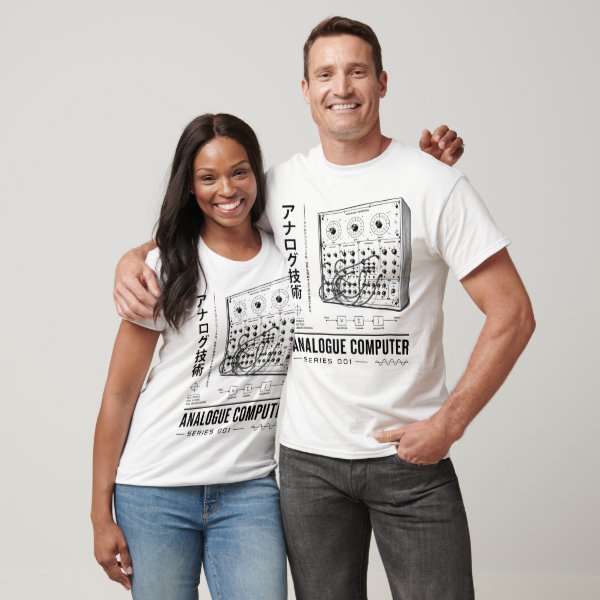
Analogue Computer Series 001 T-Shirt
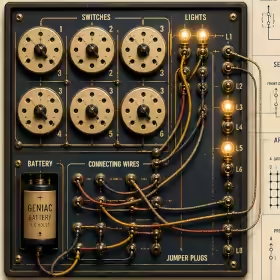
This month's newsletter explores the surprising resurgence of pocket computing through the M5Stack Cardputer ADV, Meshtastic communications and hands-on programming. Yet the ideas behind these devices are far older than modern microcontrollers. The Analogue Computer Series 001 retrocomputing themed t-shirt celebrates a time when computation was visible, tangible and understandable—an era of switches, logic circuits, decision trees and experimental learning machines. Whether you are fascinated by Cardputers, early personal computers, GENIACs or the history of computing itself, this design pays tribute to the enduring idea that understanding technology begins by exploring how it works.
Disclosure: this is a commercial product link to an external Zazzle store associated with philreichert.org. Purchases are handled by Zazzle.
Writer's Notes
Many readers will remember the era of pocket computers, organisers and programmable handheld devices. Machines such as the Psion Organiser, Psion Series 3, HP calculators and countless BASIC-based pocket computers encouraged experimentation. They were small enough to carry everywhere, yet open enough to understand and program.
The Cardputer rekindles some of that spirit. It is not the most powerful computer I own. In fact, it is probably one of the least powerful. Yet it is one of the most interesting because it invites exploration rather than abstraction.
Throughout this newsletter I found myself repeatedly drawing comparisons between modern maker culture and earlier hobby computing movements. Meshtastic reminded me of amateur radio. Cardputer programming reminded me of the home computer revolution. Even the enthusiasm of today's community echoes the excitement found in old computing magazines where readers shared programs, ideas and experiments.
I suspect that is why the Cardputer has resonated with me. It feels less like a consumer appliance and more like a personal computer in the original sense of the term: a machine that belongs to its owner and rewards curiosity.
Whether the Cardputer becomes a long-term platform or simply an interesting diversion remains to be seen. Either way, it has already achieved something increasingly rare in modern technology—it has made computing fun again.
Reader Guide
The following material expands on the terminology, historical context, technical concepts, and related reading connected to this article.
Glossary
- Cardputer ADV
- A compact programmable computer from M5Stack that combines an ESP32-based controller, keyboard, colour screen, battery, speaker and expansion options in a pocket-sized device. In this newsletter, the Cardputer ADV is treated less as a novelty gadget and more as a modern continuation of the pocket computer tradition.
- Meshtastic
- An open-source communications system that uses LoRa radios to send text messages and small data packets without relying on mobile phone towers or the internet. Its importance in the newsletter is that it turns devices such as the Cardputer ADV into standalone off-grid communication terminals.
- Pocket computer
- A small portable computer designed to be carried and programmed directly by its owner. Classic examples include programmable calculators, Psion organisers and BASIC-style handheld computers. The newsletter uses this idea to place the Cardputer ADV within a longer history of personal, understandable and programmable machines.
- ESP32
- A family of low-cost microcontrollers commonly used in maker, IoT and embedded systems projects. The Cardputer ADV uses ESP32 technology to provide wireless connectivity, hardware control and programmable behaviour, making it suitable for small tools such as loggers, terminals, dashboards and experimental devices.
- Embedded system
- A computer built into a device to perform a specific task rather than acting as a general-purpose desktop or laptop. The newsletter argues that the Cardputer ADV is most useful when treated as a dedicated embedded tool, such as a field logger, Meshtastic terminal, sensor monitor or pocket notebook.
Frequently asked questions
What makes the M5Stack Cardputer ADV interesting in 2026?
The M5Stack Cardputer ADV is interesting because it combines a keyboard, colour display, battery, speaker, Wi-Fi, Bluetooth, SD card support and expansion options in a small programmable device. This makes it feel closer to a true pocket computer than a typical development board.
Why is Meshtastic a good match for the Cardputer ADV?
Meshtastic is a strong match for the Cardputer ADV because many LoRa mesh devices rely on a phone for typing and display. The Cardputer ADV already has a screen and keyboard, allowing it to work more like a standalone messaging terminal for off-grid text communication.
What can the Cardputer ADV be programmed with?
The Cardputer ADV can be programmed through several paths, including UIFlow, MicroPython, the Arduino framework and ESP-IDF. Beginners may prefer UIFlow or MicroPython, while more advanced users may choose Arduino or ESP-IDF for deeper hardware control.
What are practical non-hacking projects for the Cardputer ADV?
Practical non-hacking projects include a field inspection logger, personal digital notebook, Meshtastic communications terminal, home automation controller, sensor logger, attendance register or retro BASIC-style pocket computer. The strongest projects treat the Cardputer as a dedicated tool rather than a miniature smartphone.
Related articles…

References
- Cardputer Mesh Kit - This is the official manufacturer's page for the Mesh Kit
- Review: M5Stack Cardputer Adv Version (ESP32-S3) - An introductory review of the Cardputer
- Launcher Firmware Catalog
- M5STACK Project Hub - The official enthusiast project hub page
- M5Stack Unveils the CardputerZero - Raspberry Pi's cheapest computer-on-module finds a home in the first Cardputer not to be powered by an Espressif ESP32 microcontroller
- A brief experience with the Cardputer uLisp Machine - Paolo Amoroso's experience using the previous model Cardputer, not the Cardputer ADv.
- UI Flow - online development environment
- uLisp - Lisp for microcontrollers
- Why Mesh Networks Hit a Density Wall (And the Physics That Breaks Through) - Edge Orbital, Edge Orbital is building infrastructure for the human mesh — the people you already trust to notice.
Disclosure
This newsletter was researched and written using publicly available information from manufacturer websites, project documentation, community resources, news articles and other open sources available at the time of publication. While reasonable efforts have been made to ensure accuracy, specifications, features, software availability and community projects may change over time. References to products, services or projects are provided for informational and educational purposes and do not constitute endorsement by the author or publisher.