When Your Content Improves, But the Income Stream Doesn’t

Introduction
There is a quiet frustration that sits beneath many independent publishing efforts. The work improves. The writing becomes sharper. The structure tightens. The ideas carry more weight. Yet the outcome does not move. Traffic feels static. Engagement is shallow. Income, if present at all, remains flat.
This tension is easy to misdiagnose. It appears to be a problem of quality. It suggests that more refinement is required. But in many cases, the opposite is true. The quality is already sufficient. The missing piece is direction.
In You’re Busy Publishing Content, But Nothing Is Moving, the focus was on this exact problem. Work accumulates, systems expand, and content stacks deepen, yet the publication itself does not gain momentum. The effort is real, but the movement is not.
This article addresses the next layer of that problem. If the system exists, and the content is strong, what actually causes movement? The answer is not more output. It is not even better output. It is the presence of a defined path.
The Gap Between Quality Content and Conversion
At a certain point in independent publishing, something changes. Your content improves. You write with more clarity. Your ideas become more structured. Your voice becomes more consistent. You are faster, more confident, and more aligned with your intent. You have found the writer's competitive advantage described in the Three Tiers of Writing in the Age of AI. On the surface, everything is working. Yet the outcome does not move in the same direction.
You build within a niche. You develop ideas. You produce content that informs, entertains, or motivates. Through approaches like the Topic Content Stack, you create depth. Supporting articles, anchor pieces, editorial layers, and related assets begin to form a system. Over time, that system becomes richer and more capable.
But then a pattern becomes clear. People arrive. They read. They leave. The interaction is brief. The content does what it is supposed to do. It answers the question. It satisfies the reader. From their perspective, the experience is complete.
From your perspective, it is not. You expect more. More engagement. More return visits. More interaction with the rest of your work. Some signal that effort is compounding. Instead, each article behaves like an isolated event.
This is the gap. There is a gap between the quality of your content and your ability to guide a reader to a next step. The system produces value, but it has no defined way to carry that value forward. This is not a failure of content. It is a missing layer in the publishing system.
It is also a normal stage of development. Craft has matured. System design has not yet caught up. Recognising this gap is not a setback. It is the point where publishing shifts from producing content to designing movement.
This is the difference between content that exists and content that performs.
Conversion Is the Missing Layer
Independent publishing often begins with a simple goal. Create content that is engaging and valuable. Over time, that goal is achieved. Readers arrive. They engage. They leave satisfied.
But a satisfied reader is not the end state of a functioning system. It is a completed interaction. There is no reason to continue. No reason to explore further. No reason to return. The experience ends at the point it succeeds.
This is where many publishers stall. The content works, but it works in isolation.
The shift comes when the goal changes. Not just to satisfy the reader, but to guide them to a next step. You are solving problems and providing value. But you also have more to offer, and that needs to be visible within the experience.
Good content earns attention.
A Conversion Path gives that attention somewhere to go.
When a reader finds value in one piece, there should be a natural continuation. Another article. A deeper layer. A related idea. In some cases, a product, a recommendation, or a way to stay connected.
Done well, this feels like a continuation. The experience is not interrupted. It is extended. The reader is guided to a next step that builds on the value they have already received.
This is not about pushing readers. It is about guiding them. Content is no longer a collection of individual outputs. It becomes part of a system designed to move a reader from one step to the next.
This is the missing layer. It leads directly to a structured concept: The Conversion Path.
The Conversion Path (TCP)
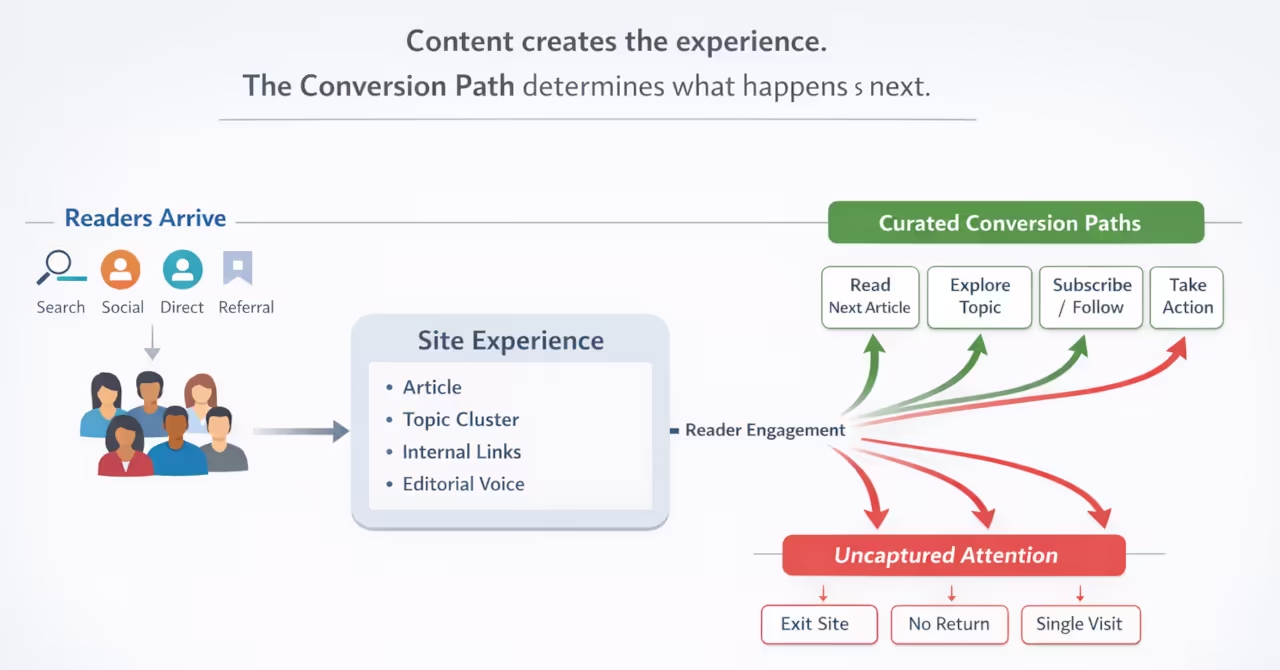
The Conversion Path, or TCP, is the designed direction a reader follows from attention to a defined next step. It is not a marketing tactic. It is a structural decision about what happens after attention is earned.
When a reader arrives on an article, something has already worked. A title, a topic, or a search result has earned attention. That is the first step. But attention is unstable. Without direction, it fades.
The Conversion Path answers a simple question.
What should happen next?
With a Conversion Path, an article becomes part of a sequence. It connects to another idea, another asset, or another layer of the site. The reader is guided from one step to the next.
This is where content begins to compound.
Designing the Next Step
You cannot design a path without defining the next step. Before applying The Conversion Path, you need to be clear about what you want a reader to do next.
Conversion is often misunderstood. It is not limited to transactions. It is a set of possible next steps, each designed to extend engagement.
Conversion is not a single action.
It is a set of possible next steps.
When a reader finishes a piece of content, only a small number of meaningful directions exist. The role of the publisher is to define those directions and guide the reader toward them.
The most immediate next step is to continue reading. A reader who has just engaged with one idea is often open to a deeper or related idea. This might be another article within the same topic, a supporting piece within your Topic Content Stack, or a more detailed exploration of the same theme.
Another next step is to return later. Not every reader continues immediately, but they may choose to stay connected. Newsletters, RSS feeds, and habitual reading patterns extend the relationship over time.
A further step is to engage with your broader body of work. A reader begins to recognise your voice and structure. They move from consuming a single article to engaging with a publication.
There is also the opportunity for practical action. This may be an affiliate link, a recommended product, or a downloadable resource. When aligned with the content, this extends the value rather than interrupting it.
Each of these actions represents a different outcome. What matters is that they are intentionally curated. Without that curation, the reader reaches the end of your content and the system resets.
Suggested Curated Steps
In practice, most independent publishers work with a small set of repeatable next steps. These represent the common directions a reader can be guided toward once attention has been earned.
- Read a related article – Continue within the same topic through a supporting or adjacent piece.
- Explore a topic cluster – Move from a single article into a broader body of work.
- Follow a series – Progress through a structured sequence of articles.
- Subscribe for updates – Stay connected and return over time.
- Engage with the publication – Build familiarity with the work as a whole.
- Access a deeper resource – Download a guide or supporting material.
- Act on a recommendation – Follow a relevant product or resource.
- Return to continue later – Revisit the site intentionally.
Consider a simple example. A reader lands on an article about fixing weak AI outputs. At the conclusion, they are guided to a related piece on auditing superintelligence. From there, they are directed to a newsletter issue that synthesises both ideas. One entry point becomes a sequence. The reader takes multiple steps without friction. This is a working Conversion Path.
Connecting the Conversion Path to the Topic Content Stack
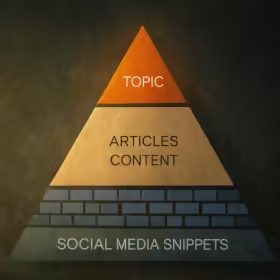
The Conversion Path (TCP) connects directly to the Topic Content Stack approach. The stack builds depth within a topic through multiple related articles. TCP gives that structure direction by defining how readers move between those articles.
Instead of a loose collection of content, the stack becomes a pathway. A reader can enter at any point and still be guided through the topic. Each article has a role. Each link has intent.
This changes how an article is planned. The writer is no longer asking only what the article should say, but where it should lead. An anchor article may direct readers to supporting pieces. A supporting article may direct them back to the anchor. An editorial piece may direct them to a newsletter, a checklist, or a related cluster. The stack provides structure. TCP provides movement.
This is where independent publishing begins to feel coherent. The site behaves as a system rather than a collection of pages.
Designing for Movement, Not Just Output
The key shift is to design for movement. Output still matters, but it is no longer the only metric. When you publish an article, you are placing an entry point into your system.
The question is what happens after that entry point is used. If nothing happens, the system is incomplete. If something happens consistently, even in small ways, the system begins to work.
This is how independent publishing moves from effort to outcome. Not through more content, and not through better content alone, but through connected content.
Movement should be designed during the planning stage. Where should internal links appear. Which section supports a recommendation. What resource or article should follow. These are editorial decisions, not afterthoughts.
Conversion Path Metrics
Once you have defined your curated Conversion Paths, the next step is to measure how they perform. A Conversion Path is not just a design decision. It is something that can be observed and improved over time.
Independent publishing does not require complex analytics systems, but it does require awareness. You are looking for simple signals that indicate whether readers are taking the next step you have designed.
- Click-through to related content – Movement between articles.
- Pages per session – Depth of engagement per visit.
- Return visitor rate – Ongoing relationship over time.
- Newsletter or feed subscriptions – Commitment to stay connected.
- Time on site – Sustained engagement.
- Scroll depth or completion rate – Content consumption behaviour.
- Outbound clicks – Interaction with recommendations or resources.
- Download or resource access – Engagement with deeper material.
A common mistake is to focus on a single conversion measure. Independent publishing operates across multiple paths, and each path reflects a different type of value.
Track a small set of measures that match your intended paths. Performance will shift over time. Small changes in structure or placement can lead to different outcomes. The goal is to understand how the system behaves as a whole.
A practical starting point is simple. Choose three measures that match the intended next step of the article. If the goal is deeper reading, track internal clicks, pages per session, and return visits. If the goal is support, track outbound clicks, downloads, and subscriptions. Design the path, then observe whether it is followed.
Conclusion
The frustration of improving without seeing results is real. It is also solvable. The solution is not another round of refinement, and it is not simply producing more. The real shift comes when you introduce direction. A Conversion Path turns attention into movement. It gives your work a role beyond being read once and forgotten.
Good content earns attention. A Conversion Path gives that attention somewhere to go. Once that bridge exists, improvement stops being invisible. It becomes part of a system that can guide readers, build return behaviour, and create outcomes that compound over time.
Once you see this, you cannot unsee it. Every article becomes more than an isolated piece of publishing. It becomes an entry point, a decision, and an opportunity to guide the next step.
The final step is to recognise that the most valuable asset in this system is not the individual article, but the body of work you have already built. In You’re Ignoring Your Most Valuable Publishing Asset, the focus shifts to activation—how existing content, when properly connected and surfaced, becomes the real driver of long-term value.
Author's Notes
This is one of those ideas that feels obvious once you see it, but took a long time to properly articulate. I’ve been building content systems for years now, and I could see the pattern. Articles were improving. Structure was improving. Output was consistent. But the outcomes were not moving in the same way. That disconnect sat there for a while before I could properly define what was missing.
What I’ve called The Conversion Path is my attempt to give that missing piece a name and a structure. It is deliberately simple. There’s no complexity in the concept itself. The power comes from applying it consistently. Once you start asking “what happens next?” at the point of publishing, everything changes. Articles stop being endpoints and start becoming entry points.
I suspect many readers will feel like they are already doing this, at least in part. And that’s probably true. Most of us naturally link to related content or suggest something else to read. But without a clear framework, the results are inconsistent. Sometimes it works. Sometimes it doesn’t. By defining the Conversion Path explicitly, you move from accidental outcomes to intentional design.
What I like most about this idea is that it doesn’t require more content, or even better content. It requires clearer thinking. You are taking the value you are already creating and giving it direction. That is a much more efficient way to improve a system, especially in independent publishing where time and energy are always constrained.
If this article lands the way I think it will, then it becomes something I’ll build on. There’s more depth here than one piece can cover. But this is the starting point. A simple question, applied consistently: what should happen next?