Three Tiers of Writing in the Age of AI
Introduction: Why the Internet Feels Different Now
Something has shifted in the texture of online writing. The web is full of competent prose. It is often clear. It is often well structured. It is often pleasant to read. Yet a lot of it now feels interchangeable. You can move from one article to the next and feel like you have not really met an author. You have met a style.
This article is not a complaint about AI. It is a field note from inside a transition. I write and publish as an independent digital publisher. I read widely. I have noticed that the centre of gravity has moved. The problem is not that machines can write. The problem is that too much writing now carries a weak authorial signal. It becomes hard to tell who is doing the thinking, or what prompted it.
In the previous article, 7 Ways Microsites Can Boost Efficiency, Scalability, and Creativity, the focus was on building the system that supports publishing. Once that system exists, the question naturally shifts. How does writing actually move through it? What kinds of content should exist within it, and how should they differ?
This article explores that question through a simple model. Not all writing serves the same purpose. Not all writing should be produced in the same way. Understanding the differences is what allows a publishing system to function with both clarity and intent.
The Rapid Evolution of Modern Writing
Writing is still an author communicating to an audience. It still relies on the same enduring forces. A message, a voice, a reader, and a reason to keep going. People still want enjoyment. They still want discovery. They still want to feel that there is a person on the other side who means something by the words.
What has changed is the rate of change in publishing tools. Publishing friction has been falling for a long time. Printing scaled distribution. Desktop publishing raised expectations of finish. The web removed many gatekeepers and made publication instant. Large language models arrived and altered the production of text at scale. That change landed in months, not decades.
For me, this has been a boon. I can publish faster. I can articulate ideas more clearly. I can polish language without draining energy from the thinking itself. I can also reach readers who expect a higher baseline of clarity than the old web demanded. That is a real shift. It changes what the audience tolerates and what they reward.
This perspective is shaped by practice rather than theory. It comes from maintaining multiple independent websites, publishing regularly, and watching how real readers respond to clarity, tone, and intent over time.
Writing Development Levels
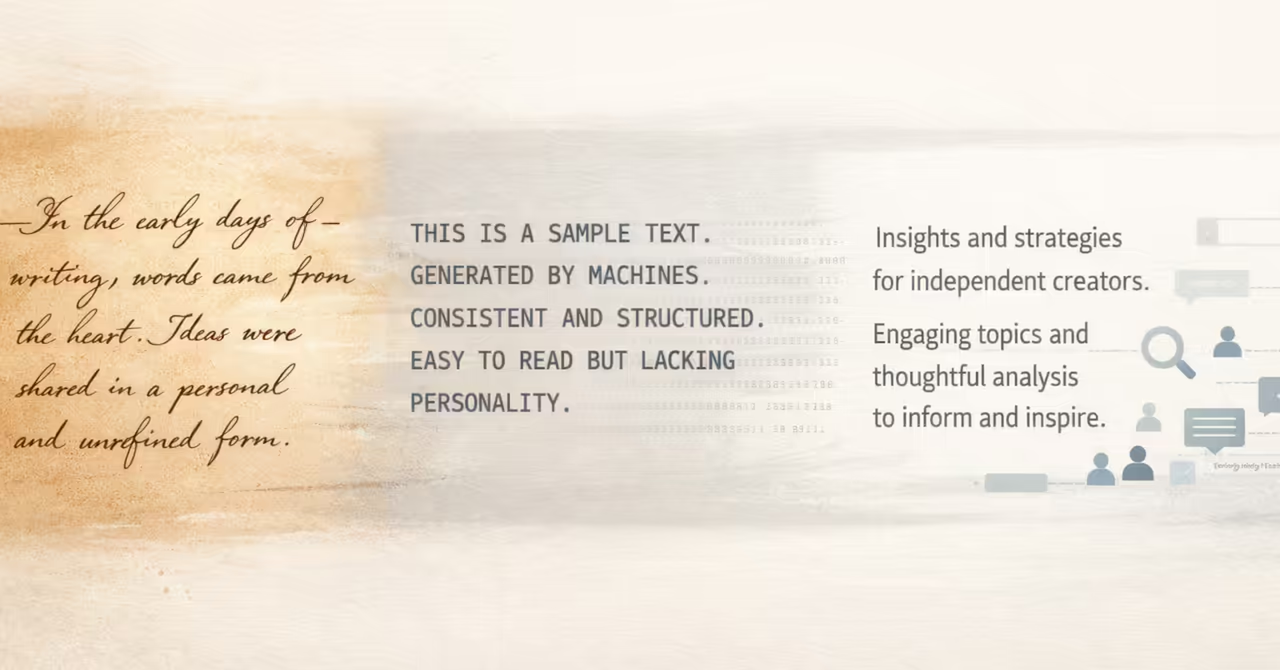
The model in this article is a practical lens. It is not a moral ranking. It is a way of describing three modes of modern writing that now coexist online. Each tier has strengths. Each tier has failure modes. The tiers are useful because they help you notice what readers are reacting to.
Tier 1: Pre-AI Authenticity
Tier 1 is human-first writing. It is often personal and idiosyncratic. It can feel alive because the writer is not hiding. It signals a real person, with real preferences, and real limitations. It can also be hard work for the reader when structure is weak.
Common strengths of Tier 1 writing include:
- A distinct voice that feels owned and recognisable.
- Personal stakes and lived context.
- Surprising turns of phrase and genuine opinion.
Common failure modes include:
- Loose structure that makes the reader do the organising.
- Wandering introductions and unclear payoffs.
- Ambiguity that is accidental rather than intentional.
- Indulgent length without a clear purpose.
Tier 1 used to win on raw authenticity. It still can. The change is that many readers now expect clarity and shape as a baseline. A sincere voice is not always enough if the reading experience is costly.
Tier 2: AI-Native Prose
Tier 2 is what happens when AI becomes the primary driver of the text. The writing is usually smooth. The grammar is clean. The structure is competent. The tone is safe. The problem is that it often converges on the same patterns. It reads like it was designed to offend nobody and surprise nobody.
Recognisable features of Tier 2 writing often include:
- Technically correct sentences with few imperfections.
- Balanced framing that avoids strong commitment.
- Predictable pacing and familiar paragraph shapes.
- Generalised examples that could fit almost any context.
Why did Tier 2 become so common? My observation is that the incentives are obvious. Professionals are under time pressure. Many organisations reward safe consistency. AI makes it easy to produce acceptable text quickly. That creates a flood of writing that meets surface standards. It does not always carry the signal of a thinking person.
Reader fatigue is an understandable response. The prose is not wrong. It is often useful. It can also feel like background noise when too much of the web shares the same voice. The issue is not quality. The issue is sameness.
Tier 3: AI-Mediated Authorship
Tier 3 is where I think the most durable opportunity sits for independent publishers. It is not anti-AI. It is pro-authorship. The writer does the thinking. The writer sets the intent. AI is used as a tool for clarity, structure, and polish. The key difference is that AI is not deciding what the piece means.
Recognisable features of Tier 3 writing include:
- A clear authorial point of view that is actually held.
- Clean structure that respects the reader’s attention.
- Intentional choices about what to include and exclude.
- Specificity drawn from lived experience or close observation.
- Language that is refined, but still sounds owned.
Tier 3 still allows imperfection, but it is a chosen imperfection. It can be rough at the idea level because it is honest about uncertainty. It can show thinking in motion. It avoids careless mess. It also avoids sterile neutrality. The reader feels a person who is present, not a system filling a template.
A useful way to summarise the difference is simple:
- Tier 1 often has a strong person but weak scaffolding.
- Tier 2 often has strong scaffolding but a faint person.
- Tier 3 aims for both, with the person in charge.
The Writer’s Competitive Advantage
If you are an independent publisher, you may have advantages that large systems do not. You can move at your own pace. You can build trust with a small audience. You can write in a way that does not need to win a feed. You can afford to be specific and thoughtful because you are not optimising for scale at all costs.
There is also a deeper point. Writing is not only output. Writing is a method of thinking. When AI is used to replace thinking, the work may look polished but feel hollow. When AI is used to support thinking, the work can become clearer without losing authorship.
This is where the independent publisher can be structurally stronger. You can treat AI as a craft tool. You can use it to tighten the work. You can still keep the message anchored in lived perspective. You can write for intellectual companionship, not just reach.
Further Development
What follows is speculation. It is not a prediction in the academic sense. It is a guess informed by what I see and feel as a writer and reader right now.
I suspect audiences will keep raising their expectations. Clarity will be cheap. Basic competence will be assumed. The differentiator will be authorship. Readers will reward work that shows intention, specificity, and a real mind at work. They will also reward writing that respects their time.
There is also a more optimistic angle. AI can reduce the cost of making a clean first draft. That can free writers to take more conceptual risks. It can encourage more people to publish. It can help independent voices find their shape faster.
One future-focused thought to end with. Imagine a web where most text is generated instantly, on demand, and tailored to the reader. In that world, the rare and valuable thing may not be information. It may be the felt presence of a particular author. A voice you return to, not because it is efficient, but because it is yours to recognise.
Conclusion
Writing has not lost its core purpose, but the environment around it has changed. Clarity is easier to achieve. Structure is easier to produce. What is harder to maintain is a sense of authorship that feels intentional and owned. The three tiers described here are not a hierarchy of value, but a way of recognising how different forms of writing behave within that environment.
For an independent publisher, this matters because writing is not just expression. It is part of a system. Some pieces explore ideas quickly. Others develop them fully. The strength of the whole comes from understanding the role each piece plays, and choosing the level of effort accordingly.
Once you begin to see writing in this way, another problem becomes more visible. You can be producing content across different tiers, staying active, and still feel like nothing is actually progressing. In You’re Busy Publishing Content, But Nothing Is Moving, the focus shifts again—from how writing is structured to why output alone does not always translate into momentum.
Author's Notes
This article came from a growing irritation rather than a neat idea. I kept encountering writing that was structurally correct but difficult to distinguish from everything else around it. It wasn’t bad writing. It was competent, consistent, and forgettable. I needed a way to describe that pattern without turning it into a complaint about tools or trends. The three tiers emerged as a way to name what I was seeing rather than argue against it.
I also wrote this to clarify my own position as a publisher. It is easy to drift into habits without noticing, especially when the tools make production easier. The tier model gave me a way to check my own work. Not every piece needs the same level of effort, but every piece should have a clear source of intent. This article is less about judging writing and more about maintaining control over how and why it is produced.
There is also a practical motive behind this piece. I am building a publishing system that relies on different types of output working together. For that system to hold, I need a way to separate exploratory writing from developed work without devaluing either. The tiers provide that separation. They allow me to move faster when needed, slow down when it matters, and keep the overall body of work coherent.