Adapting to the Age of AI: Making Human Judgement Visible Again
◆ Revised

Introduction
The greatest thing AI may take from professionals is not their job. It may be the evidence that they are good at it.
For the past several years, discussions about artificial intelligence have been dominated by a familiar question: will AI replace jobs?
While that concern remains, a more subtle challenge is beginning to emerge. AI can now generate reports, summaries, procedures, presentations, recommendations, and analyses that often appear competent at first glance. Many of the outputs that once demonstrated expertise can now be produced in seconds.
This creates an uncomfortable question for experienced professionals. If the output no longer proves expertise, what does?
The challenge of adapting to the age of AI may not be learning how to use new tools. It may be learning how to demonstrate value when the work products that once signalled competence become increasingly easy to generate.
The Anxiety Nobody Talks About
Most conversations about AI focus on productivity gains. Work is completed faster. Information is easier to access. Drafts appear almost instantly.
Yet beneath these benefits sits a quieter form of anxiety.
Many professionals have spent years building expertise that revealed itself through tangible outputs. The report, the presentation, the analysis, the procedure, or the recommendation became visible evidence of accumulated knowledge and judgement.
As AI becomes capable of producing similar outputs, it is natural to wonder whether the signals of expertise are changing.
This is not necessarily a fear of unemployment. It is often a concern that experience becomes harder to recognise. A professional may possess deep industry knowledge, understand historical context, anticipate risks, and consistently make sound decisions, yet the documents they produce may no longer distinguish them from someone using a sophisticated AI assistant.
The discomfort comes from a simple reality. Expertise still matters, but the traditional ways of displaying expertise may be losing some of their power.
For decades, producing information was itself a valuable skill. Today, information is becoming abundant. The question is what happens next.
The concern is not that expertise disappears. The concern is that expertise becomes harder for others to recognise.
When Competence Becomes Common
One of AI's most significant effects is that it raises the baseline quality of routine work.
A blank page no longer remains blank for long. Drafts, summaries, checklists, comparisons, and recommendations can be generated quickly and presented with remarkable confidence.
This is useful. It is also deceptive.
A polished answer and a trustworthy answer are not necessarily the same thing.
As AI-generated outputs become increasingly sophisticated, the challenge shifts. The problem is no longer generating information. The problem is evaluating it.
In a previous discussion on auditing machine-generated knowledge, a central observation emerged: output quality and output reliability are different questions. An answer may appear complete, structured, and convincing while still containing weak assumptions, missing context, or subtle errors.
Confidence and correctness are not the same thing.
The ability to recognise that distinction becomes increasingly valuable as AI improves.
"When competent outputs become abundant, judgement becomes the scarce resource."
This may be one of the defining shifts of the AI era. The production of information becomes easier. The verification of information becomes more important.
Where Experience Still Matters
Many organisations already understand this principle, even if they do not describe it in AI terms.
A procedure can appear complete until implementation reveals a missing assumption. The formatting may be flawless. The language may be clear. Yet a single overlooked condition can create confusion when real work begins.
Similarly, the most valuable reviews are often not the ones that find spelling mistakes or formatting issues. They are the reviews that challenge an assumption that everyone else accepted without question.
In engineering, quality management, governance, and project delivery, problems rarely emerge because information was unavailable. Problems emerge because information was misunderstood, misapplied, or accepted without sufficient scrutiny.
This is why independent review remains common in high-consequence environments. A second set of eyes is not there simply to read the document. It is there to challenge the thinking behind it.
Verification processes exist because organisations have long recognised a simple truth: confidence and correctness are not the same thing.
AI does not remove that reality. In many cases, it makes it more important.
Where Value Moves Next
As information becomes easier to produce, professional value begins to move elsewhere.
The valuable contribution is increasingly found before the answer rather than within it.
It lies in framing the problem correctly. Identifying risks that others have missed. Understanding context. Asking questions that expose weak assumptions. Evaluating competing recommendations. Making decisions when certainty is impossible.
These are not new skills. They are simply becoming more visible as routine information work becomes easier to automate.
The professional who understands why a recommendation matters may create more value than the person who merely presents it.
The individual who can distinguish between a convincing answer and a trustworthy one may become more valuable than the individual who can generate the largest volume of content.
"Producing information is becoming cheaper. Determining whether it can be trusted remains expensive."
This shift does not reduce the importance of expertise. It changes where expertise reveals itself.
Conclusion
Artificial intelligence is changing how information is produced, organised, and distributed. That much seems increasingly certain.
What remains less appreciated is that AI may be changing the visibility of expertise more than the importance of expertise itself.
Experienced professionals are unlikely to be valued simply because they can produce information. They will increasingly be valued because they can evaluate it, challenge it, contextualise it, and decide what should be done with it.
The future may belong less to those who generate answers and more to those who know which answers deserve to be trusted.
That raises an even broader question. If expertise is becoming less visible in the output itself, how will professionals demonstrate competence, build trust, and continue learning in an AI-assisted world? That question is explored further in READ0316 and may prove to be one of the more interesting challenges of the decade ahead.
Featured Product
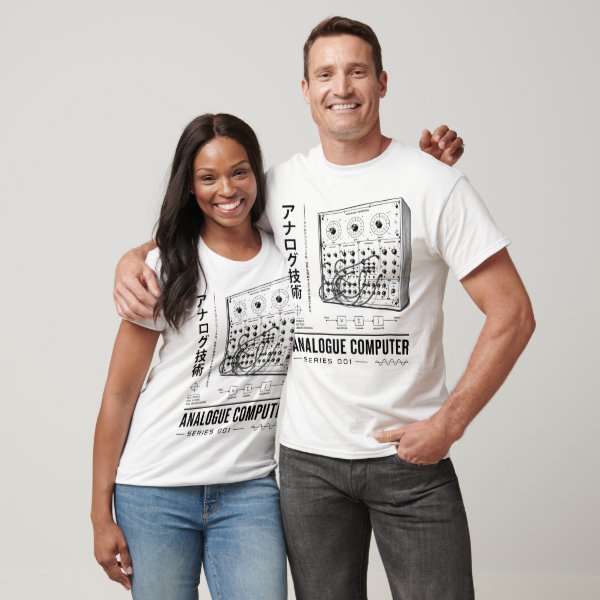
Analogue Computer Series 001 T-Shirt
This article explores how professional expertise remains valuable even as artificial intelligence makes information easier to generate. Long before AI assistants and digital workspaces, engineers and experimenters built analogue computers whose workings could be observed directly through switches, wires, dials and illuminated indicators. The Analogue Computer Series 001 T-shirt celebrates that tradition of visible thinking—a reminder that while technology changes, the human challenge of understanding, verifying and trusting information remains remarkably familiar.
Disclosure: this is a commercial product link to an external Zazzle store associated with philreichert.org. Purchases are handled by Zazzle.
Writer's Notes
When I first wrote this article in 2023, much of the conversation around AI centred on automation, productivity and whether machines would replace human jobs. Revisiting it several years later, I realised the debate had matured. Today, I am less interested in whether AI can generate reports, summaries or recommendations, and more interested in what happens when it can do so competently. The question that captured my attention was not whether expertise still matters, but how expertise is recognised when the finished work no longer reveals who did the thinking. That observation became the foundation for this revised edition and connects naturally with my later writing on verification, trust and the challenge of evaluating machine-generated knowledge.
Reader Guide
The following material expands on the terminology, historical context, technical concepts, and related reading connected to this article.
Glossary
- Artificial Intelligence (AI)
- Computer systems capable of generating text, analysing information, recognising patterns, and performing tasks that traditionally required human intelligence.
- Professional Judgement
- The ability to evaluate information, consider context, identify risks, and make informed decisions based on experience and expertise.
- Expertise
- Deep knowledge and practical understanding developed through education, training, and real-world experience within a particular field.
- Verification
- The process of checking whether information, conclusions, or recommendations are accurate, reliable, and fit for their intended purpose.
- Context
- The surrounding circumstances, constraints, history, objectives, and relationships that influence how information should be interpreted and applied.
- Independent Review
- An assessment performed by a separate person or team to challenge assumptions, identify risks, and confirm the quality of work before implementation or approval.
- AI-Generated Content
- Text, reports, summaries, analyses, images, or other outputs created wholly or partially by artificial intelligence systems.
- Knowledge Work
- Professional activities centred on analysing information, solving problems, making decisions, and applying expertise rather than performing physical tasks.
Frequently asked questions
How is AI changing the way professionals demonstrate expertise?
AI is making many routine outputs easier to produce, including reports, summaries, procedures and recommendations. This means expertise may become less visible in the finished document and more visible in how professionals frame problems, identify risks, challenge assumptions and decide what information can be trusted.
Why does professional judgement matter more in the age of AI?
Professional judgement matters because a polished AI-generated answer is not always a trustworthy answer. Experienced people are still needed to evaluate context, check assumptions, verify information and decide whether an output is suitable for real-world use.
What is the main challenge of adapting to AI at work?
The main challenge is not simply learning how to use AI tools. It is learning how to make human expertise visible, trusted and useful when competent-looking information can be generated quickly and cheaply.
Connected Threads
- The Audit of a Superintelligence - explores a growing challenge of the AI era: the difference between generating convincing answers and verifying whether those answers can be trusted.
- The ChatGPT Projects Secret Most Users Miss - examines how AI tools are evolving from simple chat interfaces into persistent workspaces, raising new questions about knowledge management, expertise, and professional workflows.
Related articles…


Disclosure
This article discusses artificial intelligence, professional expertise, and workplace adaptation from the perspective of a quality and systems practitioner. It is intended as commentary and analysis rather than professional, legal, or technical advice. Any references to AI technologies are illustrative only and do not constitute endorsement of a particular product, platform, or vendor.