You’re Busy Publishing Content, But Nothing Is Moving

Introduction
Independent digital publishers often mistake visible activity for real movement. A week filled with drafting, formatting, posting, image preparation, social snippets, and metadata edits can feel productive because there is evidence everywhere. New pages exist. New files exist. New effort has clearly been spent. Yet at the end of the cycle, the publication itself may not be any stronger. The topic has not deepened. The archive has not become more useful. The reader has not been given a stronger pathway through the subject. The work moved, but the system did not.
This is the friction behind a great deal of modern publishing fatigue. A publisher can remain busy for months while feeling that nothing is moving. The problem is not laziness, nor lack of ideas, nor even poor output. The problem is often structural. Much of the work is being performed at the level of the individual artefact, when the real gains come from building a topic as a coordinated publishing system. In other words, the publication needs more than production. It needs direction, sequencing, and editorial leverage.
In the previous article, Three Tiers of Writing in the Age of AI, the focus was on how different types of writing behave within a modern publishing system. Not all content plays the same role. Some pieces explore, some clarify, and some establish authority. This article moves one step further. If writing exists in different tiers, how should those pieces be organised so they actually build momentum rather than sit as isolated output?
That is where the Topic Content Stack (TCS): a layered publishing system becomes useful. It starts with a simple shift in thinking. A topic is not one article. A topic is not even a cluster of articles. A topic is a publishing push with layers that perform different roles. Some layers create texture and coverage. Some establish authority. Some bring editorial control and synthesis. Some harvest lighter derivative assets that can travel through the modern sliced-content environment. The publisher is no longer merely making pieces. The publisher is building pressure on a subject.
Why Busy Work Fails to Compound
The independent publisher is especially vulnerable to the illusion of motion because so much of the labour is visible. A paragraph written is visible. An image cropped is visible. A page published is visible. Even small technical jobs feel satisfying because they produce an immediate before-and-after result. That is not meaningless work, but it can disguise a deeper weakness. A publication can continue to generate isolated artefacts without increasing its coherence, relevance, or retrieval power.
The issue is that isolated output rarely compounds on its own. One article may be good. Five articles may also be good. But if they are not deliberately tied together through topic development, the publication behaves more like a storage shelf than a living system. Readers encounter single pieces rather than a strong editorial field. Search engines encounter fragments rather than a reinforced pattern. The publisher experiences effort, but not leverage.
This is why the work that matters most can sometimes feel like nothing is happening. Topic planning, internal linking strategy, archive review, title positioning, newsletter synthesis, quote harvesting, and structural sequencing often do not produce the same emotional reward as publishing a fresh page. They are quieter forms of labour. Yet these are often the tasks that convert output into momentum. They make the next article easier to write, the previous article easier to rediscover, and the whole body of work easier for readers to trust.
From Single Artefacts to Topic Systems
The most common publishing habit is what might be called the single artefact loop. A good idea appears, an article is written, it is published, and then attention moves elsewhere. There is nothing wrong with this at a basic level. Many worthwhile pages have been created this way. But the model does not scale particularly well if the goal is long-term topical development. Each new item must carry its own weight, introduce its own framing, and fight for its own visibility. The archive grows, but the editorial system remains weak.
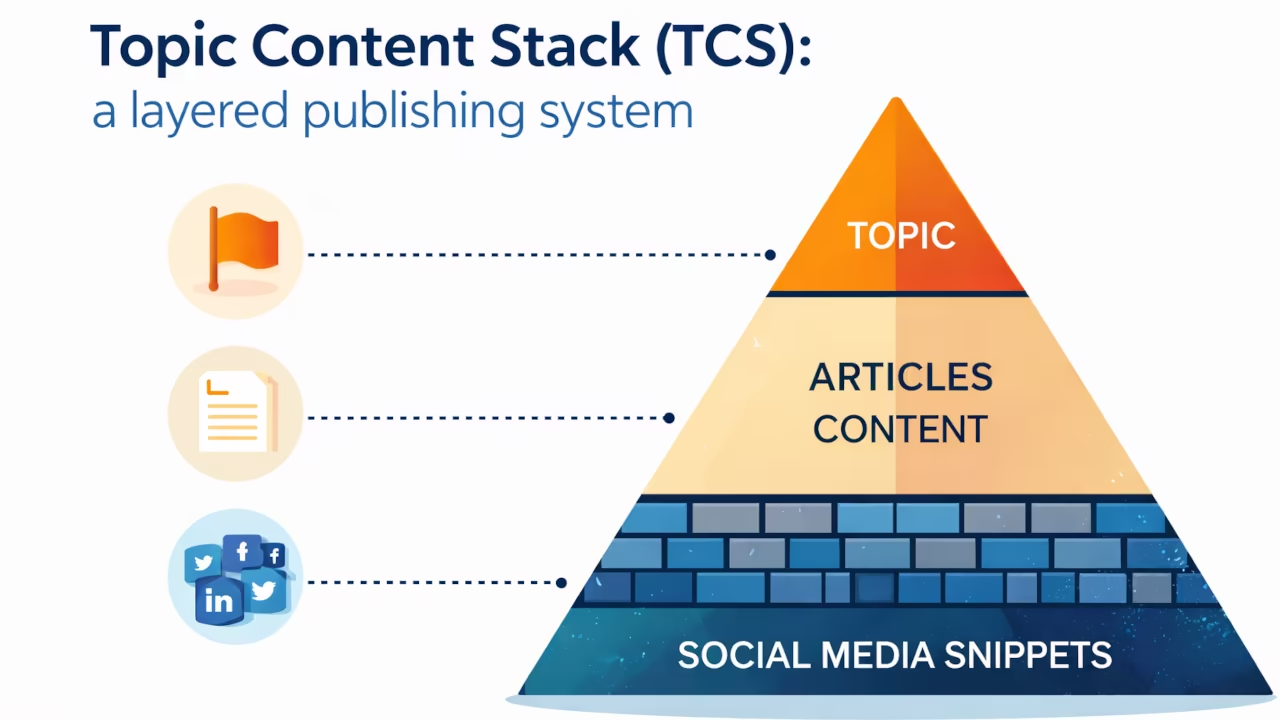
The Topic Content Stack offers a more practical alternative. Instead of asking, “What article should I write next?”, the publisher asks, “What topic should I develop over the next cycle?” That question changes the unit of work. The unit is no longer the page. The unit becomes the topic push. Once that shift happens, the publisher can make decisions that are directional rather than merely productive.
Publishing ten unrelated articles in a month creates production activity. Topic concentration builds authority and compounding value.
A topic push acknowledges that not every piece needs to do the same job. Some pages should widen the field. Some should go deep. Some should connect the pieces and interpret what has been learned. Some should create lighter assets that can be reused, quoted, downloaded, reposted, or repackaged. Instead of treating every publication as a standalone event, the publisher builds a stack in which each layer contributes to the strength of the topic as a whole.
The Layers of the Topic Content Stack
The first layer is texture and coverage. These are the 70% articles. They are not careless articles. They are purposeful supporting pieces written to develop surface area around the topic. They may answer adjacent questions, address friction points, present examples, challenge assumptions, or bridge into related discussions. Their job is not necessarily to become the definitive page. Their job is to create breadth, relevance, and useful entry points. They tell the publication, the reader, and the wider web that this topic is being seriously developed.
The second layer is authority and structure. This is the 95% article. It is the key piece that gives shape to the topic push. Where the texture articles create coverage, the anchor article creates order. It names the core problem, explains the mechanism, gives the strongest insight, and acts as the most deliberate expression of the editorial thesis. If the surrounding 70% pages are outposts, this is the town centre.
The third layer is editorial control and synthesis. This is where the newsletter becomes essential. A newsletter can do what a standard article often cannot. It can interpret the topic push, link disparate pieces together, frame the meaning of the work, and guide the reader through the stack as a coherent editorial encounter. It is not merely a summary vehicle. It is the unifying instrument. It tells the reader what matters and why these pieces belong together.
The fourth layer is extraction and derivatives. Once a topic has been properly developed, lighter assets can be harvested from it. Quotes, glossaries, sidebars, checklists, short games, mini-downloadables, visual snippets, definitions, and excerpt cards all become easier to produce because the intellectual work has already been done upstream. These smaller assets are not replacements for the main publishing work. They are by-products of a stronger system. They allow a topic to travel further in fragmented environments without forcing the publisher to invent meaning from scratch each time.
What This Looks Like in Practice
Imagine an independent publisher chooses a topic for the next month: perhaps digital archiving, game soundtrack history, or practical AI use in small publishing environments. Under the single artefact model, the likely outcome is one polished article and a handful of disconnected notes. Under the Topic Content Stack model, the publisher sets a short-term goal to develop the topic properly.
First come several texture pieces. One may define the core tension. Another may explain a technical obstacle. Another may explore a reader-facing use case. Another may challenge a common lazy assumption in the field. These pieces create surface area. They are easier to produce than a major feature, but they are not random. Each supports the chosen topic.
Then comes the anchor article. This is where the most refined argument appears. It may consolidate lessons, establish the most useful model, or make the strongest editorial claim. By this stage, the publisher is not writing from a blank page. The texture articles have already exposed language, examples, objections, and patterns. The 95% article becomes easier to write well because the stack has already prepared the ground.
After that, the newsletter pulls the topic together. It can point readers to the most useful pages, interpret the topic in a broader editorial voice, and create a sense that the publication is not just producing content but curating thought. This matters because readers often value guidance as much as volume. A good newsletter does not merely link. It creates editorial gravity.
Finally, the derivatives are extracted. A quote from the anchor piece becomes a shareable tile. A short glossary term becomes a newsletter sidebar. A checklist becomes a downloadable page. A small word game, timeline, or reference table becomes a light engagement asset. In a fragmented media environment, this final stage matters more than many publishers admit. But it only works cleanly when the upstream topic development has already been done.
Why the System Feels Slower Than It Is
One reason publishers resist this approach is that system-building can feel inefficient in the short term. It seems faster to publish whatever is ready and move on. It seems indulgent to plan supporting pieces, tighten internal linking, or prepare a newsletter that interprets the topic. Yet this feeling is deceptive. The stack may appear slower because more thought is happening before the final visible output appears. In reality, it is often producing stronger compounding value.
Once a topic has been built as a stack, future work becomes easier. Related articles have somewhere to link. New ideas have an established context. Readers can move through the archive with less friction. The publication becomes better at receiving and holding attention. Even monetisation opportunities become clearer, because the publisher is no longer offering isolated pages but organised areas of value.
This is the key insight. Progress in publishing does not come only from increasing output. It comes from improving the system that gives output its role, sequence, and afterlife. That is why the most important work can feel strangely invisible. You may spend a day refining topic structure and feel that nothing has happened. But if that refinement causes six future pieces to reinforce one another, then something very important has happened indeed.
Conclusion
Independent digital publishing improves when a topic is treated as a strategic build rather than a series of isolated acts. The Topic Content Stack is useful because it gives that build a practical form. Texture articles create coverage. The anchor article creates authority. The newsletter creates editorial control. Derivative assets create distributional reach. Together they turn effort into structure.
For a publisher trying to make practical improvements, this matters far more than another burst of undirected productivity. The goal is not to appear busy. The goal is to make the publication stronger each cycle. A good stack does exactly that. It creates a body of work that can be found, navigated, understood, and reused. It turns scattered effort into coordinated pressure on a topic.
Once this structure is in place, a more pointed question begins to emerge. If the system is improving and the content is getting stronger, why does the outcome still feel unchanged? Why does better work not always translate into greater readership, engagement, or income? In When Your Content Improves, But the Income Stream Doesn’t, the focus shifts from building the system to introducing direction—and understanding how a defined path turns attention into movement.
Author's Notes
I am enthusiastic about this model because it gave shape to something I had already been learning the hard way through practice. I found that my best ideas were rarely single articles. They were topic clusters trying to emerge. One article would clarify the tension. Another would handle a side question. A stronger piece would then arrive later with better language and a clearer argument because the ground had already been prepared. That was the turning point for me. I stopped seeing content as isolated output and started seeing it as a developing field of work.
What makes this especially valuable as an independent publisher is that I do not have a large team, a media budget, or a formal editorial department. I have to build leverage into the system itself. ChatGPT became useful to me not as a replacement for authorship, but as a thinking partner that helped me test structures, pressure-test naming, explore supporting angles, and identify where a topic still felt thin. That process reinforced a practical truth. If I only chase finished articles, I stay busy. If I build a topic properly, I strengthen the publication. That difference matters when you are trying to grow a serious body of work over time rather than just keep a website active.
I am also enthusiastic because this approach suits the reality of modern small publishing. A good topic can now support more than one page. It can support a feature, supporting texture pieces, a newsletter editorial, glossary terms, quotations, diagrams, and smaller sliced assets that travel well in different contexts. I have seen that this creates more value from the same underlying idea without diluting it. It also gives older work a second life, because the archive becomes something you can reconnect, reinterpret, and strengthen. For me, that is where independent digital publishing becomes exciting. It stops being a treadmill of output and starts becoming a system that can actually compound.