The Miscellaneum 004 – Game Soundtracks

Editorial
Some game soundtracks are easy to forget. Others stay with you. This issue looks at why.
This month begins with a simple shift in attention. I spend a fair amount of time listening to music, experimenting with it on the Akai MPC, and more recently, generating it through tools like Suno. Alongside that sits another habit that has grown quietly over time: listening to game soundtracks.
What is notable is that the listening is often detached from the games themselves. I do not need to have played the game to understand or enjoy the music. The soundtrack stands on its own. It carries structure, intent, and character independent of the original experience.
That observation shaped this issue.
We begin with the early Brandish soundtracks from the Japanese PC-98 era. I have not played these games, yet the music holds attention. The compositions are concise. The tonal palette is constrained by the hardware. Despite that, or perhaps because of it, the tracks retain clarity and purpose decades later. They still feel alive.
This raises a useful question. Why does this music persist?
Part of the answer sits in how game soundtracks are constructed. Early video game music required short loops, but those loops were not arbitrary. They were designed to sustain tension, signal danger, or provide relief. A dungeon theme does not simply fill space. It establishes a condition. That condition repeats, but it also evolves in the listener’s perception.
As the medium developed, so did the structure. Soundtracks moved from functional loops to layered compositions. Themes began to track progression. Motifs reappeared with variation. Music started to guide the player, not just accompany them. The underlying ideas, however, remained consistent: tension and release, pacing, and narrative through sound.
There are also cases where the relationship runs in reverse. The Killer Cuts promotional CD is not the game soundtrack itself, but music inspired by it. It leans into the aesthetic and extends it into a different listening context. It is less constrained, more expressive, and openly commercial. It also works.
Taken together, these examples point to a broader system. Game music is not a secondary artefact. It is a parallel form of composition with its own rules, constraints, and opportunities.
From there, the path forward becomes clearer. If early hardware limitations shaped distinctive musical language, and modern systems expanded it into narrative form, then generative tools introduce another shift. AI can now produce adaptive or personalised soundscapes. The question is no longer how music supports the game, but how it responds to the player in real time.
Across all of this, the same terms continue to appear. Progression. Soundscape. Story.
That consistency is useful. It suggests that while the tools change, the underlying principles do not.
This is the space we are exploring in this issue. A simple question about why game music works leads outward into structure, history, and future direction. That process of following the question is the point.

New Pages


Site Updates
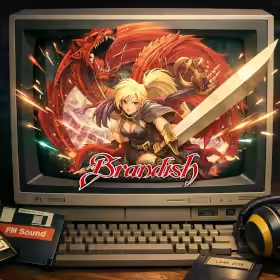


In The Margins
A small linguistic aside. One word we’ve picked up along the way that helps describe what we’re hearing in game soundtracks, and how that sound shapes the experience.
Mellifluous
- Meaning
- Having a smooth, flowing, and sweetly pleasing sound; often used to describe voices, musical passages, or tones that seem to glide effortlessly and harmoniously. In video game music, it often describes themes that remain easy to listen to even when repeated during extended play.
- Pronunciation (Australian English)
- /məˈlɪfluːəs/ “muh-LIF-loo-uhs”
- In a sentence
- The opening theme unfolds in a mellifluous line, its melody carrying the player gently into the game’s world before any action begins.
- Why use it (rather than “pleasant”, “smooth”, or “melodic”)
-
- Mellifluous captures both texture and motion, implying a continuous, flowing line that sits comfortably in the mix.
- Pleasant is broad and non-specific, offering little insight into how the sound behaves.
- Smooth suggests lack of friction, but not necessarily musical intent or character.
- Melodic describes structure, but not the sensory quality or ease of listening.
- Miscellaneum note
- In game soundtracks, mellifluous writing often reflects constraint as much as intent. On systems like FM synthesis or early sample playback, composers shaped lines carefully to avoid harshness while maintaining clarity. The result is music that flows, supports the scene, and remains listenable even when looped repeatedly during play. A well-constructed game soundtrack often relies on this quality to sustain immersion without fatigue.
Web Finds
Some links we’ve been exploring lately that you might enjoy as well.
- Amiga Game Soundtrack Archive – A large, directory-style archive of Amiga game music presented in a raw, text-driven format. It rewards deliberate exploration. Best approached with a title in mind, though browsing can surface unexpected finds from the FM and MOD era.
- Salade de Mais – A long-running underground blog dedicated to game soundtrack releases. Carefully curated and quietly opinionated, it is well suited to discovering albums you did not know you were looking for, across a wide range of platforms and styles.
- Designing a Game for Music – A short academic essay exploring how music can move beyond accompaniment to become a structural element of gameplay. It frames audio as an interactive system, offering a useful lens for thinking about game sound beyond the soundtrack.
- Game Audio School – Sound Studies Blog – This is where things start to get interesting. A reflective blog that pushes sound studies into the red, exploring how audio operates as perception, memory, and system within games. It moves beyond implementation and into interpretation, and is well worth spending time with if you want to understand what game sound is actually doing.
Paper Games
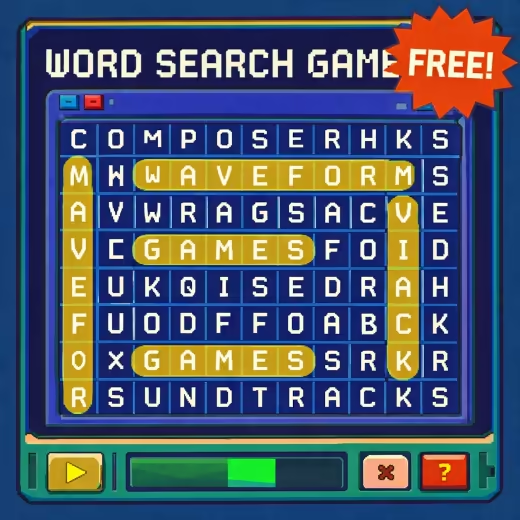
(no registration required)
Creator's Log
A few notes from the workshop: what's been fixed, improved, or learned on the road to keeping this site fast, useful, and brimming with curiosities.
- Listening as Method: How We Review Soundtracks
- This month we spent time refining how we approach soundtrack reviews. Release data is already well documented elsewhere, and while useful, it does not explain why the music works. Our focus is different. We listen first, then describe what we hear. That shift changes the structure of the articles. Rather than catalogue entries, the reviews reflect lived experience. Tone, pacing, and atmosphere take precedence. Over time, this approach has proven more useful, because it treats game music as something to be understood through listening, not just documented.
- Market Snapshots and Adding Texture
- We continue to experiment with how articles connect to the wider market. Affiliate links remain a small but practical part of that. If a reader discovers a soundtrack through an article, it makes sense to show where it can be found. More recently, we have started adding market snapshots. These capture what we observe at the time of writing. Availability, price range, and whether an item sits as a common release or a collector piece. This adds another layer to the article, not as promotion, but as context. It helps position the artefact within the real conditions of the market, and contributes to the overall texture of the work.