Shadow of the Beast Soundtracks (2008) – Amiga Atmosphere
Introduction
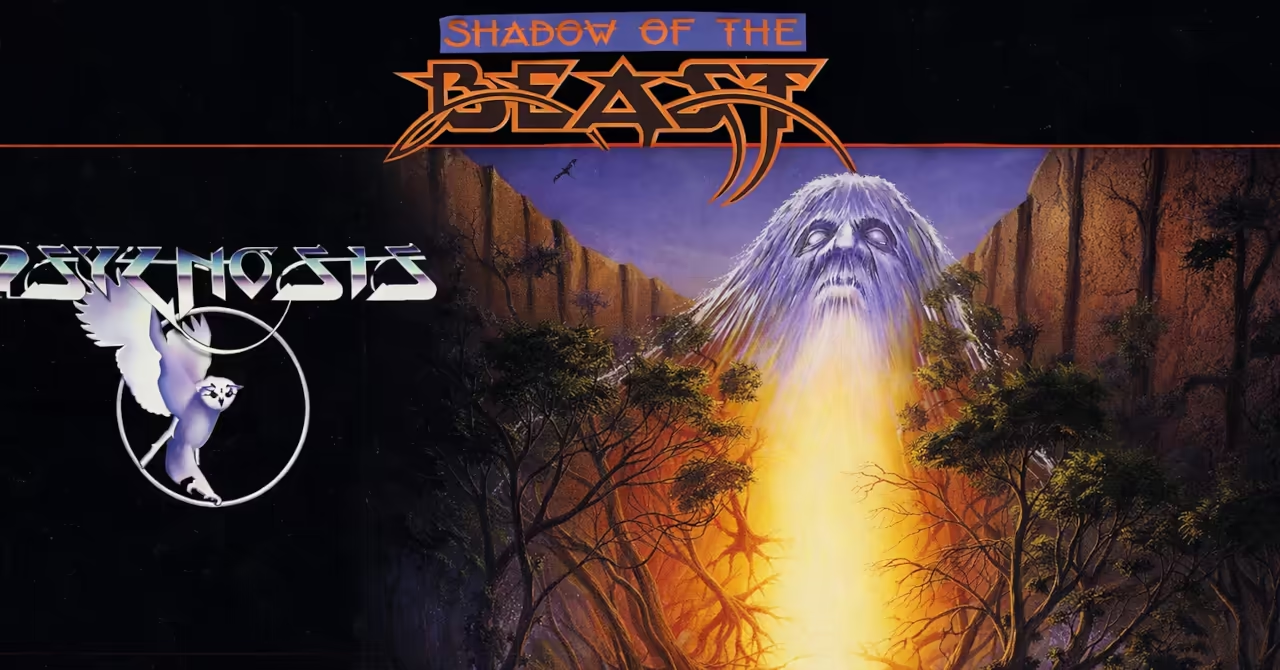
Shadow of the Beast (1989) is often remembered for its visual presentation, but its soundtrack is what endures. Written for the Commodore Amiga’s Paula soundchip, the music established a distinct identity built on texture, pacing, and stereo space. In 2008, this legacy was captured in The Soundtracks, a CD release that presents the original audio without reinterpretation. This article examines that release, the listening experience it offers, and what it reveals about early Amiga-era game audio.
The release appears to present direct recordings of the original Amiga audio rather than a re-arranged or remastered version. What remains is a clear capture of that approach. The sound is sample-based. The stereo image is defined by the system rather than post-production. It is less an album in the traditional sense and more a record of how game audio functioned at the time.
Album Snapshot
The compilation brings together music from Shadow of the Beast, Shadow of the Beast II, and Shadow of the Beast III. The first game’s soundtrack was composed by David Whittaker, a well-known video game composer of the period, and it establishes the tone that carries through the series. The pieces are not structured as standalone songs. They are built to support environments and transitions within the game.
Track titles reflect this role. They point to locations, encounters, and states rather than musical ideas. The pacing remains controlled throughout. It tends to sit in a moderate range, which allows tension to build without pushing the listener forward too quickly.
The sound set is consistent. Short drum samples provide structure. Mallet-style tones appear in accents and transitions. Sustained wind-like sounds fill the background. Together they form a palette that feels stable across the full runtime of the disc.
Historical Placement
The Commodore Amiga used the Paula audio chip (see the Commodore Amiga Journal for further detail). It provided four independent audio channels. These were typically split across the left and right outputs. The result was a stereo field defined by placement rather than blending.
The system relied on sampled sound. This allowed composers to work with recorded tones and percussive elements. It marked a shift from earlier systems that relied on more limited sound generation. The difference was noticeable when connected to a stereo system rather than a television speaker.
Each channel remained discrete. There was no internal mixing into a unified stereo image. This can still be heard clearly in playback. Sounds often sit firmly on one side, with other elements answering from the opposite channel. The effect is simple but effective.
On a near-field setup, this separation becomes more apparent. Individual elements occupy defined positions. Tracks such as Searching the Fort make this easy to observe. The audio layout follows the hardware channel design.
Sonic Architecture
The soundtrack is restrained in its construction. It does not rely on strong melodic lines. Instead, it builds its identity through repetition and layering. Rhythm plays a central role, but it is controlled rather than dominant.
Low-frequency pulses provide a sense of movement. Drum patterns introduce pressure without becoming aggressive. These elements remain steady while other sounds move around them. The listener is guided without being directed.
Melodic fragments appear briefly and then recede. They do not resolve into full themes. They function as markers within the sound rather than focal points. This approach keeps attention on the overall texture.
The choice of sounds reinforces this. Percussive hits are clean and direct. Mallet tones add a lighter edge. Sustained tones create space behind the main elements. The combination produces a continuous background rather than a sequence of highlights.
The Amiga’s audio system allowed multiple sampled sounds to be played simultaneously, creating a stereo field that was unusual for home computers of the time.
Legacy and Modern Relevance
The 2008 CD release reflects continued interest in this style of game audio. The material does not change form when removed from the game. It remains structured around atmosphere rather than progression. That quality allows it to stand on its own.
Modern game and film audio often follow similar principles. Texture and space are used to support the visual environment. This soundtrack shows an early example of that approach in practice. It demonstrates how limited systems could still produce a defined listening experience.
The connection to broader soundscape design is clear. Game audio shapes perception as much as image. This release provides a direct reference point for that idea. It captures a stage in the development of interactive audio.
As a listening experience, the value lies in consistency and detail. The tracks do not compete for attention. They reward sustained listening. Small variations become more noticeable over time.
Listening Guide
A useful way to approach the soundtrack is to focus on a small group of tracks. These provide a clear sense of how the material operates across different situations.
Intro opens with layered windpipe-style tones. A marimba-like sound appears in the transitions. The drum machine remains controlled. The track sets the tone without drawing attention to itself.
The Cavern Battles introduces more pressure. The drums carry greater weight. The pacing tightens slightly. A shaker sits over the rhythm, while the tonal elements maintain an uneasy atmosphere.
Guardian Battle presents a more direct form of the sound. The rhythm is more pronounced. The pacing feels sharper. The overall effect reflects a moment of escalation within the game.
Game Over shifts the approach. Synth pads become more prominent. A guitar tone sits above the mix. The track is brief, but it leaves a clear impression. It stands apart from the surrounding material.
Track Listing and Release Reference
The 2008 CD compiles material from the three Shadow of the Beast titles. For the full track listing, release details, and collector metadata, refer to the Discogs entry:
Shadow of the Beast – The Soundtracks (2008) – Discogs Listing
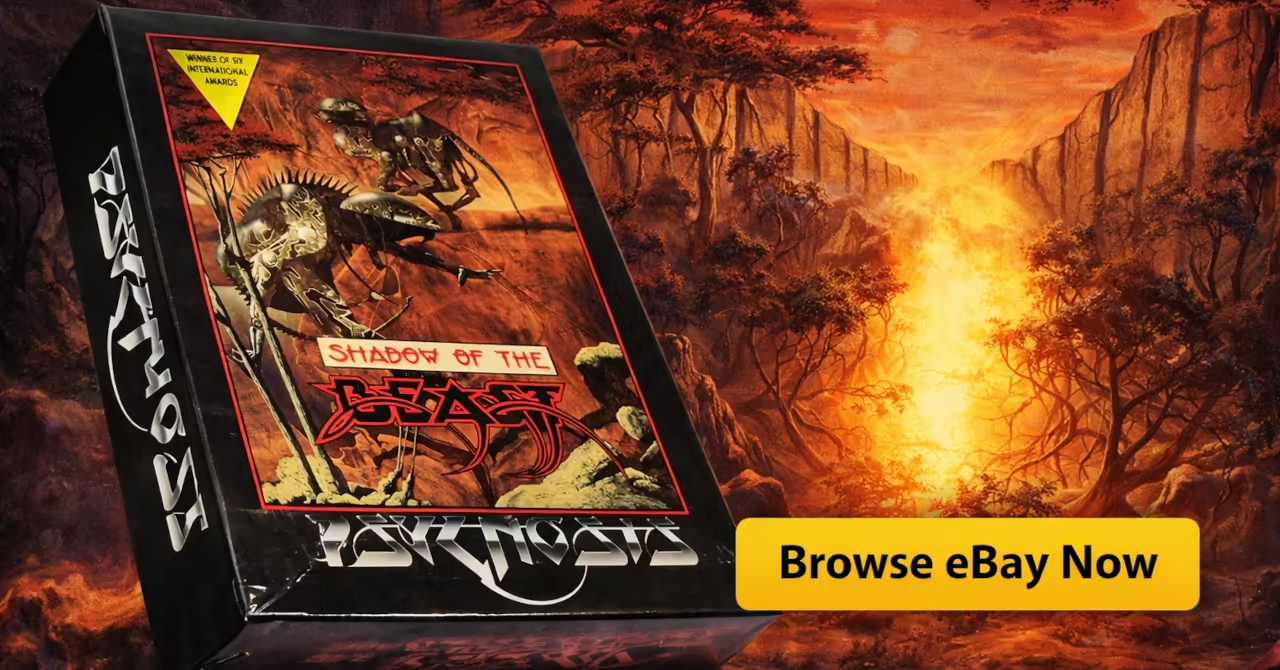
Collector market snapshot: The Shadow of the Beast – The Soundtracks CD was a limited release and is rarely seen on the secondary market. By contrast, original Shadow of the Beast Amiga copies—boxed editions, disks, and manuals—still appear with some regularity. For collectors, the original Psygnosis release remains the more accessible entry point, offering the artwork, packaging, and period context that defined the game.
AudioPhil Editorial
This is not a soundtrack you put on for catchy hooks or standout singles. It is something quite different. Shadow of the Beast – The Soundtracks is an atmosphere piece first and foremost, and that is exactly why it holds up. Listening to it now, through a proper stereo setup rather than a television speaker, reveals just how deliberate the space and separation really are. The Amiga’s Paula output, split cleanly across left and right, creates a soundstage that feels wide, almost physical. You can hear elements sitting independently rather than collapsing into a single channel, and that alone is enough to transport me straight back to that era.
I remember the shift clearly. Moving from the Commodore 64 into the Amiga was not just a graphical upgrade, it was an audio awakening. For the first time, you could plug the machine into a stereo system and actually listen to a game. My own setup at the time—what I would now describe as a fairly average Commodore-branded stereo—felt enormous. Loud, wide, and immersive. In hindsight it was nothing special, but at the time it was transformative. Going forward again to early PCs after that was, frankly, a let-down. Poor soundcards, inconsistent support, and music that felt like a step backwards. The Amiga had already shown what was possible.
What stands out with Shadow of the Beast is its restraint. It never tries to be a “music album” in the traditional sense. There are no big melodic payoffs, no obvious centrepieces. Instead, it builds tension through repetition and texture. The percussion keeps a steady pressure—almost like a heartbeat—while the tonal elements drift in and out of focus. It is active listening music, not passive. You are aware of it, but it never overwhelms. It sits just behind your attention, shaping the experience rather than demanding it.
That balance is probably why it warranted a CD release years later. If this had just been a collection of beeps and novelty sounds, it would have been forgotten. But there is something here that endures. It feels closer to a modern television or film soundscape than a conventional game soundtrack. You can hear the early form of something that would later become standard practice: music designed to support space, tension, and mood rather than dominate it.
Listening today on a modern workstation, with a clean stereo image and decent speakers positioned properly, that intent comes through clearly. Tracks like Searching the Fort reveal just how separated the channels are, almost like two conversations happening at once. It is not polished in the modern sense, but it is intentional, and that matters more. You are not hearing a remaster or reinterpretation—you are hearing the machine, the samples, and the composer working within those constraints.
This is the kind of artefact I enjoy returning to. Not because it is perfect, but because it captures a moment where technology and creativity met in a very specific way. It reminds me that game audio did not always aim to impress—it aimed to immerse. And sometimes, by doing less, it achieved far more.
Notes & Memoranda
As is often the case, the subject extends beyond the bounds of a single article. The notes and memoranda below gather together useful definitions, related observations, references, and occasional curiosities discovered along the way.
How Google Reads This Article
An interesting postscript: Google Search has used this article as a source when explaining the Shadow of the Beast soundtrack. Its AI Overview identifies PhilReichert.org's analysis of David Whittaker's composition, the Amiga's Paula sound chip and the relationship between the game's audio and its distinctive technical presentation.
That is a useful second opinion on what this article has become: not simply a nostalgic listen to an old game soundtrack, but a small reference point connecting Amiga hardware, composition and early game sound design.
Roger Dean and the World Outside the Screen
The atmosphere of Shadow of the Beast did not begin when the game loaded. Its extraordinary box artwork was created by Roger Dean, the artist famous for his album covers and fantastic landscapes.
COMPUTE!'s Gazette, revisiting the artwork in its April 2026 feature The Game in the Box: Box Art vs Reality, describes Dean's cover as a surreal alien and fantasy landscape. The magazine makes an interesting distinction between the technical achievement of the game itself — including its celebrated early parallax scrolling — and the considerably more fantastic world suggested by Dean's painting.
That distinction is particularly relevant to the soundtrack. The cover art and David Whittaker's music were both doing something that the graphics alone could not: extending the imagined world beyond what was literally visible on the Amiga's screen. Dean gave the game a world to imagine; Whittaker gave that world an atmosphere to inhabit.
Glossary
- Paula chip
- Paula is the custom audio chip used in the Commodore Amiga, responsible for playback of sampled sound. It supports four independent audio channels, typically split across left and right stereo output, enabling early forms of multi-layered digital music in games like Shadow of the Beast.
- MOD music
- MOD music refers to a file format and composition style used on the Amiga, where music is constructed from short audio samples triggered in patterns. Rather than streaming recorded audio, MOD files sequence samples to create complete tracks within tight memory constraints.
- Sample-based audio
- Sample-based audio uses recorded snippets of real sound—such as drum hits or instrument tones—which are played back at different pitches and timings to create music. This approach allowed Amiga composers to achieve more realistic sound compared to purely synthesized systems.
- Stereo channels
- Stereo channels refer to the separation of audio into left and right outputs. On the Amiga, individual sound channels were assigned to either side, creating a distinct spatial effect where different elements of a track can be heard independently across the stereo field.
- Atmospheric soundtrack
- An atmospheric soundtrack focuses on mood, texture, and environment rather than melody or song structure. In Shadow of the Beast, this approach creates a sense of space and tension that supports the game world without dominating the player’s attention.
Frequently asked questions
What exactly is the 2008 CD release—remaster or original audio?
The 2008 CD release appears to present the original Amiga-era audio rather than a newly arranged remaster or cover version. Based on listening, it preserves the distinctive character of the Paula-driven soundtrack, including the strong stereo separation and sample-based sound associated with the original game audio.
Is Shadow of the Beast - The Soundtracks rare or collectable?
Yes, the CD appears to be relatively scarce and is likely collectable for Amiga enthusiasts, retro game soundtrack collectors, and Psygnosis fans. At the time of writing, it was not readily available on major secondary marketplaces, which suggests it is not a common item in circulation.
Why does the audio sound so separated between left and right channels?
The pronounced stereo separation comes from the Commodore Amiga’s Paula audio architecture. Paula handled four independent audio channels, typically split across the left and right outputs rather than internally mixed into a modern stereo image. This gives many Amiga soundtracks, including Shadow of the Beast, a wide and clearly separated soundstage.
Is the soundtrack using real instruments or synthesized sounds?
It uses both sampled and synthesized character. Amiga soundtracks of this period were commonly built from short recorded samples of instrument-like sounds, percussion, and tonal textures, which were then sequenced into music. So while the soundtrack is not a live studio recording, it is also more than simple beeps or pure synthesis.