When Home Computers Became the Centre of a Music Studio
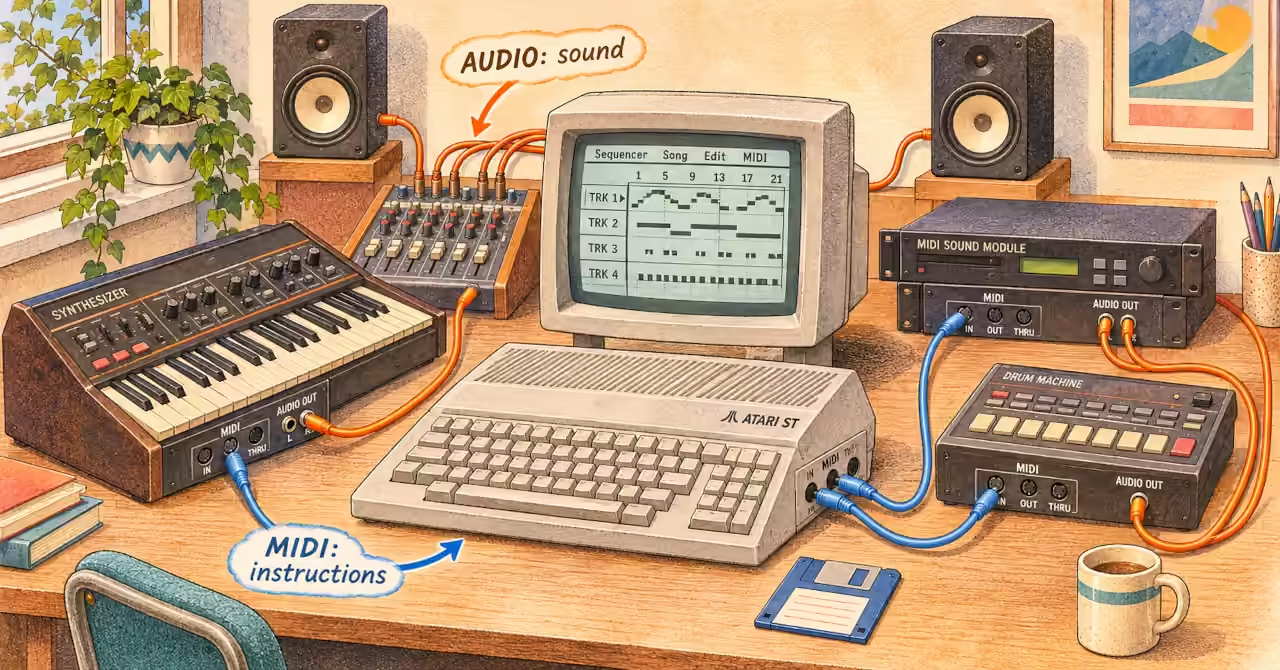
A home computer could make a tune without running a studio. The more interesting threshold came when it could organise instruments around it: remember a performance, send it back to a synthesiser, change the arrangement and keep the session moving. The computer did not have to produce the finest sound in the room. It had to make the room work together.
For MIDI-based home studios, the middle and later 1980s provide a useful answer to the question of when that happened. MIDI emerged in 1983; the Atari ST arrived in 1985 with MIDI connections built in; Steinberg's Pro-24 followed in 1986, with Cubase arriving in 1989. These are milestones in a transition, rather than a claim that one machine or program invented the computer studio.
Sound-chip composition continued alongside this development, with its own creative demands. As SID vs MIDI: Two Ways Computers Make Music explores, a computer could produce sound itself or direct another instrument. The studio brought those possibilities together.
MIDI changed the job
The key distinction is between sound and instructions about sound. MIDI carries messages about musical events and controls, rather than the audio waveform itself. A note number, velocity value or program-change message can cross a MIDI connection while the actual sound comes from the receiving instrument. The MIDI Association describes this shared hardware-and-software language in its core specification overview.
The standard's emergence in 1983 gave instruments from different manufacturers a common way to communicate. The MIDI Association's history places that development within several years of negotiation between companies. Linking electronic instruments was a central concern; the computer became another participant in that conversation.
For a computer, though, this was fertile ground. Musical events could become data to store and rearrange. Instead of asking whether its internal sound chip could imitate a studio synthesiser, the owner could ask whether the computer could direct the synthesiser already on the desk. The problem shifted from tone generation towards coordination.
The studio did not begin with the ST
Computer sequencing was possible before Atari supplied those convenient sockets. Steinberg's company chronology places its Commodore 64 sequencer Pro-16 in 1984, using an external MIDI interface. With the appropriate interface and software, a familiar home machine could already take on the organising role.
The distinction is practical. An add-on interface meant another purchase and a compatibility decision. The ST made the connection part of the machine. Building the interface in reduced the effort required to assemble a system.
That earlier route deserves its own visit: the Commodore 64 as a MIDI workstation hub explores the interface-equipped alternative.
The ST arrived with the ports
The Atari ST's built-in MIDI IN and OUT gave a musician an unusually direct starting point in 1985. A November 1988 STart account describes the 520ST's arrival that summer and the appeal of avoiding separate interfaces. The machine supplied a shared hardware starting point for music-software developers as well as their customers.
A socket is a modest feature until it removes the reason a project never starts. A musician still needed software, instruments and cables, but did not first have to choose a MIDI expansion box for the computer. That is the useful hinge in the ST story: fewer preliminary decisions stood between an idea and a functioning rig.
The screen mattered too. Once notes and parts were visible as editable material, composition could feel less like repeatedly attempting a perfect take and more like revising a document.
Software made the arrangement a working document
Steinberg's history dates Pro-24 for the ST to 1986 and Cubase 1.0 to 1989. Pro-24 offered substantial sequencing and editing facilities. Cubase developed the graphical approach further, making the arrangement something a musician could work on directly at the screen.
Tom Jeffries's Spring 1987 STart introduction describes what musicians could already do: record MIDI events, edit individual notes, transpose parts and correct their timing. These capabilities made a performance useful beyond the moment it was played.
An eight-bar bass phrase could be copied into the next verse, then transposed without another performance. A misplaced note could be corrected while the rest of the take stayed intact. A musician could try a different arrangement, listen, change it again and save the result. The computer became the place where successive musical decisions accumulated.
What was actually saved?
Consider an illustrative setup: a MIDI keyboard, a computer running a sequencer, a sound module and a drum machine. The keyboard sends performance information to the computer. On playback, the sequencer sends note events to the module and, where supported and configured, timing messages to the drum machine. The instruments' audio outputs still need to reach a mixer, recorder or monitoring system.
| Path | What travels | What it achieves |
|---|---|---|
| Keyboard → computer → instrument | MIDI performance and control messages | Captures and replays instructions |
| Instrument → mixer or recorder | Audio | Makes the performance audible or records its sound |
The example explains both the power and the limitation. Saving a sequence preserves musical instructions; it does not necessarily preserve the exact sound heard during the session. A program change selects a sound on the receiving instrument, so a changed patch bank can change the result. A vocal or guitar recording does not become part of a MIDI sequence merely because it was playing alongside it.
Patch editors and librarians could help retain instrument settings, but recall depended on the equipment, software and data saved. MIDI was not a promise that every knob, cable and mixer setting would return automatically. The computer made the arrangement persistent; the rest of the studio could still require notes and deliberate setup.
When the computer began running the session
For the MIDI-controlled home studio, the transition involved three useful thresholds: a shared control language in 1983, a convenient computer platform in 1985, and increasingly capable sequencing software through the later 1980s. Together, they made it easier to build a studio around a computer and return to an arrangement as a continuing piece of work.
What changed was the centre of gravity. When the arrangement lived on disk and could be revised at the screen, the computer became more than one performer among the others. It became the place where the performance was planned, remembered and put back into motion. Its decisive contribution was the ability to organise the rest of the room.
To explore the tools that put this approach into practice, continue to Atari ST Music Software, covering sequencers, patch editors and other applications that gave the machine its musical role.
Featured Product
Analogue Computer Series 001 T-Shirt
From MIDI instructions to saved arrangements, this story celebrates computers that brought a roomful of equipment together. Carry that fascination into everyday wear with the Analogue Computer Series 001 T-Shirt — a nod to an earlier age of computing, when switches, circuitry and glowing indicators made the machinery part of the spectacle.
Disclosure: this is a commercial product link to an external Zazzle store associated with philreichert.org. Purchases are handled by Zazzle.

Writer's Notes
Reader Guide
The following material expands on the terminology, historical context, technical concepts, and related reading connected to this article.
Glossary
- MIDI
- Musical Instrument Digital Interface: a shared system for exchanging performance and control data between compatible devices. For the distinction between making sound and sending musical instructions, see SID vs MIDI: Two Ways Computers Make Music.
- Sequencer
- Hardware or software that stores and plays a sequence of events. In this article, those events are MIDI instructions. Explore examples in Atari ST Music Software.
- Velocity
- A MIDI value associated with a note's attack, commonly used to control loudness or timbre; its effect depends on the instrument.
- Program change
- A message selecting an instrument program or patch. It does not transfer the sound itself.
- Quantisation
- Adjusting event timing towards a chosen rhythmic grid. It is an editing choice, not a guarantee of a better performance.
- Patch librarian
- Software for organising and storing compatible instruments' sound-program data.
Questions readers ask
Did the Atari ST invent the computer music studio?
No. Computer sequencing existed before it. The ST reduced setup friction by including MIDI ports, making it an appealing platform for sequencing software.
Does MIDI carry the sound of an instrument?
No. MIDI carries performance and control information. In the setup described here, the instrument produces audio through a separate audio connection.
Why mention Cubase in 1989?
Its release is a useful software milestone. Earlier sequencers were already doing serious work, so 1989 is not a universal starting date for the computer studio.
Can a saved MIDI sequence restore the whole studio?
Not by itself. Sound programs, external audio and mixer settings may require separate storage, documentation or setup. Recall depends on the equipment and software involved.
Related articles…



References and further reading
- MIDI Association: MIDI 1.0 Core Specifications. Overview of the protocol. The detailed specification linked there is the 1996 revision, not an original 1983 document.
- MIDI Association: MIDI History Chapter 6 — MIDI Begins 1981–1983. History drawing on participant accounts and industry records.
- Steinberg: company history. Manufacturer chronology for Pro-16 (1984), Pro-24 (1986) and Cubase (1989).
- Jim Pierson-Perry: The Professional MIDI Machine — And How It Grew. STart, November 1988. Contemporary account of the 1985 ST launch and the MIDI-software ecosystem.
- Tom Jeffries: The Ins, Outs, and Thrus of MIDI. STart, Spring 1987. Contemporary explanation of event recording, sequencing and editing.
- MIDI Association: Summary of MIDI 1.0 Messages. Reference for note events, velocity, program changes and system messages.
- Phil Reichert: Atari ST Music Software. Related reading on sequencers, patch editors and other music applications for the Atari ST.
Sources consulted 14 November 2026. Dates identify documented milestones; the argument about the studio becoming a system is editorial interpretation.
Disclosure
This article was developed with AI-assisted research and writing tools using the sources listed above. Historical dates identify documented milestones; interpretations about the computer’s changing role in the studio are editorial observations. The AI-generated hero illustration is an interpretation of a period studio, not an exact equipment layout or wiring guide.