Can You Legally Build a Dyson Sphere?

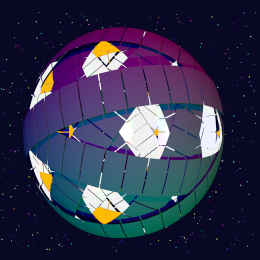
A Dyson sphere promises an almost absurd prize: access to a significant share of a star’s energy. As explored in Benefits of a Dyson Sphere – Why Civilisations Might Build One, that could make stellar-scale engineering attractive to a sufficiently advanced civilisation. But deciding to build one raises a wonderfully awkward question: who gives you permission? The law has no trouble recognising a launch, a satellite, a licence applicant, a debris cloud, or a state’s responsibility for what its nationals do in space. It has much less to say about a “Dyson sphere”, because that phrase describes a theoretical concept rather than a recognised class of regulated object. Turn the concept into an engineering programme, however, and the fantasy rapidly becomes paperwork. Launch licensing, environmental review, liability, continuing supervision, international consultation and registration all begin to matter. Space law does not need a special anti-Dyson statute to enter the story. It only needs someone to start building one.
The treaty regulates activity, not fantasy
The central legal fact is that the governing framework for outer space was built around states and space objects, not around megastructures. The 1967 Outer Space Treaty says outer space is free for exploration and use, forbids national appropriation by sovereignty, use, occupation, or any other means, and makes states internationally responsible for national activities in space, including those carried out by non-governmental entities. It also requires consultation if a state has reason to believe a planned activity would cause potentially harmful interference.
That is why the first answer has to be cautious: a Dyson sphere is not unlawful simply because of its extraordinary scale. The 1967 Outer Space Treaty does not reserve the exploration and use of space to governments, nor does it impose a general prohibition on private space activity. Instead, Article VI makes states internationally responsible for their national activities in outer space and specifically requires the activities of non-governmental entities to receive authorization and continuing supervision by the appropriate state. A private consortium beginning a solar-collection swarm would therefore need to operate within a national regulatory framework capable of providing that authorization and supervision. The treaty does not tell us whether a completed Dyson sphere would itself be lawful; rather, it establishes obligations that would apply to the activities undertaken to construct and operate one. At such an unprecedented scale, satisfying those obligations would likely become a continuing governance problem rather than a one-time approval.
The treaty’s environmental language also matters. Article IX requires states to conduct activities so as to avoid harmful contamination and adverse changes to Earth’s environment from extraterrestrial matter, and it explicitly contemplates international consultation when harmful interference is possible. That clause is not written for Dyson spheres, but it is exactly the kind of provision lawyers reach for when a project is so large that ordinary assumptions about scale stop working. Once a system begins to alter orbital conditions in a persistent way, “we only meant to collect sunlight” stops being a complete explanation.
Launch law is where theory becomes paperwork
If a Dyson-sphere project were launched from U.S. territory, by a U.S. entity, or with U.S. space hardware, it would run into the Federal Aviation Administration’s commercial space licensing regime. The FAA authorizes launch and reentry operations, launch and reentry site operations, and safety element approvals; payload review is normally folded into launch authorization; and license or permit holders must provide evidence of funds to cover potential damage from a mishap. Environmental review under NEPA is part of the authorization process, but completion of that review does not itself guarantee approval.
For a conventional satellite mission, that system is manageable. For a Dyson sphere, it becomes revealing. The law scales by event, not by dream. It is built to review a launch, a payload, a spaceport, a reentry path, and the environmental consequences of each. A solar megastructure is not a single event; it is a construction regime, possibly lasting generations. That means the legal question would quickly mutate from “is the sphere allowed?” to something more administrative and much less romantic: what is the unit of authorization
If the answer is a million launches, repeated over decades, the legal process is not just a gate. It becomes part of the architecture. That is not a dramatic flourish; it is the practical consequence of a system that insists on legibility. The law wants traceable actors, bounded operations, reviewable safety cases, and documented responsibility. A Dyson sphere wants distributed construction, redundancy, and constant adaptation. Those impulses can coexist, but they do not fit each other neatly.
Debris makes it a public hazard
The debris problem is where the speculative megastructure becomes an actual risk to other users of space. NASA’s orbital debris mitigation guidance exists because collisions, fragmentation, and long-lived debris are not abstract possibilities. They are the residue of how space activity works in practice. Its standards cover control of debris during normal operations, minimization of debris from explosions, mission planning to reduce debris generation, and post-mission disposal. NASA also states that these requirements apply to programs and projects intended to reach orbit, with independent review.
Now translate that into a Dyson swarm: many small collectors, vast orbital real estate, constant station-keeping, collision avoidance, replacement logistics, and probably a steady stream of maintenance traffic. Even if every individual unit is modest, the ensemble would occupy so much space and require so much coordination that debris management would no longer be a side issue. It would be one of the core design constraints. A project that large would have to show, not merely promise, that it can avoid creating a persistent hazard to other satellites, scientific missions, and future settlements.
At this point, the legal analysis stops being about elegance and starts being about accountability. The Outer Space Treaty’s requirement of due regard and its consultation language make it hard to defend a system that predictably imposes risk on everyone else in orbit. Liability law sharpens the point. The Liability Convention, which elaborates on Article VII of the treaty, is built around compensation for damage caused by space objects, and in some cases strict liability for damage on Earth’s surface or to aircraft. That is not a permission slip. It is the sign that every launched component is also a potential legal instrument of damage.
Building for everyone is the hardest part
The Outer Space Treaty says space activities are to be carried out for the benefit and in the interests of all countries, and that exploration and use should be free for all states on a basis of equality. That language does not create a modern political commons in the simple sense, but it does impose a normative burden that becomes harder to dodge as the project grows. A Dyson sphere cannot easily present itself as a private enclosure of solar output and still claim to fit comfortably inside the treaty’s cooperative spirit. The project would need some theory of access, transparency, and non-exclusion stronger than “we got there first.”
That has practical consequences. A solar collector swarm large enough to matter would likely need radio coordination, traffic management, interference avoidance, and operational envelopes that other actors can understand. In other words, it would need to behave less like a fortification and more like infrastructure. The law already anticipates consultation when harmful interference is possible, and the UN registration regime exists to support transparency about space objects. A lawful megastructure would therefore need to look like a continuously supervised utility, not a private claim staked across the solar system. That is not a formal treaty formula in so many words; it is the operational shape of compliance.
Resource acquisition makes the problem more tangled. A Dyson sphere would not be made from pure ambition. It would be built from mined material, orbital fabrication, and likely extensive use of asteroid or lunar resources. The current treaty framework is famously clearer about non-appropriation than about the ownership of extracted resources. That uncertainty cuts against any easy claim that one actor can convert the Sun’s output into an unchallengeable private estate. The governance gap is real, and a project at this scale would force it into the open rather than solve it quietly.
Legal, yes; simple, no
So, can you legally build a Dyson sphere? Under today’s law, there is no single prohibition declaring a solar megastructure unlawful. The 1967 Outer Space Treaty permits the exploration and use of outer space while prohibiting national appropriation and imposing obligations including state responsibility, authorization and continuing supervision of non-governmental activities, due regard for other users, and consultation where potentially harmful interference may occur. National laws would add further requirements: a project involving the United States, for example, could encounter launch licensing, payload review, financial-responsibility requirements and environmental assessment. Debris mitigation, registration and international liability would add further layers. Existing law therefore provides principles that could govern the activities used to construct a Dyson sphere, but it does not provide a ready-made legal answer for the megastructure itself.
That distinction matters. A Dyson sphere would probably have to function less like a privately owned machine and more like continuously supervised infrastructure. Construction could extend across generations, individual components might fall under different regulatory regimes, and failures or interference could affect states and space users far removed from the original builders. Questions of access, transparency and non-exclusion would inevitably arise, but current treaties do not prescribe a specific Dyson-sphere governance model. They were written for activities vastly smaller than stellar-scale engineering. The challenge would therefore be to apply existing principles of responsibility, supervision, liability and due regard to a project whose scale their authors never contemplated.
The real obstacle, then, is not that space law fails to contain the words “Dyson sphere.” Of course it does not. The harder question is whether anyone could construct and operate one while remaining accountable for its consequences across decades, jurisdictions and potentially millions of individual space objects. Current international law leaves much of that question unresolved, but it does make one principle difficult to escape: building at stellar scale would not mean escaping responsibility at human scale.
And responsibility matters for another reason. A civilisation capable of building a Dyson sphere would possess an extraordinary strategic advantage over one that could not. If such a structure belonged not to us but to an aggressive extraterrestrial civilisation, legal arguments might suddenly become the least of our concerns. Continue with How to Attack an Alien Dyson Sphere and Win.
Featured Product
Analogue Computer Series 001 T-Shirt
If ideas like Dyson Spheres, analogue computers and civilisation-scale engineering capture your imagination, the Analogue Computer Series 001 T-shirt is made for you. Inspired by the golden age of engineering, it celebrates the elegant problem-solving that shaped modern technology long before the digital era. It's a subtle conversation starter for engineers, makers, scientists and science fiction enthusiasts who appreciate that today's biggest ideas often begin with yesterday's brilliant thinking.
Disclosure: this is a commercial product link to an external Zazzle store associated with philreichert.org. Purchases are handled by Zazzle.

Writer's Notes
Reader Guide
The following material expands on the terminology, historical context, technical concepts, and related reading connected to this article.
Glossary
Some of the terms used in this article have specialised, historical or technical meanings. This glossary provides additional context for selected terms and ideas.
- Dyson sphere
- A theoretical megastructure conceived to capture a large fraction of a star’s energy by surrounding it with engineered collectors; named after physicist Freeman Dyson. In practice the term denotes a design problem rather than a single machine — the imagined solid shell is mechanically implausible, so discussions of a “Dyson sphere” usually signal questions about scale, resource needs, orbital management and the legal/regulatory consequences of turning a concept into an engineering programme.
- Dyson swarm
- A practical variant of the Dyson concept made up of many independent orbiting collectors or mirrors rather than a continuous shell. Because it is distributed, a swarm requires continuous station‑keeping, collision avoidance, replacement logistics and traffic coordination, which multiply operational risk, debris generation and the regulatory responsibilities associated with each launched unit.
- Outer Space Treaty (1967)
- The foundational multilateral treaty that governs activities in outer space, establishing that space is free for exploration and use, forbidding national appropriation by sovereignty or occupation, and making states internationally responsible for national activities — including those of private entities. It also imposes duties such as ‘due regard’ for other users and consultation where activities could cause harmful interference, so large projects cannot proceed without a sponsoring state able to authorise and supervise them.
- Liability Convention
- The 1972 international agreement that operationalises the treaty’s damage‑compensation rules by assigning responsibility for harm caused by space objects — imposing absolute (strict) liability for damage on the Earth’s surface or to aircraft and fault‑based liability for damage in space. It creates a mechanism for states to claim compensation and therefore turns every launched component into a potential source of legal and financial exposure.
- NEPA (National Environmental Policy Act)
- U.S. law requiring federal agencies to assess the environmental consequences of major federal actions through an Environmental Assessment (EA) or, for significant impacts, a more detailed Environmental Impact Statement (EIS). In the space context NEPA review is part of launch authorisation and forces consideration of environmental and cumulative effects, but it is a procedural safeguard — completion of the review does not automatically approve a proposed activity.
Frequently asked questions
Curious about something you’ve just read? These frequently asked questions explore some of the key ideas, details and questions surrounding the topic.
Is a Dyson sphere explicitly illegal under current space law?
No single treaty declares a solar megastructure unlawful. Existing treaties permit the exploration and use of outer space but impose obligations including non-appropriation, state responsibility, authorization and continuing supervision of non-governmental activities, due regard for other users, and consultation where potentially harmful interference may occur.
What U.S. approvals would a Dyson-sphere project face if launched from U.S. territory or by a U.S. entity?
A project of this kind could fall within the FAA's commercial space licensing regime for launch and reentry operations, launch and reentry sites, safety approvals and payload review. It could also require evidence of financial responsibility for potential mishap damage and be subject to environmental review under NEPA, although completion of that review would not itself guarantee approval.
How would orbital debris and liability rules affect a Dyson swarm?
Debris mitigation would become a major design and operational constraint. NASA's orbital debris guidance addresses debris control, collision risk, mission planning and disposal, while the Liability Convention provides a framework for state liability for damage caused by space objects, including absolute liability in some circumstances.
Could a Dyson sphere be treated as private property and exclude other states or users?
Current space law does not provide a straightforward answer. The Outer Space Treaty prohibits national appropriation and requires space activities to respect principles including freedom of use, state responsibility and due regard for other users. A privately controlled Dyson sphere would therefore raise unresolved questions about access, interference, resource ownership and exclusive control, particularly at a scale never contemplated by the existing treaties.
Related articles…


References and Further Reading
- United Nations Office for Outer Space Affairs, Outer Space Treaty.
- United Nations Treaty Collection, Convention on Registration of Objects Launched into Outer Space.
- Federal Aviation Administration, Licenses, Permits and Approvals.
- Federal Aviation Administration, Environmental review for commercial space launch and reentry.
- NASA Orbital Debris Program Office, Orbital Debris Mitigation.
- United Nations Office for Outer Space Affairs, Liability Convention.
Disclosure
This article was prepared using a combination of original research, published sources, archival material, and digital research and writing tools, including the use of large language model tools. Sources are referenced where appropriate. The author reviews and edits the article and may make ongoing editorial updates. Any commercial relationships, affiliate links, sponsorships, or other material interests relevant to the article are disclosed separately where applicable.