Benefits of a Dyson Sphere – Why Civilisations Might Build One

Introduction
Most articles introduce the Dyson Sphere as one of science fiction's greatest engineering ideas. That is true, but it is also the least interesting thing about it.
The better question is far more practical.
Why would an intelligent civilisation ever decide to build one?
That question has fascinated me for years, not only because of the engineering involved, but because of what it reveals about civilisation itself. If you'd like to explore the mythology before returning to the engineering, have a look at my Dyson Sphere Alien Log, where I trace Dyson Spheres through science fiction and even imagine the unsettling prospect of one entering our own Solar System.
Strip away the dramatic artwork and impossible scales and something surprisingly familiar appears. Engineers rarely build enormous projects because they look impressive. They build bridges because rivers interrupt commerce. They build power stations because industry needs electricity. They build communications networks because people refuse to wait for information.
Every great engineering achievement begins with a bottleneck.
The Dyson Sphere is no exception.
Every Success Creates the Next Constraint
History suggests that civilisation never stops asking for more energy.
The first industries burned timber until forests became scarce. Coal replaced wood. Oil transformed transport. Electricity reshaped entire economies. Today, artificial intelligence, electrified transport and cloud computing are pushing demand higher once again.
Every breakthrough removes one limitation while exposing the next.
If humanity, or any civilisation, continues expanding for thousands of years, the challenge eventually changes. It is no longer how to generate more electricity for one planet. It becomes how to power an entire Solar System.
Fortunately, nature has already built the ultimate power station.
The Sun Is Already Doing the Hard Work
The Sun continuously produces around 3.8 × 1026 watts of energy. Earth intercepts only a tiny fraction of that output, yet it has powered every civilisation in human history.
From a systems engineering perspective, that is almost absurd.
Imagine owning a factory beside the world's largest hydroelectric dam while connecting only a single extension lead to it. The logical response would not be to build another generator. It would be to make better use of the one already available.
A Dyson Swarm applies exactly that logic to a star.
It is one of those rare ideas that sounds like science fiction until you view it as an engineering problem.
A Solar System Becomes an Industrial Economy
Once civilisation begins manufacturing in orbit, mining asteroids and constructing permanent habitats in space, planetary thinking starts to break down.
Heavy industry no longer competes with cities for land. Metals arrive from asteroids rather than mines. Spacecraft are assembled where they never need to escape gravity.
The next bottleneck is energy.
Cheap, abundant power makes refining metals easier, recycling more economical and large-scale manufacturing routine. The entire Solar System begins operating as one connected industrial economy.
This idea is explored further in Why a Dyson Sphere is a Game-Changer for Human Civilization, where we look beyond engineering and examine how abundant energy could reshape society itself.
Think Network, Not Megastructure
This is where popular culture often takes a wrong turn.
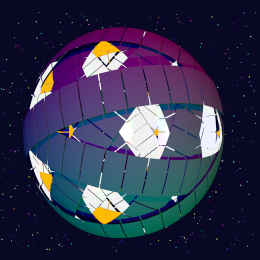
The famous image of a rigid shell surrounding the Sun is unforgettable, but it is probably the least practical interpretation of Freeman Dyson's proposal.
Engineers tend to think differently.
Instead of one impossibly large object, imagine millions of independent solar collectors orbiting the Sun. New collectors are added as demand grows. Older ones are retired. Individual failures barely matter because the network continues operating.
It looks less like an ancient monument and more like the evolution of today's electrical grid or the internet.
Scalable. Modular. Fault tolerant.
Good engineering usually is.
The Hidden Customer Is Computation
Science fiction often assumes a Dyson Sphere exists to launch enormous starships.
That may happen one day, but a more immediate customer could be computation itself.
Artificial intelligence, scientific simulation, planetary modelling and autonomous industries all consume astonishing amounts of electricity. A civilisation spread across hundreds of worlds could require computational resources beyond anything we currently imagine.
At that point, harvesting stellar energy no longer looks extravagant.
It simply becomes another utility.
Building for the Next Million Years
Perhaps the greatest benefit of a Dyson Sphere has nothing to do with power generation.
It represents a civilisation that has stopped planning in decades and started planning in geological time.
Distributing people, industry and knowledge across many worlds reduces the risk of a single catastrophe ending everything. Expanding a stellar energy network one collector at a time becomes no different from adding another substation to a modern electrical grid.
The remarkable thing is not that a Dyson Swarm would be enormous.
It is that, for a sufficiently advanced civilisation, it might eventually become ordinary.
That may be the most surprising insight of all. The Dyson Sphere is not the destination. It is simply the infrastructure built by a civilisation that has outgrown the limits of a single world.
If you've enjoyed exploring why a civilisation might build a Dyson Sphere, the next question is equally intriguing: what happens if someone else builds one first? In How to attack a Dyson Sphere…and Win, I examine the other side of the equation and ask whether humanity should spend as much time thinking about defence as engineering.
And if your heart still belongs to ambitious engineering ideas from the analogue age, the Analogue Computer Series 001 T-shirt quietly celebrates an era when elegant thinking solved extraordinary problems long before silicon did.
Featured Product
Analogue Computer Series 001 T-Shirt
If ideas like Dyson Spheres, analogue computers and civilisation-scale engineering capture your imagination, the Analogue Computer Series 001 T-shirt is made for you. Inspired by the golden age of engineering, it celebrates the elegant problem-solving that shaped modern technology long before the digital era. It's a subtle conversation starter for engineers, makers, scientists and science fiction enthusiasts who appreciate that today's biggest ideas often begin with yesterday's brilliant thinking.
Disclosure: this is a commercial product link to an external Zazzle store associated with philreichert.org. Purchases are handled by Zazzle.

Writer's Notes
Reader Guide
The following material expands on the terminology, historical context, technical concepts, and related reading connected to this article.
Glossary
- Dyson Sphere
- A theoretical system designed to capture a large share of a star’s energy. In this article, it represents the infrastructure an advanced civilisation might build after outgrowing the resources of a single planet.
- Dyson Swarm
- A vast collection of independent energy-collecting satellites orbiting a star. The article presents this as more realistic than a solid shell because it could be expanded gradually, repaired and improved over time.
- Systems Engineering
- A discipline concerned with how complex parts work together as a complete system. Here, it shifts the Dyson Sphere from fantasy to a practical question about energy, reliability, growth and long-term planning.
- Stellar Energy
- The enormous energy released by a star through nuclear fusion. The Sun produces far more power than Earth receives, making the unused output feel less like empty space and more like an untapped power station.
- Fault Tolerant
- Able to continue operating when individual components fail. A Dyson Swarm could lose collectors without collapsing, much as a well-designed network survives the failure of a single machine.
- Orbital Manufacturing
- The production of materials and equipment in space rather than on a planet. In the article, it allows factories, shipyards and heavy industry to grow without competing with cities for land.
- Computational Infrastructure
- The processors, data centres and energy systems needed to perform large-scale computation. The article suggests that future artificial intelligence and scientific simulation may consume stellar energy long before starships do.
- Geological Time
- Timescales measured in thousands, millions or billions of years. Planning on this scale means treating civilisation as something that must survive far beyond normal political or economic horizons.
Frequently asked questions
What are the main benefits of a Dyson Sphere?
A Dyson Sphere could provide an advanced civilisation with access to an enormous share of its star's energy. That power could support orbital industry, large-scale computing, artificial habitats, interplanetary transport and long-term expansion beyond a single planet.
Would a Dyson Sphere be a solid shell around a star?
Probably not. A more practical design would be a Dyson Swarm made from millions of independent collectors orbiting the star. This approach would be modular, scalable and able to continue operating when individual components failed.
Why would a civilisation need so much energy?
A civilisation spread across a solar system could require vast amounts of energy for manufacturing, asteroid mining, space habitats, scientific research, artificial intelligence and transportation. As growth continues, the energy available from one planet may become a serious limitation.
Could humanity build a Dyson Sphere?
Humanity cannot build a complete Dyson Sphere with present technology. However, a Dyson Swarm could theoretically begin with individual solar-power satellites and expand gradually over centuries as space manufacturing and resource extraction improved.
Related articles…


Disclosure
This article explores the Dyson Sphere as a thought experiment based on established scientific concepts and systems engineering principles. While inspired by ideas proposed by physicist Freeman Dyson, many of the technologies and scenarios discussed remain speculative and extend well beyond current engineering capabilities. The purpose of this article is to encourage curiosity and informed discussion about future civilisation-scale engineering rather than to predict how or when such structures could be built.