Commodore MAX Machine: The Japanese Proto-Commodore 64
◆ Revised

An Overlooked Member of the Commodore Family
The Commodore MAX occupies a curious place in Commodore's history. Announced alongside the Commodore 64, BX256, B128 and P Series in 1982, it was intended as a low-cost entry-level home computer. While the Commodore 64 would become one of the most successful personal computers ever produced, the MAX followed a very different path and quickly faded into obscurity.
With a planned retail price of just US$179.95 and a BASIC cartridge available separately, the MAX was designed to introduce new users to home computing at a significantly lower price than the Commodore 64. Several technical specifications were still listed as "unknown" in early announcements, reflecting how early the machine was in its development when first presented to the public.
Despite its modest ambitions, the Commodore MAX is historically significant because it shared much of its underlying architecture with the Commodore 64. Many of the routines required to support MAX compatibility would remain inside the Commodore 64's ROM for years afterwards, preserving evidence of this little-known branch of Commodore's development.
The MAX was marketed primarily in Japan, where it appeared in distinctive Japanese packaging and branding. Production numbers were low and the machine enjoyed only a brief commercial life before Commodore concentrated its efforts on the far more capable Commodore 64. Today, surviving examples are uncommon and have become sought-after pieces of Commodore history.
Looking back more than forty years later, the Commodore MAX represents an intriguing "what if?" in the evolution of home computing. Rather than becoming a successful product in its own right, it became a technological stepping stone whose legacy lives on through the enormously successful Commodore 64.
Specification
| Feature | Specification |
|---|---|
| Manufacturer | Commodore Business Machines |
| Model | Commodore MAX Machine (Ultimax architecture) |
| Release Year | 1982 |
| Primary Market | Japan |
| CPU | MOS Technology 6510 |
| Clock Speed | Approximately 1 MHz |
| RAM | 2 KB |
| ROM | Cartridge-based software and BASIC cartridge |
| Graphics | MOS VIC-II video chip |
| Sound | MOS SID 6581 sound chip |
| Keyboard | Membrane keyboard |
| Storage | ROM cartridges |
| Expansion | Cartridge port, joystick ports |
| Launch Price | US$179.95 (planned) |
Although the Commodore MAX shared the VIC-II graphics chip, SID sound chip and 6510 processor with the Commodore 64, its reduced memory and cartridge-only software ecosystem made it a much more limited machine. The Commodore 64 would go on to become one of the world's best-selling home computers, while the MAX enjoyed only a brief commercial life.
Commodore MAX Keyboard
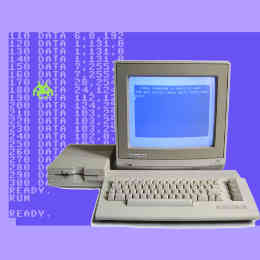
One of the Commodore MAX Machine's most distinctive features is its membrane keyboard. Unlike the full-travel keyboard that would become one of the Commodore 64's greatest strengths, the MAX used a flat membrane design more commonly associated with inexpensive home computers of the early 1980s. While perfectly adequate for launching games or entering the occasional command, it was far from ideal for extended typing or programming.
A first-hand account from an early MAX Machine owner confirms this impression. After finally acquiring a MAX Machine and experimenting with both the MAX BASIC and MINI BASIC cartridges, the author concluded that programming on the machine would have been "a nightmare". They compared the keyboard unfavourably with those of the Sinclair ZX81 and Atari 400—hardly famous for their typing experience themselves.
The criticism becomes even more understandable when viewed alongside the machine's hardware limitations. The standard MAX BASIC cartridge provided around 2 KB of programming space, while the MINI BASIC cartridge left the programmer with only 510 bytes and no ability to save programs to cassette. In that context, the membrane keyboard was just one of several compromises made to reduce cost.
Ironically, Commodore would soon become renowned for producing one of the finest keyboards in the home computer market. The Commodore 64's full-stroke keyboard encouraged users to write programs, compose documents and spend hours at the machine. The MAX Machine instead feels like a glimpse into an alternate history—one where Commodore briefly pursued a games console with a keyboard before discovering that people wanted something much more versatile.
Commodore MAX Exhibits

Collector's Market
The Commodore MAX remains a genuinely scarce collectible. Complete MAX computers appear only occasionally and command premium prices, while most listings consist of software cartridges, manuals, packaging, replacement parts and related Commodore memorabilia. The market reflects the machine's short production run, making original hardware significantly rarer than equivalent Commodore 64 equipment. For collectors, patience is essential—it's often easier to acquire a collection of MAX accessories than to find the computer itself, making every surviving system an increasingly desirable piece of Commodore history.

Gallery


Curator's Notes
I was only vaguely aware that Commodore had released a limited-run pre-C64 computer in Japan. My assumption is that the MAX Machine was intended, at least in part, to test or challenge the Japanese home computer market before the Commodore 64 arrived.
I'm glad to have progressively found more information and references to this unusual machine. I have never personally seen a Commodore MAX Machine, much less used one, but it feels like a key part of the 8-bit journey that connects the Commodore VIC-20 to the Commodore 64.
This article is therefore a starting point rather than a final word. I hope to collect more information, references and observations over time as I continue exploring this fascinating branch of Commodore history.
Reader Guide
The following material expands on the terminology, historical context, technical concepts, and related reading connected to this article.
Frequently asked questions
What was the Commodore MAX Machine?
The Commodore MAX Machine was a short-lived 8-bit home computer released by Commodore in 1982. It was positioned as a low-cost entry-level machine and shared several important technologies with the later Commodore 64.
Was the Commodore MAX related to the Commodore 64?
Was the Commodore MAX released only in Japan?
The Commodore MAX is most strongly associated with the Japanese market, where it was released in limited numbers. Closely related versions and references also appeared under names such as Ultimax, so "Japanese-only" should be treated carefully.
Why is the Commodore MAX important today?
The Commodore MAX is important because it helps connect the Commodore VIC-20 era to the Commodore 64. Although it was not commercially successful, it preserves a fascinating branch of Commodore's early 1980s home computer strategy.
Connected Threads
- Commodore C64 Games Computer — the main Commodore 64 topic page now points readers toward this Commodore MAX article as a related look at the short-lived Japanese machine that shared key technology with the C64.
Related articles…



References
- Commodore MAX Machine / Ultimax — archived reference used as an early source of first-hand information about the MAX Machine.
- Compute! Magazine Issue 26 (July 1982) Review — philreichert.org article that led to this wider look at Commodore's early 8-bit machine lineup.
- MAX Machine — general encyclopedic reference.
Disclosure
This page is a personal collection of Commodore 64 resources that have caught the curator's attention. Links are provided for reference and exploration; inclusion does not imply endorsement, accuracy, or ongoing availability. Images on this page have been artistically edited, restored or recreated from historical source material to improve presentation while preserving the historical subject being discussed.