Killer Instinct – Killer Cuts Soundtrack (1994 Promotional CD)
Introduction
Killer Cuts is one of those releases that sits in an unusual space between game soundtrack, promotional object, and full-blown commercial dance record. Although associated with Killer Instinct, this is not the sort of album that feels like a simple dump of in-game audio. It behaves more like a purpose-built CD production from the 1990s, with loud breakbeats, sampled vocals, polished sequencing, and a confidence that pushes it well beyond background music.
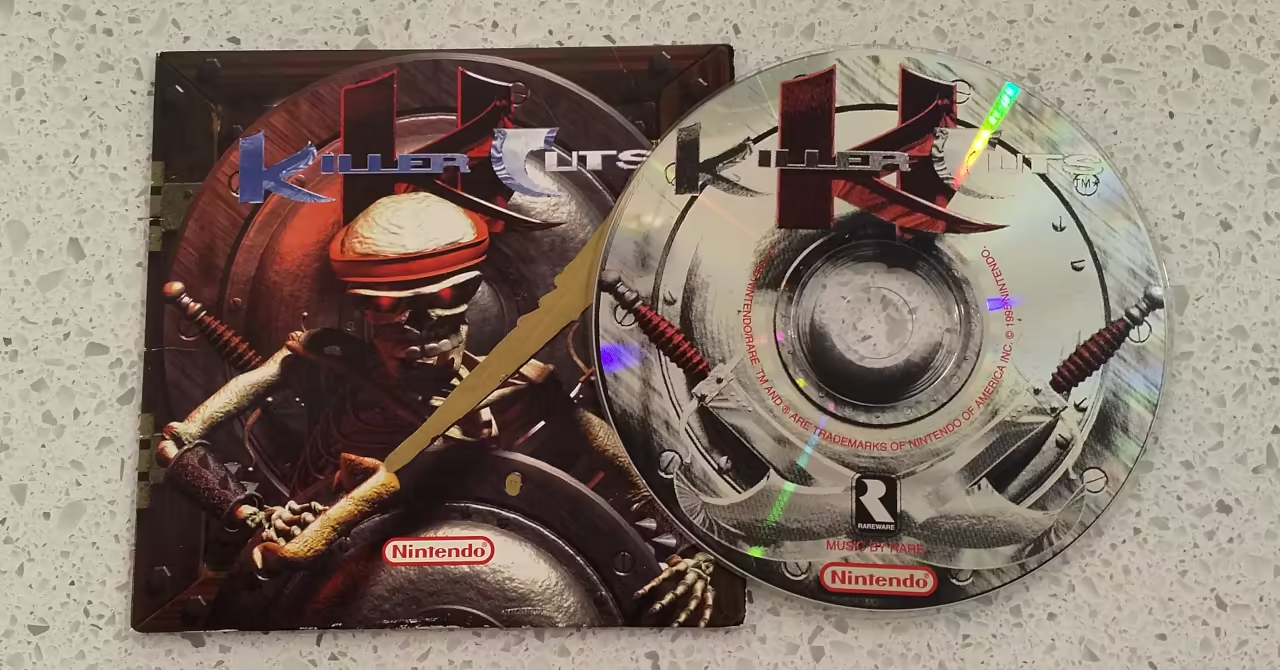
My connection to this album is also personal. I first bought the disc from a second-hand record dealer in the 1990s, long before I understood its status as a promotional release bundled with the game. At the time, I simply knew that it was a striking electronic album with a game tie-in and that I liked it enough to keep it in rotation. I even marked the blade on the front cover with a gold paint pen, which felt entirely normal in that era and now leaves the copy with its own small and very human history.
Later, after the disc had left my hands in the second-hand market, I unexpectedly found what appears to be the same copy again in a Lifeline shop in Camden, New South Wales. I bought it back immediately. That story matters because this article is not based on a passing stream or a casual search result. It is based on a soundtrack artefact that I have physically owned, lost, recovered, and continued to enjoy over many years.
I also come to this album from the listening side rather than the gameplay side. I have not played Killer Instinct in any meaningful way, so my judgement here is not shaped by character loyalty or arcade memories. I know this record as a CD. I know it as an object on the shelf, as a disc in the car, and as a lively, sample-heavy album played through a Marantz UD5005 on a main stereo system. From that angle, Killer Cuts remains genuinely excellent. It opens hard, keeps the energy up, and never really stops long enough to apologise for being a very 1990s piece of digital production.
Album Snapshot
Killer Cuts is best understood as a promotional soundtrack album linked to Killer Instinct, rather than a conventional score album in the older sense. The disc is arranged as a sequence of vocal, dance, and groove-driven tracks that stand on their own as listening material. It is built for CD playback, not for hardware limitation. That distinction is important, because the album belongs to the era when game-related music could escape the machine and be reframed as a separate commercial product.
The track list runs across a full set of theme-oriented cuts, opening with K. I. Feeling and moving through titles such as The Way U Move, Controlling Transmission, Do It Now!, The Instinct, Yo Check This Out!, and Freeze!, before ending with the hidden humiliation track. The naming already tells you something about the record. These are not abstract cues. They are statement tracks. They announce attitude, movement, confrontation, swagger, and rhythm.
In listening terms, the album plays like a strong mid-1990s electronic production with one foot in breakbeat culture and another in aggressive commercial soundtrack packaging. It is full of drum loops, call-outs, vocal cuts, synth stabs, and bass programming that sits right on the beat. The result is less an atmospheric score and more a sequence of ready-to-go performance tracks. For that reason, it works best when played straight through from start to finish. I do not tend to cherry-pick it. I put the disc on and let it run.
Historical Placement
Composer and Studio Context
Although the sleeve does not clearly credit individual composers, the album is commonly associated in later discographies with Rare’s music team, particularly Robin Beanland and Graeme Norgate. Whether approached through documentation or through the sound itself, the record clearly reflects a studio environment comfortable with sequencing, sampling, and game-adjacent music that could survive outside the game.
What matters most in the listening is not the paperwork but the production confidence. This is not hesitant work. The album sounds like it was assembled by people who understood how to make electronic tracks move. Even when a piece leans toward novelty or character, the underlying structure still holds. The grooves are deliberate, the beats are assertive, and the transitions feel like they belong to a commercial audio release rather than a technical afterthought.
That point helps explain why the disc still lands well today. Some retro game albums survive because of melody. Some survive because of nostalgia. Killer Cuts survives because it was built with enough studio discipline to function as an album. You may hear its period character immediately, but you also hear craft.
Platform Audio Context
This soundtrack also marks a very different audio world from the PC-98 material discussed in the Brandish articles. Those recordings invite attention to synthesis hardware, timbral constraint, and the pleasing edge of older sound chips. Killer Cuts does the opposite. There is no analogue aura here, and no hardware limitation to admire as part of the charm. This is digital production through and through.
That is part of its historical interest. The album sits in the period when game music could become a CD-era object with its own market presence, detached from the exact sound of the console or arcade board. Instead of asking what the hardware could produce in real time, the question became what kind of soundtrack identity could be packaged around the game. In this case, the answer was loud, rhythmic, sample-driven dance music presented with confidence as a finished release.
That makes Killer Cuts an interesting historical counterpoint to more hardware-bound retro game albums. It is connected to the game world, but it is not trapped inside it. The CD has its own life. It can be appreciated without reference to level design, character picks, or arcade mastery. For a listener coming to it as an album first, that independence is one of its strengths.
Sonic Architecture
Key Tracks
K. I. Feeling is the correct way to open this disc because it wastes no time explaining itself. It steps forward with a classic dance-floor posture and declares that this will be a rhythm-led record. The drums arrive with a programmed, Roland-like directness, the vocal stabs snap into place, and the female vocal phrases give the track lift rather than softness. It is an invitation to groove, but it is also a mission statement. The album starts here, and it starts with confidence.
The Instinct feels like the title cut in spirit even if the album has several strong identity markers. This track is cleaner and smoother in its presentation, with orchestral-style stabs, saturated guitar colour, and a polished blend of synthetic and rock-derived gestures. It has the kind of sheen that allows it to cross over in the imagination. One can easily hear it as the sort of 1990s track that might have slipped onto a radio playlist and left listeners wondering why they had missed it the first time around.
Yo Check This Out! pushes the sample culture of the album right to the surface. This is the track that most strongly announces the era’s fascination with loops, chopped phrases, and assembled energy. It almost behaves like a compact megamix, less concerned with subtle development than with impact, movement, and the sheer pleasure of layering recognisable production tricks into a coherent hit of momentum. If someone asked what 1990s sample-heavy soundtrack crossover culture sounded like in a few minutes, this would be a strong answer.
Listening Notes
The dominant impression of Killer Cuts is that it absolutely screams sample packs, DJ-style vocal edits, and bass lines that lock themselves to the beat with no wasted motion. Everything feels committed to impact. The drums are not shy. The grooves are not subtle. The arrangement language is built around immediate intelligibility. You hear the loop, the stab, the call-out, and the drop in functionally clear terms. It is music designed to hit first and explain itself later.
There is also a very specific pleasure in hearing how thoroughly the album commits to its digital identity. This is not music that tries to disguise its production methods. On the contrary, the sequencing, the loop logic, and the sample use are very much part of the appeal. It sounds like the work of people operating in a world of sample libraries, Akai-style sampler thinking, MIDI-driven arrangement, and bright, forceful synth voicing. The Roland-style stabs I hear throughout are a good example of that. They are not there to create atmosphere. They are there to punch holes in the mix and keep the excitement high.
The bass approach is equally important. Rather than drifting underneath the tracks, the low end behaves as an active rhythmic partner. It follows the beat on point, helping to tighten the whole record into a danceable engine. That is one reason the album works so well in the car and on a full stereo. It is music that wants physical playback. The beat does not merely accompany the track. The beat is the point.
The vocal material also deserves mention. These are not lyrical songs in the pop sense, but neither are they abstract instrumentals. Call-outs, vocal fragments, and short performance gestures are used as rhythmic tools. They supply attitude, punctuation, and an almost DJ-like sense of crowd communication. That gives the album much of its extroverted personality. Even when the musical content is built from familiar breakbeat and sample-era ingredients, the vocal cuts keep the tracks animated and recognisable.
As a listening experience, the album benefits from being approached as a complete run rather than a test of isolated favourites. I do love certain tracks more than others, but the real strength lies in how the disc keeps rolling. It cuts straight into the action and does not really loosen its grip until the final note. That consistency is one of its underrated virtues. A lesser soundtrack album might have one or two memorable pieces surrounded by filler. Killer Cuts keeps the pressure on.
Legacy and Modern Relevance
Where to Listen
The best way to hear Killer Cuts remains on the original CD if you have access to one, because the physical object is part of the appeal. The packaging, the promo identity, and the act of dropping the disc into a player all reinforce what sort of release this is. For listeners who do not own the album, archived online copies have also made the music more accessible, including preserved uploads through the Internet Archive.
In legacy terms, the album deserves attention because it captures a specific moment when game culture, promotional packaging, and commercial electronic production met in a particularly direct way. It is not the same kind of historical document as an FM-synthesis score or a hardware-bound console soundtrack. Its significance lies in how fully it embraces CD-era digital style. It is a game-linked artefact, but it is also an unapologetic 1990s dance record.
That is why it remains so enjoyable. Yes, it is unmistakably of its time. Yes, it is full of production signatures that point straight back to the sample-heavy culture of the 1990s. But those are not weaknesses here. They are the substance of the release. Killer Cuts does not transcend its era by escaping it. It succeeds by expressing it with force.
My own verdict is simple. This is not merely a curiosity attached to a famous game. It is a genuinely excellent album that still grooves, still entertains, and still rewards replay on proper speakers. It remains one of the more vivid examples of how a game soundtrack tie-in could become a satisfying listening object in its own right.
Collector market snapshot: Original Killer Instinct – Killer Cuts promotional CDs appear regularly on the second-hand market. Typical listings range from around $15 USD for a disc-only copy to roughly $25–30 USD when the original cardboard promotional sleeve is included. For collectors and fans of the game, the version with the sleeve is usually the more satisfying option, as it preserves the distinctive promotional packaging that made this soundtrack release memorable in the first place.
AudioPhil Editorial
In many ways, this small promotional CD sits close to the origin story of philreichert.org itself. Killer Cuts represents the kind of artefact that fascinates me: a piece of media that sits at the intersection of several cultural moments. It connects 1990s retrogaming with the era of sample-based electronic production, rave culture, and the sheer joy of loud, energetic music. You cannot simply walk into a shop and buy one of these today. It belongs to a particular time and to a particular game, which makes it an object worth documenting and sharing.
I enjoy writing investigative articles about music and technology, but the experience becomes far richer when the artefact itself is sitting on the shelf. Actually owning the object you are discussing creates a stronger connection to the story behind it. This CD is exactly that kind of piece. It has moved through the second-hand market, disappeared, and eventually returned to my collection again. Purchasing something with your own money for your own listening pleasure creates a commitment that streaming never quite replaces. This is AudioPhil in his natural habitat.
What ultimately makes Killer Cuts memorable is its unapologetic commitment to groove. Breakbeat drums, vocal samples, and synth stabs are everywhere, and the record never pretends to be anything else. It screams its era, but that is exactly why it works. The beats are strong, the call-outs are playful, and the whole album carries the kind of gaming energy that defined the mid-1990s. Raves knew how to party, and this CD captures that spirit perfectly. Decades later it still lands with the same cheerful confidence: a slap-happy 1990s dance groove that refuses to sit still.
Glossary
- Breakbeat
- Breakbeat refers to a style of drum programming built from sampled drum breaks, often taken from earlier recordings and rearranged into new rhythmic patterns. In the context of Killer Cuts, breakbeats provide the driving rhythm that gives many tracks their energetic, dance-oriented feel.
- Sample pack
- A sample pack is a collection of recorded sounds such as drum hits, loops, bass tones, and vocal fragments that producers can load into samplers or sequencers. During the 1990s these libraries were widely used in electronic music production and helped shape the sound of albums like Killer Cuts.
- Akai sampler
- Akai professional samplers were widely used digital instruments that allowed producers to record, edit, and play back audio samples from a keyboard or sequencer. In the 1990s they were central tools in dance and game-related music production, enabling producers to assemble tracks from drum loops, vocal cuts, and other recorded sounds.
- Vocal sample
- A vocal sample is a short recorded phrase, shout, or spoken line that is inserted into a track as part of the rhythm or arrangement. In Killer Cuts, vocal samples are used as energetic call-outs that reinforce the aggressive tone of the music and add character to the dance-oriented production.
- Synth stab
- A synth stab is a short, sharply played synthesizer chord or note used to punctuate the rhythm of a track. These bright, percussive sounds are common in electronic dance music and appear frequently in Killer Cuts to add impact and emphasis within the beat-driven arrangements.
- Promotional soundtrack CD
- A promotional soundtrack CD is a music release distributed to promote a game, film, or other media product. Rather than containing the exact audio used in the game, these albums are often produced as standalone listening experiences, presenting themed music inspired by the title. Killer Cuts was released as a promotional album linked to the Killer Instinct franchise.
- Sequencing
- Sequencing is the process of arranging musical notes, rhythms, and samples in a digital system so that they play back in a structured pattern. In electronic music production this is commonly done through MIDI-controlled devices and computer software, allowing producers to assemble complex tracks from loops and programmed parts.
Frequently asked questions
What is the Killer Cuts soundtrack?
Killer Cuts is a promotional soundtrack CD associated with Killer Instinct. Rather than simply presenting raw in-game audio, it was produced as a standalone album built around 1990s electronic dance production, vocal samples, and aggressive beat-driven arrangements. It sits somewhere between game tie-in merchandise and a commercial listening release in its own right.
Is Killer Cuts the same music heard inside the game?
Not exactly. Killer Cuts is better understood as a soundtrack album inspired by the game and its characters, rather than a direct copy of the game audio as heard through the original hardware. The CD was produced for standalone listening, with polished studio mixing, sample-heavy arrangements, and a stronger commercial music presentation than the game itself would have delivered.
What musical style is the Killer Cuts album?
The album is best described as sample-heavy 1990s electronic dance music with strong breakbeat influence. It features dominant drum loops, DJ-style vocal cuts, tightly programmed bass lines, synth stabs, and the kind of energetic digital production associated with rave-era and club-oriented music of the period.
Why are promotional soundtrack CDs like Killer Cuts interesting to collectors?
Promotional soundtrack CDs are interesting because they capture a specific moment in game history when publishers used music releases to extend a title beyond the screen. They are part soundtrack, part marketing object, and part cultural artefact. For collectors and listeners alike, they often preserve packaging, artwork, and production choices that reflect how games were presented to audiences in their own time.