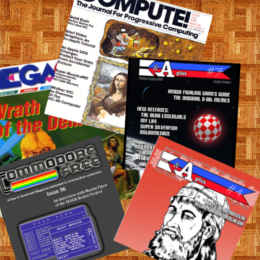
Compute! Magazine Issue 26 (July 1982) | Commodore C64 Debut
Published 01 Jan 2018 ♦ Updated 22 Jun 2026

The Announcement That Changed Everything
The real treasure in this issue is not hidden in an advertisement or buried deep within the magazine. It appears right in the Editor's Notes, where Compute! provided readers with an early glimpse of Commodore's forthcoming third-generation computer range. Looking back with forty years of hindsight, it is remarkable to see the BX256, B128, P Series, Commodore 64 and MAX Machine presented together as members of the same family. At the time these machines were only announcements, but many would go on to become important milestones in Commodore's history.
The specification table is particularly fascinating because it captures a moment before the market had spoken. The BX256 and B128 were positioned as serious business machines with large memory capacities and IEEE-488 interfaces, while the P Series promised colour graphics and CP/M compatibility. The Commodore 64 was listed almost matter-of-factly amongst its larger siblings, carrying a planned retail price of US$595 and support for existing VIC peripherals. Few readers could have predicted that this relatively affordable model would ultimately overshadow every other machine in the lineup.
Perhaps the most intriguing entry is the Commodore MAX. Several of its specifications were still listed as unknown, reflecting how early these announcements were in the product development cycle. With a planned retail price of just US$179.95 and a BASIC cartridge available, the MAX was clearly intended as an entry-level system. History would take a different path, with the Commodore 64 becoming the company's defining home computer, while the MAX faded into obscurity. That makes this preview all the more valuable today, preserving a snapshot of Commodore's ambitions before the winners and losers had been decided.

The microcomputer we are least familiar with is the Commodore Max. For some reason we think that it should have been called MAXX as the XX gives it more max. But in looking up the specs for the Commodore Max should have called the Commodore Min as it is a stripped down introductory version of the C64. Apparently Commodore only sold these machines in Japan as an introductory C64. The C64 would forever hold code and settings for this very short lived machine so it could be called compatible.

Image: Commodore Max in Japanese livery
Source: Wikimedia
Commodore BX-256 was a German only machine built for business. It is a great looking machine and looks different to the shoe boxes available at the time. I recommend a look at this site for more details. The official Commodore marketing material for the BX256-80 is here.

The attached article from Compute! magazine in July 1982 highlights the unveiling of Commodore's third-generation lineup at the Chicago Consumer Electronics Show. This lineup marked a significant milestone in the evolution of personal computing, demonstrating Commodore's innovation and ambition.
The BX256 and B128 were advanced models featuring substantial RAM (256K and 128K respectively) and IEEE-488 interfaces, designed for more demanding computing tasks. These models catered to users requiring powerful systems for business or scientific applications, positioning Commodore as a serious player in the high-performance computing market.
The "P" Series offered a blend of performance and versatility, with 128K RAM and impressive graphics resolution (320x200). Its CP/M compatibility made it a versatile choice for users needing both business and recreational capabilities.
The Commodore 64 (C64), perhaps the most iconic, revolutionized the home computer market with its affordable price of $595, robust 64K RAM, and support for VIC peripherals. It became a bestseller, renowned for its graphical capabilities and extensive software library, fostering a vibrant community of developers and enthusiasts.
Finally, the MAX, with its BASIC Cartridge and planned retail price of $179.95, was targeted at entry-level users. Despite its lower profile, it contributed to Commodore's broad appeal by making computing accessible to a wider audience.
Each model in this lineup played a crucial role in solidifying Commodore's legacy, driving technological advancements, and shaping the personal computing landscape of the 1980s.