Suno AI Music Journal
Updated 25 October 2025

Recent SUNO announcements
Mobile Data Usage
As my use of Suno has grown, I have seen a clear change in mobile data consumption. For a long period my typical monthly mobile usage sat at around 4 GB across all apps. Once I began using Suno more actively on my phone, the figures reported by my device’s “Mobile and Data Usage” screen showed a noticeable increase. Suno’s own usage records on my phone indicated approximately 1.86 GB of mobile data in August, 13.38 GB in September, and then a jump to about 137 GB of foreground data (with roughly 0.7 GB in background) in October. All dates are for 2025. These values are drawn directly from the phone’s usage report for the Suno app, and they reflect how much data passed specifically over the mobile network, not Wi-Fi.
Looking at how I actually use Suno helps explain these numbers. A lot of my creative work with Suno happens while I am commuting, generating songs and listening to drafts on the train where I am normally on mobile data and not Wi-Fi. Each generated track involves downloading the audio to the device, and replaying tracks means streaming them again, which adds up when done regularly. By contrast, I do not spend as much time listening to or generating Suno tracks at home on Wi-Fi. Taken together, the usage pattern on my phone suggests that the high monthly totals are a direct result of active, intentional use of Suno over mobile data during these commuting sessions, rather than background activity or unexplained usage.
Future Development Areas
Prompt suggestions
Jot it down
Labs.Google Alternatives
Music-FX

Google Labs MusicFX has quietly settled into the role of a fun, low-pressure sketchpad for musical ideas rather than a full-fledged production tool. Once positioned as a bold AI experiment, it now feels more like a forgotten prototype—sound quality is limited, variation is minimal, and each clip loops the same take even when it claims to generate again.
Yet that simplicity is oddly liberating. MusicFX excels at delivering a quick spark—a fleeting rhythm, groove, or texture you can catch in seconds—without overcomplication or setup. For creators, it's the digital equivalent of humming into a tape recorder or scratching a riff on paper: a way to audition moods before serious work begins. Many artists now treat it as an idea incubator, generating the spark in MusicFX and then moving to Suno, where the idea can evolve into a complete, polished composition.
Music-FX DJ
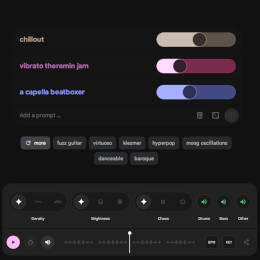
Google Labs MusicFX DJ
is an intriguing offshoot of Google's AI music experiments—and despite its confusing overlap in name with the older
MusicFX generator, this version actually feels more refined and interactive. Instead of generating short standalone loops,
MusicFX DJ lets you blend multiple prompt tags in real time, gradually shaping a full–length, evolving track.
The interface works like a hybrid between a DJ mixer and a generative sequencer: you enter mood or genre tags
(for example, retro funk,
drum & bass,
ambient pads
),
and the system continuously morphs between them, building transitions and layering instrumentation as it goes.
It's a surprisingly smooth experience — the algorithm understands balance and dynamics, keeping the mix coherent even when blending contrasting tags. You can also tweak tempo, energy, and texture controls mid-session to hear how the AI responds to live direction. The only major drawback is that you can save only the final 60 seconds of your creation, so capturing an extended performance or smooth buildup isn’t yet possible. Still, it’s an excellent sandbox for sonic exploration — ideal for discovering unexpected genre fusions or atmospheric backdrops that you might later refine in tools like Suno or your own DAW.