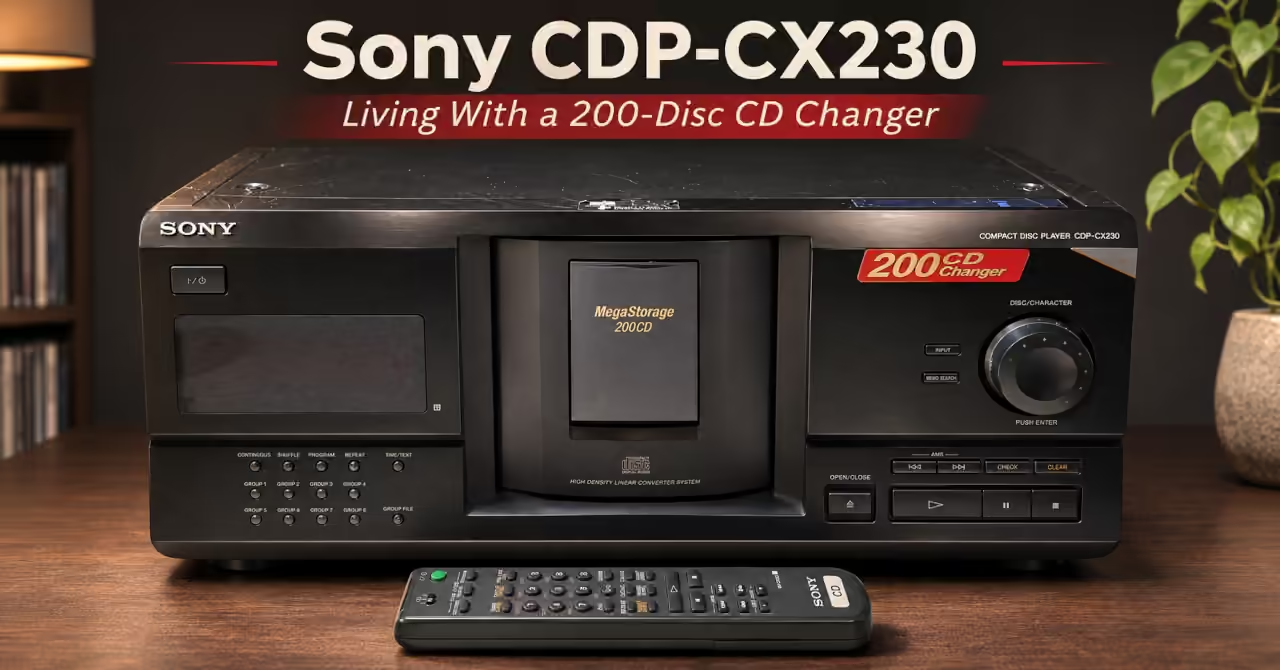
Sony CDP-CX230: Living With a 200-Disc CD Changer
◆ Revised
Introduction
Imagine owning 200 music CDs and having almost every album ready to play without leaving your chair. That was the idea behind Sony's CDP-CX230 MegaStorage CD changer, a remarkable piece of audio equipment from the late 1990s.
Most CD players hold one disc at a time. Some hold five or six. The Sony CDP-CX230 takes a different approach. It stores up to 200 CDs inside a large rotating carousel, then selects and plays whichever disc you want. What would normally take up several shelves can become a music collection managed by one machine.
I've owned a CDP-CX230 for some time, and my experience has been extremely positive. I keep approximately 50 music CDs inside mine, including a selection of Christmas albums that I leave ready for December. I haven't bothered typing album names into its memory, and I have never felt the need to fill every available position.
My Sony is connected by an optical digital cable to a Marantz AV8003 AV preamplifier/processor. It has been straightforward to operate and has given me no electrical or mechanical trouble during my ownership.
The CDP-CX230 is certainly an unusual-looking CD player, but its real achievement is practical. Sony made a machine that turns a large collection of physical recordings into something easy to enjoy. And more than two decades after its introduction, that remains a useful idea.
A Shelf That Moves
The first thing to understand about the CDP-CX230 is how it stores music. Instead of using a normal disc tray, Sony fitted a large circular magazine inside the cabinet. This is called a carousel, and it contains 200 numbered slots arranged around its edge.
Each CD stands upright in its own position. When you select a disc, the carousel rotates until that slot reaches the playback mechanism. The machine then moves the selected CD into position so it can be played.
It is a clever solution to a simple problem. You might own hundreds of CDs, but you cannot listen to them all at once. More importantly, you may not want to search through shelves of cases every time you feel like hearing another album.
The CDP-CX230 handles the searching and disc changing for you. Once your collection is loaded, you can select an album using the front panel or remote control. The mechanism does the physical work.
This was an ambitious approach in the late 1990s. Sony was not trying to replace the compact disc. Instead, the company was making it easier to use the CDs people already owned.
Today, streaming services offer enormous music catalogues through phones, computers and televisions. The Sony represents another approach: you choose the recordings, own the discs and decide how to organise them.
There is also something satisfying about watching a real machine carry out a task. The CDP-CX230 does not hide its purpose. Its size, controls and moving carousel all reflect the job it was designed to do.
Indexing Music
Storing 200 CDs is one achievement. Finding the right one is another.
Sony provided several ways to organise and select music on the CDP-CX230. The simplest is to use the numbered disc positions. Turn the large JOG dial on the front panel until the number you want appears, then press the dial to begin playback.
You can also select a disc directly using the remote control. This makes the machine convenient to operate from your usual listening position.
Disc Memo and CD TEXT
For owners who want to catalogue their collection, Sony included a feature called Disc Memo. It lets you enter a name of up to 13 characters for each disc position. Instead of remembering that your favourite album is in slot 42, you can give it a short title.
The player also supports CD TEXT. Some compact discs contain information about the album, artist and individual tracks. When a compatible CD TEXT disc is loaded, the Sony can display this information without requiring you to type it in yourself.
There is one important limitation to the player's memory. Sony warns in the operating manual that stored Custom File information may be erased if the machine is not used for about a month. Anyone planning to create a detailed catalogue should keep this in mind.
Eight Groups for Your Collection
Another feature, Group File, allows discs to be assigned to eight different groups. You might organise these around musical styles, favourite artists or collections that you often play together.
The player can then use these groups for continuous, random or repeated playback. This gives owners another way to manage a large collection without moving the discs themselves.
Sony even supplied holders for the printed CD booklets. These could store up to 200 booklets, with numbered labels matching the positions in the changer. The artwork and album notes could remain close at hand while the discs stayed inside the machine.
How I Actually Use It
These are useful features, but I have taken a much simpler approach with my own CDP-CX230.
I have never entered all my album names into Disc Memo. With approximately 50 music CDs installed, I find the numbered positions and normal controls perfectly adequate.
That's one of the machine's strengths. You can spend time creating a detailed music catalogue if you enjoy that sort of organisation, but you don't have to. The CDP-CX230 works just as well for someone who wants to load a collection and start listening.
The Loading Ritual
Loading the CDP-CX230 is quite different from using a conventional CD player. Instead of placing one disc into a sliding tray, you open the front cover to reveal the large carousel inside.
After switching on the machine, press OPEN/CLOSE to open the cover. Turn the JOG dial until the required disc number appears in the display. The carousel moves the corresponding slot into the loading position.
Insert the CD upright, with its printed label facing to the right. Repeat the process for the other discs you want to store.
When you have finished, close the front cover. The machine is then ready to select and play discs from the loaded collection.
The first time you see the open carousel, it is easy to appreciate just how much engineering Sony fitted into this machine. The individual slots are close together, yet each disc must be correctly positioned for the mechanism to retrieve it.
Sony's operating manual makes several important points about handling the player. Discs must be inserted straight, and you should wait until the carousel has completely stopped before adding or removing them.
The player must also stand on a level surface. Most importantly, Sony instructs owners to remove all discs before transporting it. Moving a machine with dozens of CDs still inside could place unnecessary strain on the mechanism or damage the discs.
These precautions are sensible rather than difficult. Once the collection is loaded, there is little need to open the machine during normal listening.
Playing the Collection
Despite its impressive capacity, the CDP-CX230 is surprisingly easy to operate. Select a disc, press Play and let the machine take care of the rest.
Sony provided several playback modes to suit different listening habits.
One Album or the Whole Collection
In 1 DISC mode, the player plays the tracks on your selected CD. This is much like using an ordinary single-disc player.
In ALL DISCS mode, the Sony can work through the loaded collection in disc-number order. Empty slots are skipped automatically. This is particularly useful when you want music playing for an extended period.
The Shuffle function offers another choice. It can select tracks in random order from one CD or from the wider collection. Repeat functions allow music to continue according to the playback mode you have chosen.
Creating Your Own Programmes
The CDP-CX230 can store three different playback programmes. Each programme can contain up to 32 steps, with each step representing either one track or a complete CD.
You can therefore create a sequence of favourite songs or albums without having to change their positions in the carousel.
Another useful feature lets you choose the next disc while the current one is still playing. This means you can decide what to hear next without immediately interrupting the music.
My Christmas Music Collection
My favourite practical use for the Sony is also one of the simplest.
I keep roughly 10 to 15 Christmas CDs together near the end of the carousel's numbered positions. They remain there throughout the year, ready for December.
When the Christmas season arrives, I already know where those albums are. I can select them using their disc numbers and enjoy the music without searching through CD cases.
I don't need to type in album titles or create an elaborate music database. The numbered positions are enough.
This is not quite the same as creating a playlist on a streaming service. The discs are physically stored in the machine, and I have chosen to keep this part of my collection together.
For me, that is the real appeal of MegaStorage. The player makes a familiar collection easier to use, especially when particular albums are enjoyed at certain times of year.
What About the Sound?
With so much attention given to the 200-disc mechanism, it is reasonable to ask whether the CDP-CX230 is also a capable audio player.
Sony's published specifications show that the company paid attention to sound reproduction as well as mechanical design.
The operating manual lists a frequency response of 20 Hz to 20 kHz, within ±0.5 dB. This covers the normal range of human hearing.
The specified signal-to-noise ratio is greater than 105 dB, while dynamic range is greater than 93 dB. Sony also lists harmonic distortion below 0.0045 percent and channel separation greater than 97 dB.
These figures describe the player's measured performance under Sony's test conditions. They are useful technical information, but they should not be treated as a complete description of how an audio system will sound in someone's home.
Analogue and Digital Connections
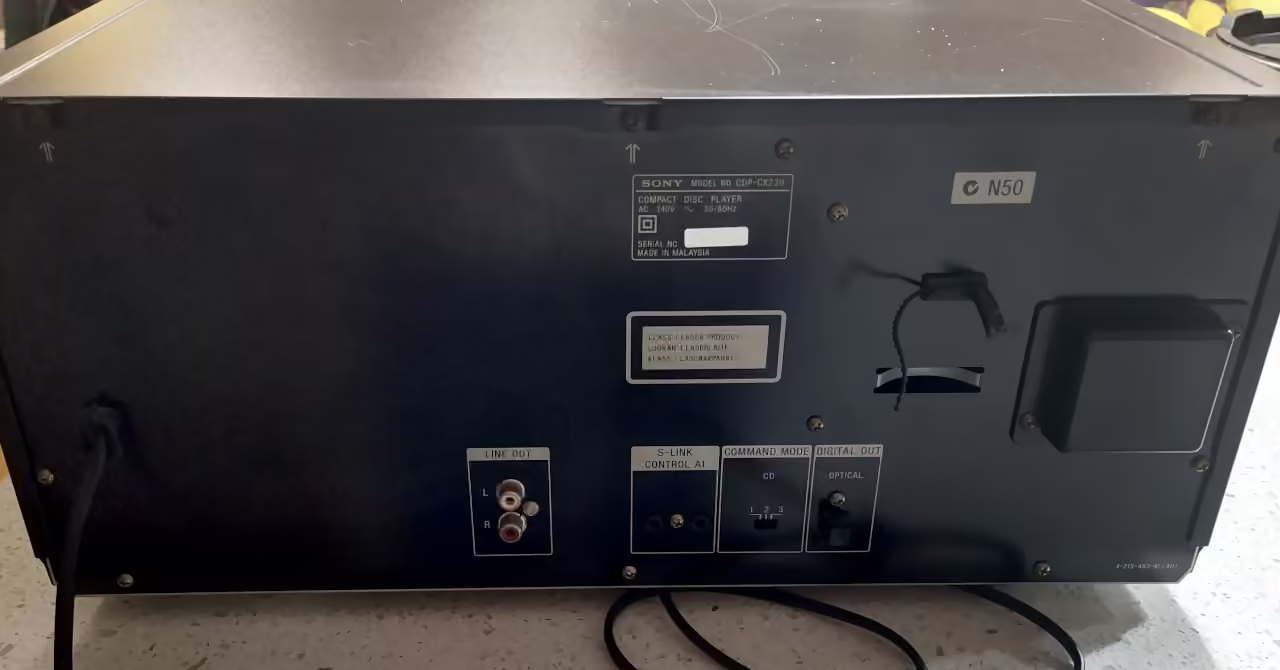
The CDP-CX230 has two ways to connect to an audio system.
Its stereo RCA outputs provide analogue audio signals that can be connected to a suitable amplifier or preamplifier. In this arrangement, the Sony's internal electronics convert the digital music data into analogue sound.
The player also has an optical digital output. This sends digital audio to another component equipped with a suitable digital input and digital-to-analogue converter, usually called a DAC.
When connected this way, the Sony acts as a CD transport. It reads the compact disc while the external DAC handles conversion to analogue audio.
My Marantz AV8003 Installation
I was concerned about sound quality when I installed my CDP-CX230, so I connected its optical digital output to my Marantz AV8003 AV preamplifier/processor.
The Marantz already had high-quality digital audio conversion facilities, making this a convenient connection for my system.
I have only ever used the Sony through its digital output. I have not compared it directly with the player's analogue RCA connections in an A/B listening test.
That is an important distinction. I cannot claim that the Marantz DAC sounds better than the Sony's internal DAC because I have not tested them against each other.
It was simply the connection I chose when setting up the equipment. It worked well, and I had no reason to change it.
For owners with a capable external DAC, the optical output makes the CDP-CX230 an attractive addition to an existing Hi-Fi system.
When 200 CDs Made Perfect Sense
To understand why Sony built a 200-disc CD changer, it helps to remember how people listened to music in the 1990s.
Compact discs had become a common way to buy and enjoy recorded music. A keen music listener could easily collect dozens or hundreds of albums over time.
That created a problem. The more discs you owned, the more time you might spend choosing, finding and changing them.
Sony's MegaStorage players offered a mechanical solution. Instead of replacing the collection with another format, they made the collection easier to access.
This idea has some similarities to modern digital music libraries. Both allow a listener to select recordings from a larger collection without handling each album separately.
But there is an important difference. With the Sony, every recording remains on a physical CD that belongs to its owner.
The machine does not need an internet connection, an online account or a music subscription. It simply plays the discs installed inside it.
The CDP-CX230 also offers a useful middle ground between a single-disc player and a computer-based music library.
You still choose and arrange your collection, but the machine reduces the effort involved in playing it.
That remains appealing today, particularly for people who already own substantial CD collections and want to keep enjoying them.
The Charm of Scale
There is no disguising the physical size of the CDP-CX230. According to Sony, the player measures approximately 430 mm wide, 200 mm high and 480 mm deep. It weighs about 9.5 kilograms.
That makes it a substantial piece of audio equipment. It needs a suitable shelf, especially because its cabinet is relatively deep.
However, that size has a purpose. The cabinet houses the disc carousel, moving mechanism, controls and playback electronics.
Sony had to design a system capable of selecting individual discs from 200 positions while keeping the operation straightforward for the listener.
There is an appealing contrast between the engineering inside the machine and the simple task it performs. You choose a disc, and the Sony finds and plays it.
Reliability and Buying Second-Hand
Any vintage CD changer deserves careful inspection before purchase, especially one with so many moving parts.
A prospective buyer should check that the carousel rotates correctly, discs load and play reliably, and the front-panel controls work as expected.
The display is also worth examining. Like many audio components of its era, the CDP-CX230 uses a fluorescent display, which may become dim as equipment ages. I would check its brightness and readability rather than assume every machine has the same condition.
My own experience has been reassuring. During my ownership, the CDP-CX230 has suffered no electrical or mechanical failures.
Its controls remain easy to use, and the disc-changing mechanism has performed the job I bought it to do.
This does not mean that every surviving example will be trouble-free. Condition and previous care matter when buying older electronics.
Nevertheless, my experience has given me considerable respect for the quality of Sony's design. For all its mechanical complexity, it has been a dependable component in my audio system.
Conclusion
The Sony CDP-CX230 MegaStorage is more than an unusual CD player. It is an ingenious answer to a practical problem: how to keep a large collection of compact discs ready to enjoy.
Its 200-disc carousel, numbered selection, memory features and flexible playback options show how seriously Sony approached that challenge.
Yet the strongest feature of the CDP-CX230 is its simplicity in everyday use. You do not have to fill every slot, enter hundreds of album names or master its programming functions.
My own machine holds roughly 50 music CDs, including a permanent selection of Christmas albums. It is connected digitally to a Marantz AV8003 and has given me no electrical or mechanical problems.
For someone who already owns a good Hi-Fi system, I think the CDP-CX230 makes an outstanding second CD player. It offers convenient access to a much larger selection of recordings than a conventional player can hold.
It may not be the smallest or simplest way to play a single CD, but that was never its purpose. Sony designed it to manage a collection, and it still does that job remarkably well.
Looking back, my only real regret is not buying one when they were new.
Writer's Notes
Living With the Sony CDP-CX230
My experience with the Sony CDP-CX230 has been overwhelmingly positive. I purchased mine second-hand, and my only real regret is that I didn't buy one when they were available new. It is a wonderfully practical machine and an excellent example of the thoughtful engineering that made Sony's audio equipment so appealing.
Although the changer accommodates 200 compact discs, I have never felt the need to fill it. My collection in the machine consists of approximately 50 music CDs. Nor have I bothered entering album titles into its Disc Memo system. I can appreciate why Sony provided such a comprehensive cataloguing facility, but I cannot imagine spending the time manually typing in the names of all those CDs. Fortunately, the player is perfectly easy to use without doing so.
A Christmas Collection Ready Every December
One of my favourite uses for the CDP-CX230 is surprisingly simple. I reserved the last 10 to 15 positions in the disc carousel for Christmas music. Those discs form a permanent seasonal collection, ready whenever December comes around.
Rather than searching through CD cases and repeatedly changing albums, I simply select the appropriate disc positions and press Play. My Christmas music is already organised and waiting. It is a small convenience, but one that demonstrates exactly why a large-capacity CD changer makes sense. The music is physically there, organised once and available whenever I want it.
Digital Audio Through a Marantz AV8003
Sound quality was an important consideration when I installed the Sony. From the outset, I connected its optical digital output to the high-quality digital-to-analogue conversion circuitry in my Marantz AV8003 AV preamplifier/processor.
I have therefore only ever used the CDP-CX230 as a digital transport. I have not conducted an A/B listening comparison between its analogue RCA outputs and the optical connection, so I cannot make a meaningful claim that one sounds better than the other. It was simply an installation decision: I already had a capable DAC in the Marantz, connected the Sony to it and got on with enjoying the music.
Reliability and Everyday Operation
The CDP-CX230 has been exceptionally straightforward to live with. Its controls are intuitive, disc selection is simple, and the mechanism makes managing a collection of CDs remarkably convenient. Despite the mechanical complexity involved in storing and selecting up to 200 discs, my particular unit has experienced no electrical or mechanical problems whatsoever.
It has the reassuring feel of typical Sony engineering from the period. I am aware that ageing fluorescent displays have a reputation for becoming dim or failing in vintage audio equipment, although this is something prospective buyers should assess on the individual unit rather than assume is inevitable.
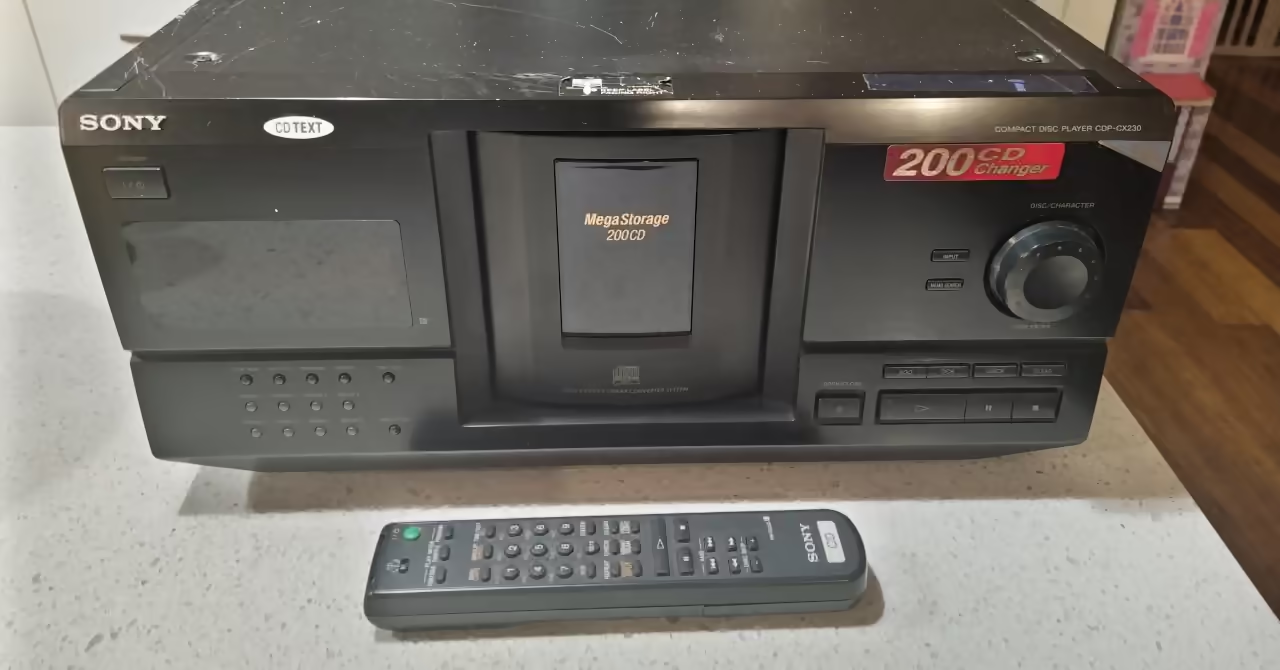
The photographs accompanying this article are of my own CDP-CX230, rather than a manufacturer's publicity unit. They illustrate the machine as I have actually owned and used it.
My Verdict
The Sony CDP-CX230 is an almost perfect second CD player for anyone with a decent audio system and an established collection of compact discs. It offers the convenience of having dozens, or potentially hundreds, of albums immediately accessible, without requiring elaborate programming or cataloguing.
For me, it has been reliable, easy to operate and consistently enjoyable. Its optical output makes integration with an external DAC straightforward, while its generous disc capacity offers practical possibilities that a conventional single-disc player cannot match.
I bought mine long after its original release. Having lived with it, I rather wish I had bought one back in 1999.
Sony CDP-CX230 Photo Gallery
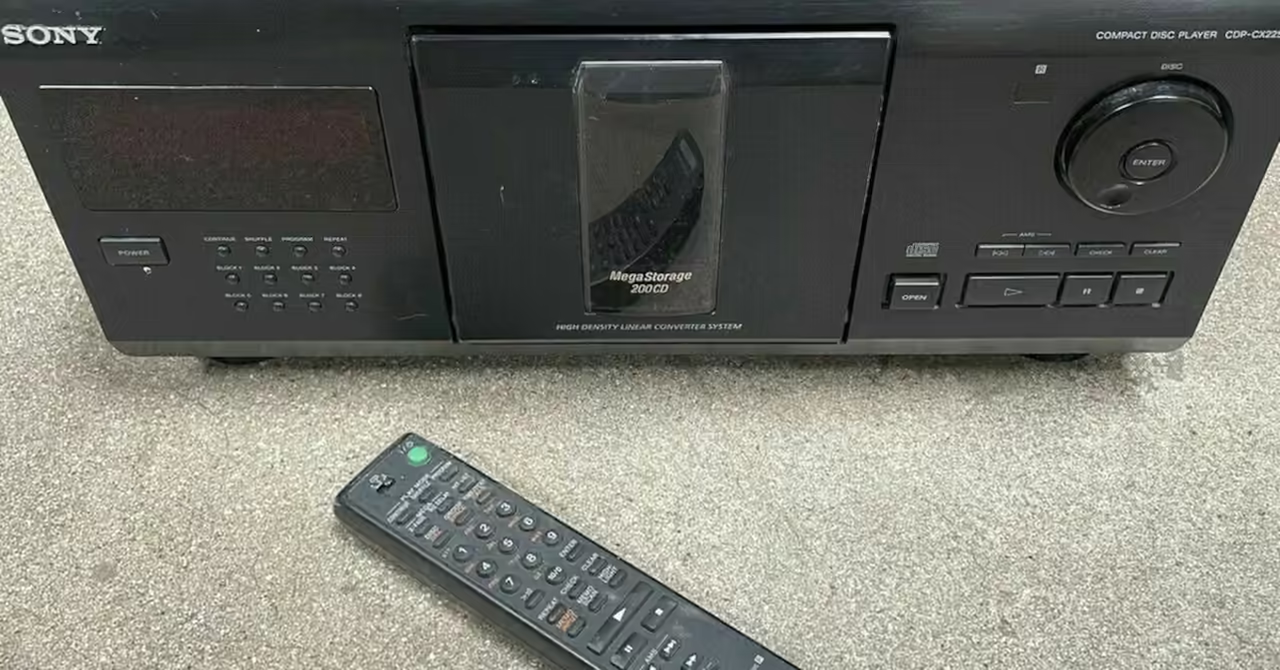
Photographs of my Sony CDP-CX230 MegaStorage 200-disc CD changer, showing the front panel, rear connections and original remote control.
Reader Guide
The following material expands on the terminology, historical context, technical concepts, and related reading connected to this article.
Glossary
Some of the terms used in this article have specialised, historical or technical meanings. This glossary provides additional context for selected terms and ideas.
- MegaStorage
- Sony's marketing name for a high-capacity, multi-disc CD player design—not a new file format—specifically the 200-disc CDP-CX230 concept that integrates large-scale mechanical storage with playback. It reflects a late-1990s approach to keeping physical music collections immediately accessible, effectively turning dozens of individual discs into a single household ‘library’ without relying on computers or streaming.
- carousel
- A large rotating disc magazine of numbered vertical slots that holds many compact discs and brings a chosen slot to a fixed loading or pickup position. Unlike single-disc trays, a carousel mechanically indexes and retrieves media, demanding precise motors, sensors and handling precautions so discs align reliably with the playback mechanism.
- Disc Memo
- A player‑local feature that lets the owner assign a short (up to 13‑character) label to a specific disc position, with the text stored in the unit’s internal memory rather than on the disc. It provides a simple, persistent catalogue for organising a large changer but only travels with the player—if the disc is removed or moved to another player the memo is not retained.
- CD TEXT
- A disc‑based metadata standard that allows compatible CDs to carry album, artist and track titles so a supporting player can display them without manual entry. Because the information is embedded on the disc itself, it stays with the recording and can reduce the need for device-specific labelling, but both the disc and the player must support the CD TEXT feature to work.
- CD transport
- A playback arrangement in which the machine handles disc selection and reads digital audio data but sends that digital stream (for example via an optical output) to a separate digital‑to‑analogue converter (DAC) elsewhere in the system. Using the unit as a transport lets owners combine the changer’s mechanical convenience with an external DAC or preamp that they consider superior for analogue conversion and sound reproduction.
Frequently asked questions
Curious about something you’ve just read? These frequently asked questions explore some of the key ideas, details and questions surrounding the topic.
How many CDs can the Sony CDP-CX230 hold?
It holds 200 compact discs in a large rotating carousel, keeping an entire collection loaded and available for selection without repeated manual swapping.
How do you locate and identify discs in the changer?
Discs are located by numerical selection using the front-panel JOG dial or direct selection via the remote, and can be identified with Disc Memo entries of up to 13 characters, CD TEXT information when available, or organisation into one of eight Group File categories.
What playback and programming options does it offer?
Playback modes include single-disc continuous, ALL DISCS, and Shuffle (across the collection or within a disc), with repeat options for track, disc or programme; it also supports three stored programmes of up to 32 steps and lets you nominate the next disc while another is playing.
What are the audio specifications and connection options?
Published specs list a 20 Hz–20 kHz frequency response within ±0.5 dB, signal-to-noise ratio over 105 dB, dynamic range greater than 93 dB, harmonic distortion under 0.0045%, and channel separation above 97 dB, with both stereo analogue RCA outputs and an optical digital output for use as a CD transport to an external DAC.
Related articles…

References and Further Reading
The following sources provide technical specifications, operating instructions and historical information for the Sony CDP-CX230 MegaStorage 200-disc CD changer. Personal ownership observations and photographs are supplied by AudioPhil.
- Sony Corporation (1999). Sony CDP-CX230 Compact Disc Player: Operating Instructions. Publication number 3-865-665-21 (1). Original multilingual owner's manual, 80 pages, covering installation, disc loading, playback, CD TEXT, programming, maintenance and specifications. Read or download the owner's manual (PDF) .
- Sony Corporation. CDP-CX230: Official Product Support. Manufacturer's support information, operating instructions and technical assistance resources. Sony product support .
- Internet Archive. Sony CDP-CX230 Operating Instructions: Archival Search. Search the Internet Archive for preserved copies of the original Sony operating instructions and related documentation. Search the Internet Archive .
- AudioPhil. Sony CDP-CX230: Personal Ownership Observations and Photographs. PhilReichert.org. Original photographs of the author's CD changer and remote control, together with firsthand observations concerning operation, reliability, disc organisation and optical digital playback through a Marantz AV8003. See the Photo Gallery and Writer's Notes accompanying this article.
Disclosure
This article is based on AudioPhil's firsthand ownership and experience of the Sony CDP-CX230 200-disc CD changer, supported by Sony's published operating instructions, technical specifications and other referenced sources. All observations, assessments and opinions are those of the author and reflect his personal experience with the equipment. They should not be interpreted as independent laboratory testing or as representative of every surviving unit. In particular, no direct listening comparison was conducted between the player's analogue outputs and its optical digital output. Photographs include images of the author's own equipment; some have been digitally retouched, enhanced or artistically reconstructed for presentation purposes and may not reproduce every physical detail exactly. Digital research, editing and writing tools, including large language models and AI image generation, have assisted in preparing this article. The author reviews and edits the published material and may make ongoing corrections or updates. This is an independent editorial article, not an endorsement by or affiliation with Sony or Marantz. Any affiliate links, sponsorships or other relevant commercial interests are disclosed separately where applicable.