Brandish PC-9801 FM Synthesis Soundtrack (1991)
Introduction
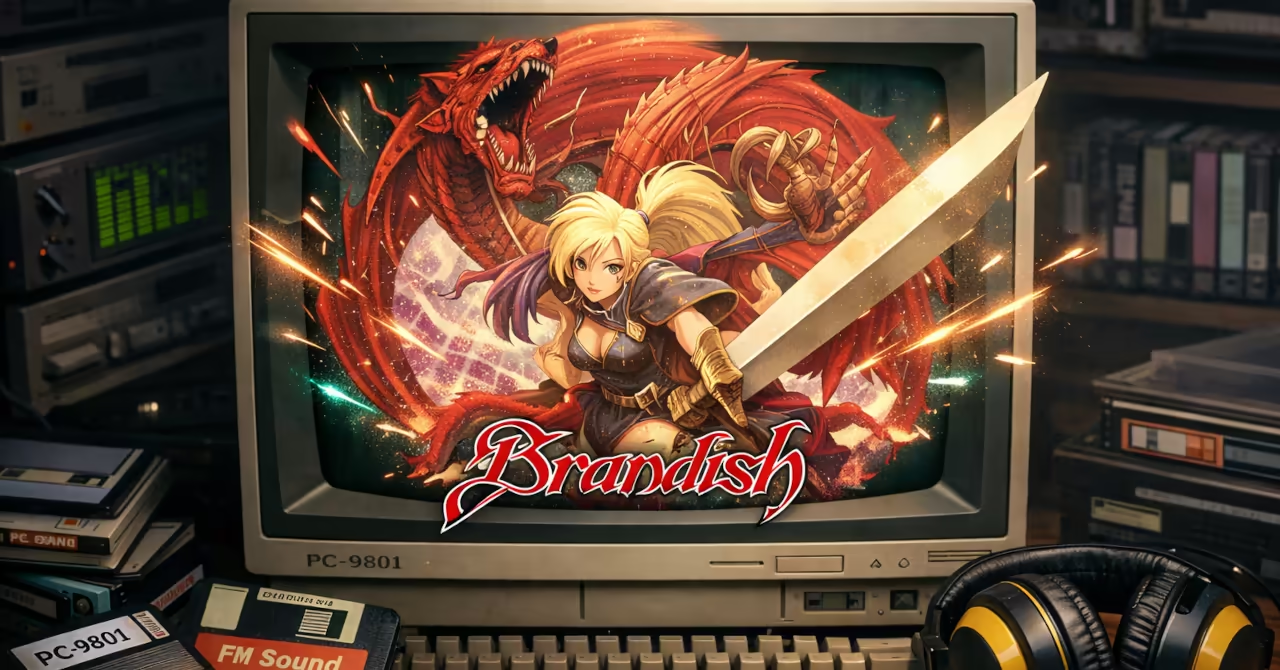
Brandish (1991) is one of those soundtrack discoveries that appears less through tidy catalogues and more through chance. I first encountered this recording while trawling through the Internet Archive, where game music is often poorly categorised and one tends to stumble across items rather than locate them cleanly. That sense of accidental discovery suits this release well. Brandish is a Falcom title with a darker musical identity than many of the company’s better-known works, and even without playing the game itself, the music stands on its own as a satisfying listening experience.
This article focuses on a fan recording of the NEC PC-9801 game music rather than the official soundtrack release. That distinction matters, but it does not reduce the value of the recording. If anything, the capture preserves some of the direct character of the FM-synthesised sound in a way that feels authentic to the era. As AudioPhil, I am approaching Brandish primarily as a listener rather than as a player. I have never played the game, nor have I ever seen an NEC PC-98 in person, but the music immediately interested me for its tone, programming style, and strong electronic character.
Album Snapshot
Brandish (1991) is represented here through a fan recording of the NEC PC-9801 game audio, rather than an official commercial soundtrack album. The music is credited to Falcom Sound Team JDK, the internal music identity closely associated with Nihon Falcom’s catalogue. What is heard in this recording is not conventional recorded studio audio, but music generated through FM synthesis and captured from the game environment. That gives the recording a particular texture: smooth, glassy, electronic, and unmistakably of its time.
For listeners interested in retro game music as an artefact, this distinction is important. This is not simply a soundtrack album in the modern sense, but a preserved example of how the game itself sounded on its original platform lineage. The result is a recording that functions both as enjoyable music and as a document of early 1990s Japanese computer game audio.
Historical Placement
Among Falcom’s successful series, Brandish has often received less attention than some of the company’s better-known properties. Yet the music has many of the qualities that make Falcom soundtracks worth revisiting: strong melodic writing, confident electronic arrangement, and a distinct sense of atmosphere. Where Brandish differs is in mood. Rather than leaning toward bright adventure or heroic momentum, the music often feels darker, more melancholic, and more enclosed, which suits the game’s dungeon-oriented reputation.
This gives the recording an interesting place within retro game music. It belongs to the broader tradition of Japanese game soundtracks that were composed to support action, exploration, and tension, but it also has a personality of its own. Even outside the context of the game, the music feels purposeful and well made. It sounds unmistakably like a game soundtrack, but a very good one.
Composer and Studio Context
The soundtrack is credited here to Falcom Sound Team JDK. Although I have not located more specific composer information from the game catalogue material I checked, that attribution is already meaningful. Falcom has long had a reputation for strong in-house music, and Brandish fits comfortably within that broader tradition while still sounding darker than many listeners might expect. The melodies and structure carry the confidence associated with Falcom’s output, even when the tone shifts toward tension and unease.
Platform Audio Context
The recording is associated with the NEC PC-9801 version, and it clearly presents as FM-synthesised music. That matters because the sound is not based on a conventional recorded waveform in the way modern digital audio usually is. It is programmed synthesis, shaped by the behaviour and analogue character of the playback hardware. In that sense it has something in common with other classic chip-based formats, although FM synthesis is a generation ahead of the Commodore 64 SID sound that many retro listeners know well.
The comparison is useful. SID has a slightly crusty, gritty character that is a signature of its era, while FM can sound smoother, cleaner, and more glassy. To my ears, the Brandish recording has better overall sound quality than a typical SID track while still retaining the unmistakable synthetic charm of early game music. FM synthesis still sounds good today, and when the composition is strong, as it is here, the format continues to hold up remarkably well. Readers interested in chip-era sound may also enjoy my separate deep-dive article on the MOS 6581 SID chip.
Sonic Architecture
The overall album sounds exactly like what it is: a game soundtrack built from loops, themes, cues, and functional pieces that support movement and action. That is not a criticism. In fact, this recording nails the style. It has the joy of early gaming in it, but with enough musical quality to make it rewarding as stand-alone listening. Some tracks behave like complete songs; others are shorter loop structures designed to support ongoing activity. Together they form a vivid electronic palette that is recognisably Falcom while still carrying a darker edge.
What stands out most is the quality of the programming and the confidence of the arrangement. The music has classic FM lead sounds, strong bass movement, percussive energy, and that electronic sheen that defined a great deal of late 1980s and early 1990s game music. At its best, Brandish sounds less like a primitive relic and more like an early form of highly stylised electronic composition. It is easy to imagine some of these tracks being appreciated by modern listeners who enjoy demoscene radio, retro electronics, or tightly programmed arcade music.
Because the music is synthesised rather than recorded, its impact depends heavily on the writing. Weak composition would be exposed immediately. Brandish avoids that problem. The stronger cues combine memorable hooks with rhythmic drive, and several of the tracks feel surprisingly modern in their layering and momentum. This is one of the reasons the recording works so well outside the game itself.
Key Tracks
Track 10: Rakshasa is the one I would recommend first to a new listener. It feels like the classic “all in one” track on the recording: dramatic, rhythmically engaging, and full of the musical turns that show what this soundtrack does well. It has the energy of a boss-level piece, with syncopated melodic patterns that keep the ear chasing the beat. The drum programming is particularly strong, including electronic tom sounds that recall Simmons-style drums, and the abrupt shifts within the arrangement give it the excitement of classic music from its era.
Track 5: Dark Zone immediately establishes rising tension. It features a classic lead sound over mildly percussive bass pulses, and one especially distinctive “boh-bah” effect that sounds almost like a sample mixed into the track even though it is part of the synthesis. It is a fine example of how FM programming can produce sounds that feel more inventive than the technology’s reputation might suggest.
Track 6: Fortress stands out as a surprisingly modern-feeling multi-layered track. It has a funky bass line, a strong lead patch, and an electronic drum sound that still has merit today. This is one of the pieces that feels as though it could sit comfortably in a retro electronic playlist or even on something like SceneSat radio. It demonstrates that strong composition and tasteful programming can let this kind of music travel well beyond its original game context.
Track 7: Dink is classic fast-paced arcade-style music. It pushes ahead at a speed that feels almost inhuman, with the lead line taking on part of the rhythmic work and several enjoyable breaks that give it a genuine arcade pulse. It is the sort of track that reminds the listener how game composers used pace and pattern to create excitement long before modern production tools made this sort of complexity easier to execute.
Track 17: Shop 2 is one of the quieter surprises of the recording. Despite the benign title, it is simply a strong piece of music: bouncing bass, electronic lead, sharp FM stabs, and excellent chord progressions. It sounds like a track that would loop beautifully, and it easily holds up on its own outside the context of a game shop screen.
Listening Notes
I listen to this recording as work music, usually through my Wharfedale Active Diamond speakers connected to my workstation. That detail is worth stating because playback quality matters. The soundtrack comes across very clearly through decent speakers and sounds far better than it ever would have through ordinary television speakers of the era. The glassy FM leads, the bass movement, and the drum patches all benefit from cleaner playback.
In use, the recording works as atmospheric support for creative activity. It is not ambient music in the strict sense, because it is too dynamic and too full of event for that label, but it occupies a similar practical role. It supports the task at hand in the same way game music supports play. While working on the computer, it brings with it the energy and joy of early gaming without demanding constant attention. That is one of its strengths. Even for someone who has never played Brandish, the music remains enjoyable as an active but non-intrusive companion.
Legacy and Modern Relevance
Brandish sits in a healthy ecosystem of retro gaming, JRPG fandom, and soundtrack appreciation, even if it remains more obscure than some of Falcom’s bigger musical landmarks. For players revisiting the series, I can easily imagine this recording being deeply enjoyable. For listeners like me, who came to it from the music side first, it still has plenty to offer. Good electronic composition survives changes in platform and fashion better than many people expect.
I do not imagine this will be a natural entry point for every modern listener. A teenager with no interest in retro games may pass it by entirely. But for anyone with an ear for early game music, FM synthesis, Falcom, or retrogaming more broadly, this recording has real value. It shows how much character and musicality could be achieved with programmed synthesis, and it rewards listeners who are willing to meet it on those terms.
Where to Listen
The recording discussed here is a fan capture of the PC-98 game music rather than the official soundtrack album. That distinction should be kept in mind when comparing track titles and running order. One useful source is the Salade de Mais recording archive, which presents the Brandish 1 and 2 PC-98 game recordings and notes that they differ from the official soundtracks. Internet Archive references have also circulated for these recordings, making them easier to discover than many niche Falcom audio artefacts from the same period.
For this article, the value of the source lies not merely in access, but in preservation. These recordings allow modern listeners to hear a version of the music that still feels close to its platform origins, and for a soundtrack built on FM synthesis, that closeness is part of the appeal.

AudioPhil Editorial
What continues to surprise me about the Brandish recording is the sheer strength and consistency of the music. Some game soundtracks put all the effort into the title theme and then allow the rest of the album to fall away into functional filler. That is not what happens here. Track after track, Brandish presents solid compositions that stand on their own. There is a confidence to the writing that feels excessive in the best possible way. No game really needs such a strong line-up of songs while a kid is simply playing through a dungeon, yet that sense of craft is part of what makes Japanese game music so compelling. There is a kind of excellence through simplicity at work here, where the materials are limited but the result feels complete.
On repeated listening, what also stands out is how well many of the instrumental choices have aged. The synth leads, electronic drums, and occasional FM stabs still sound fresh, and the music remains locked firmly into its genre without feeling trapped by it. One of the most interesting overlaps comes with Track 17, Shop 2, which at times feels remarkably close to the digital Paula-chip aesthetic of the Commodore Amiga. In fact, parts of it could almost have been lifted from a crack intro on an Amiga 880K disk. Even the playing style leans toward the logic of sampled MOD music. That crossover is fascinating because it shows how strong retro game music can blur platform boundaries in the listener’s imagination.
Perhaps the most exciting thing about Brandish is that it feels like discovering a genre you already love, only from a different doorway. One recording leads to the realisation that there is a much larger universe behind it: more Brandish music, more Falcom work, more FM-synthesised game soundtracks waiting to be explored. That is where this material fits today. It belongs to retro gaming culture, certainly, but also to the wider world of electronic nostalgia, demoscene inspiration, and vintage machine creativity. The appeal is not only that the music once accompanied games. It is that the music still has enough life, character, and programming craft to inspire listeners, coders, and audio enthusiasts decades later.
Listening session: full track playback on Wharfedale Active Diamond desktop monitors.
Glossary
- FM synthesis
- Frequency Modulation synthesis is a method of generating electronic sound by modulating one waveform with another. In game music this technique allowed composers to program melodies, bass lines, and drums directly into sound chips rather than using recorded audio samples.
- NEC PC-9801
- A Japanese personal computer platform widely used during the 1980s and early 1990s. The system supported advanced game development and distinctive FM synthesised soundtracks that became a hallmark of many Japanese computer games.
- Falcom Sound Team JDK
- The internal music production group associated with the Japanese developer Nihon Falcom. The team produced many well known game soundtracks including those for the Brandish and Ys series.
- Retro game music
- Music composed for classic video games using early synthesis chips or limited digital audio hardware. The style is often characterised by strong melodies, electronic timbres, and compositions designed to loop during gameplay.
- PC-98 game recording
- A captured recording of music played directly from a PC-98 game rather than an official commercial soundtrack release. These recordings often preserve the authentic sound of the original hardware and music programming.
Frequently asked questions
Is this the official Brandish soundtrack or a fan recording?
The article focuses on a fan recording of the NEC PC-9801 game audio rather than an official commercial soundtrack release. That distinction is important because track titles, order, and sound may differ from the official OST. Even so, the recording remains valuable because it preserves the character of the game music as heard through its original FM synthesis style.
What is FM synthesis and how does it work in game music?
FM synthesis is a method of generating sound electronically rather than playing back recorded audio files. In game music, this means melodies, bass lines, drums, and effects are programmed into a synthesizer chip, which creates the sound in real time. The result is a distinctive electronic tone that became a defining part of many 1980s and early 1990s game soundtracks.
Can the Brandish soundtrack be enjoyed without playing the game?
Yes. One of the strengths of the Brandish recording is that many of its tracks work well as stand-alone listening. The soundtrack has strong melodies, energetic rhythms, and a clear electronic identity, so it can be enjoyed as retro game music even by listeners who have never played Brandish itself.
What hardware produced the music in the PC-9801 version of Brandish?
The music discussed in the article is associated with the NEC PC-9801 version of Brandish and presents as FM-synthesised audio generated by the platform's sound hardware. In practical terms, the music was programmed for the machine rather than recorded like a modern soundtrack, which is why it has such a distinctive electronic character.