Living in the Digital Dark Age
·
Introduction
The headlines scream, "we may be creating a digital dark age." Even Wikipedia has a long description of what the digital dark age. is. Some people may call it hysteria, but we think the risk is very real. We examine the patterns that suggest we are living through a period of mass digital heritage extinction. Data and information is ruthlessly deleted at an exponential rate. Once it is gone it is gone. That is why we give a wayback link to most of the items we link to on this website.
We also believe that the reason why the issues surrounding the digital dark ages has not been illuminated is because of the two-fold trends of the Internet. Reason 1 - Data is being created at an exponential rate. Who would notice if 200MB of data was lost when 2000TB of data might be created by the hour. Reason 2 - So many many more people are using computers and smartphones and accessing the web. Literally billions of people. Would they even notice, or care, if data from 30 years ago was not available to them?
Digital content is convenient and ever present. It is easy to believe that our data will be with us forever but in reality it is fragile and unstable. Data has a natural urge to decay and become unusable either through corruption or an inability to read and use the content in its original form. Every transformation creates a new state that is different from its original form.
This article is maintained as a living knowledge page. As new evidence emerges, observations may be incorporated here, expanded into dedicated articles, or reorganised into new topic clusters. The aim is not to preserve my opinions as they were when first published, but to preserve the evolution of my understanding.
What is digital content preservation?
Digital loss can come in many forms. Our current focus is on the cultural loss as formerly popular groups and message boards disappear. Yahoo Groups is an example that springs to mind. Yahoo is within their financial right to stop supporting mailing lists However, with possibly over 150 million users of My Yahoo Groups, we can only imagine what society loses when the delete button is hit.
It is true that storage costs continue to fall. Storage costs are only one part of a very complex equation. Digital content needs to be maintained to ensure it stays relevant and accessible. Metadata needs to be store and made available. Constant review is required to ensure all of these datasets meet ongoing legislative and cultural standards.
One often overlooked issue is that software packages do not always save in a format that is 100% compliant to the relevant specification. This could be because the software developer wanted to add a snazzy feature to the file format appears to work in current software libraries but is prone to future failure. Or there is an unknown bug in the file format export function that appears to work but really is not future failure proof. Some formats are really executable formats, like PostScript, are very difficult to repair if the programming or file data gets corrupted.
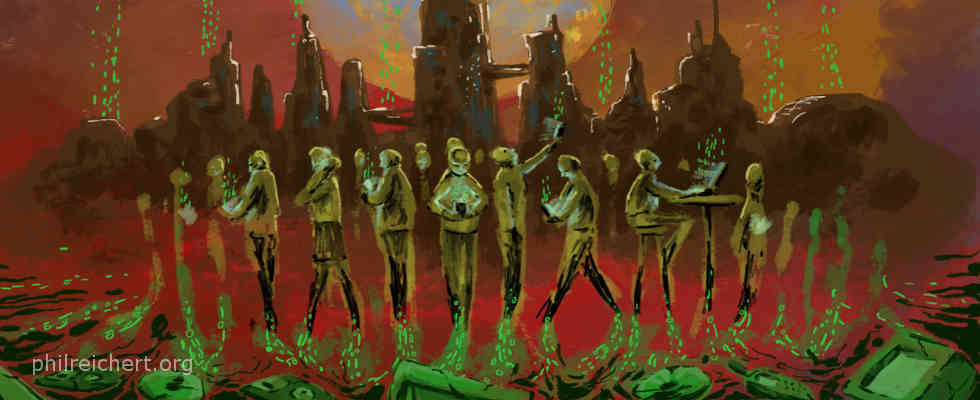
A new and fresh art installation has been created to give form and meaning to the digital dark age. Degredation advertises itself as an interactive audio visual installation inspired by the digital obsolescence and information impermanence. OK, these are two big terms that may be difficult to one's toungue around but it means that digital does not last forever. Digital content will not last 1,00 years. Your digital content may not even last 10 years. How much digital content do you have from 2010 and that gives you some idea about how much may be available 10 years from now. Eventually our digital footprint will degrade and become unrecognisable.
The Library of Congress and the fight against the Digital Dark Age
The Digital Dark Age is not inevitable. Libraries, archives and preservation organisations around the world are actively developing methods for keeping digital material accessible despite changing hardware, software and file formats. One of the most important examples is the Library of Congress Preservation blog.
The Library of Congress has been involved in digital preservation for decades, including work on digital collections, preservation metadata, file-format migration, authenticity, provenance and the long-term management of born-digital material. This work is important because preserving a digital object means considerably more than keeping a copy of its original file. Future users must still be able to identify it, understand its origins, interpret its metadata and, somehow, open or reproduce it using technologies that may not yet exist.
I particularly like the Preservation blog because it makes this otherwise abstract problem visible. It records the practical work being undertaken by archivists, librarians, conservators and digital preservation specialists as they work out how today's digital culture can survive into tomorrow. If the Digital Dark Age describes the risk that society may forget large parts of its digital history, institutions such as the Library of Congress represent one of our strongest defences against it.
What is software preservation?
It isn't just your cherished photos that are important to archive. Much software that has revolutionized the way we live our lives has been lost to future generations. We put forward our list of critical software pieces that need preserving. Wikipedia is currently running with the list of commercial video games with available source code.
Dive into the captivating world of digital preservation with our latest article, 5 Best Abandonware Sites; The Fight Against Digital Decay. Unearth the treasures of the past as we journey through the top platforms dedicated to saving classic games and software from oblivion. From the vast archives of Archive.org to the nostalgic realms of myabandonware.com, discover the heroes battling the Digital Dark Age and ensuring our electronic heritage remains alive and accessible. Don't miss this deep dive into the realms where pixels of the past defy time
- Microsoft Windows 1.0 - Windows is almost ubiquitous in its market penetration and yet, the source code to the original release seems to be lost to the public forever.
- Microsoft Word v1.0 - I dig into the history of the now universal word procesor, Microsoft Word. It has an interesting history and the DOS version is the definitive link betweem command link print commands and the GUI interface we use today.
- Apple Lisa operating system source code. The codebase was released by the Computer History Museum. This is one of the most important historical releases to date. I can't imagine the GUI without the Lisa.
- Commodore Amiga Deluxe Paint source code - this most influential bitmap graphics program has finally been release for the world to review and learn from.
- Aegis Animator – The pioneering 1987 animation package for the Commodore Amiga that brought motion graphics to home computers. From the iconic ElGato.anim demo on Fred Fish Disk 125 to the modern-day preservation efforts that keep its legacy alive, this story captures the spirit of creativity that made the Amiga truly special. Read more in Animating the Amiga: The Untold Story of Aegis Animator.
- Capstone Games source code archive, giving the source code for Witchaven, Witchhaven II, William Shatner's Tekwar, and other games.
Preserving game source code
Hundreds of game source code instances, coming up from the 1970s through to today, have been collated into a single archive. The Internet Archive are kindly hosting the game source collection. There is also the video game preservation project, Historical Source project, and Libre Games archive all of which are hosted on GitHub. GitHub even has the code so you can run a very early history of Microsoft Flight Simulator.
Preserving abandoned DOS games
Archiving abandoned DOS games is essential for preserving a crucial part of gaming history. As technology advances and operating systems change, many older games become unplayable, and their code is lost or forgotten. By archiving these games, we ensure that future generations can experience and learn from the early days of PC gaming. My favourite archive is the Internet Archive's DOS games Abandonware Ark. There are over 2,800 games in the software ark.
One of the main benefits of archiving abandoned DOS games is that it provides an opportunity to study the evolution of game design and programming. These games were often created by small, independent teams with limited resources and technical knowledge. Despite these limitations, many of these games were highly innovative and influential, shaping the course of gaming history.
Archiving abandoned DOS games also has practical benefits for current gamers. Many modern games are inspired by the classics of the past, and by studying these older games, developers can gain insights into what makes a great game and how to improve the gameplay experience.
Archiving abandoned DOS games is essential for preserving gaming history and enabling future generations to experience and learn from the early days of PC gaming. By doing so, we ensure that the legacy of these games and their creators lives on, and that we can continue to learn from and be inspired by them for years to come.
How Digital Content degrades
We think that this is a classic case of digital irony. The intelligent starting point for anyone looking for information on the Digital Dark Ages is to browse the Wikipedia article. The person who claimed to have created this article was Niels Elken Sønderby as shown on the revision page back in December 2006. The linked blog post proudly proclaims:
I don't think I can think of a topic that interests me for which I haven't been able to find an article on Wikipedia.
However, recently it happened that a topic that I've heard mentioned independently by my brother-in-law and a colleague simply didn't exist on Wikipedia. So I thought that my contribution to Wikipedia should be an article on the Digital Dark Age. I hope you'll enjoy it. And be bold in editing.
Posted on Thursday 20 November 2006 by Niels Elken Sønderby
Preserving website data is more difficult that first thoughts would suggest. Let us show you visually by providing screenshots from this blog post of a decade. The information shown here is derived from the ever useful Wayback archives.

The first screenshot shows what the original post looks like. The page appears to be written in Wordpress and contains no errors. By 2016, the personal blog had fallen out of use and user's looking to read this little piece of history received a 403 error, meaning that the blog post was not available to read. The announcement for a new Wikipedia article was lost.
Then by 2019, the blog entry had returned. There are problems with this web page. For starters, it is showing scripting errors (the text in black) and the reply section is closed. Even worse, the web page has turned into an advertising page offering Buy Cialis Professional. How this relates to the original post is not obvious. To our eyes, this likes a case of subtle graffiti.
So what can we learn from this? For starters, it shows that the Internet is only a temporary repository of information. Secondly, all data can get lost. And finally, even with the original blog post data, the content management system had changed leading to errors and making it hard to read the original announcement.
And that my friends, explains the case of how digital content degrades.
Dead Links Pool
Every article on philreichert.org is built on a network of references. Some point to books, others to archived websites, museum collections, personal pages, or long-forgotten technical documentation. Together they create a small knowledge graph that allows readers to follow ideas back to their original sources.
Unfortunately, websites disappear. Domains expire, personal pages are abandoned, companies restructure, and entire collections quietly vanish. Sometimes only a broken hyperlink remains where an important piece of history once existed.
Rather than simply deleting these references, this section records some of the sources that have disappeared since publication. They serve as small case studies of the Digital Dark Age in action. The missing pages are themselves evidence of how fragile our digital heritage has become.
Wherever possible I replace dead links with archived copies or alternative sources. When that is impossible, the entry remains here as a reminder that the web is a living system, and preserving its connections is just as important as preserving the information itself.
The Dead Links Pool
- Google A500 Chrome browser emulator - This useful preservation software allowed users to emulate a Commodore Amiga A500 in the Google Chrome browser. My Commodore Amiga journal referenced this page to help readers experience the useability of this retro-computer.
- Commodore MAX Machine Specifications – One of the early enthusiast pages documenting Commodore's short-lived MAX computer. It was referenced while researching a Compute! magazine review because it provided concise technical specifications and historical context. The original site later disappeared, leaving only archived copies. It is a good reminder that many of the most valuable historical resources were created by individual enthusiasts rather than institutions.
Using Generative AI to improve digital preservation
Artificial intelligence has the potential to revolutionize the preservation of vintage computers and software in several ways:
- Digitization: AI can be used to automate the process of digitizing vintage software and data, making it easier to store, preserve, and access.
- Emulation: AI can be used to improve the accuracy of software emulation, making it possible to run vintage software on modern hardware, making it easier to experience vintage tech.
- Documentation: AI can be used to automatically generate documentation for vintage software and hardware, making it easier for people to understand how to use and preserve vintage technology.
- Restoration: AI can be used to automate the process of restoring vintage software and hardware, making it easier to bring old technology back to life.
- Collection management: AI can be used to manage large collections of vintage computers and software, making it easier to keep track of what has been preserved and where it is stored.
With the advent of generative artificial intelligence, there is a hope for preserving this valuable digital content. AI can help with the digitization of vintage computers and software, making it easier to access and experience. AI can also assist with the preservation of digital content, detecting and repairing any corruption before it becomes a problem. AI can also help with the translation of digital content into more modern formats, ensuring that data from the past remains usable for generations to come. With AI, we can ensure that our digital heritage is preserved for the future, preventing a digital dark age from becoming a reality.
I've seen people start playing text adventure games using generative AI. Apart from organising collections and improving restoration tools, it got me thinking that generative AI can plug gaps and enhance the retrogaming. By leveraging the power of AI, it will become easier to access and experience vintage tech, ensuring that it is preserved for future generations.
Five facts that make the Digital Dark Age feel real
The Digital Dark Age can sound abstract until it is broken into ordinary risks: old disks, unreadable file formats, cloud accounts, silent data corruption, and the sheer scale of digital culture we now expect the future to inherit.
That is the purpose of Five Interesting Facts About the Digital Dark Age. It takes the larger preservation concern described here and turns it into five clear pressure points that most readers can recognise in their own files, photos, devices, and online accounts.
The article explains why a digital file can survive physically while disappearing practically, why “saved” is not the same as “preserved”, why cloud storage is useful but not permanent, and why digital decay can remain invisible until the moment a file is needed.
Abandonware
One early consequence of the Digital Dark Age is the quantity of abandonware. Abandonware is the usual description of software that is ignored by the developer of the software years after the software is no longer commercially viable. Abandonware may be considered the unloved orphans of the publishing world. With the advent of Software-as-a-Service (SaaS), the problem of abandonware is likely to become more serious.
It is not all doom and gloom. Although, not strictly abandonware, the space trading game Elite is the perfect template for long superseded games. Elite was first released on the BBC Micro in 1984. At the time it was widely released across many microcomputer platforms. This ground breaking game has not been forgotten in retro-gamer's minds. The binary codes have been preserved in many locations. The groundswell of support helped convince the orginal developer to release the sourcecode as well. I consider this to be the ideal approach to managing older games.
Metadata: The Information About Information
Digital preservation is not simply about keeping files alive. It is also about preserving the information that explains what those files are. Metadata records titles, authors, publication dates, descriptions, licences, relationships, and countless other details that allow both people and machines to understand digital content.
A good example is the gradual migration from Twitter Cards towards Open Graph metadata and structured Schema.org data. Few readers ever see these tags, yet they influence how search engines, archives, AI assistants and knowledge graphs interpret a webpage. The visible page may remain unchanged while the invisible metadata evolves to support entirely new ways of discovering information.
Metadata is sometimes described as "data about data", but it can equally be thought of as context about context. Without it, a digital file may survive for decades while losing much of its meaning, provenance and discoverability.
Digital Dark Ages case studies

5 best sites
for abandonware

Yahoo Groups closes
on our digital heritage

The fall of Shoebox
cloud photo services
Ongoing Investigations
Editorial note (June 2026): The focus of this article has broadened over time. While it began as an introduction to the Digital Dark Age, it has increasingly become a record of the evidence encountered while maintaining philreichert.org.
The Digital Dark Age has become the philosophical foundation of this notebook, while Personal Digital Archiving is its practical handbook.
The investigation has gradually evolved into six related themes:
- Digital Dark Age — Why civilisation forgets
- Personal Digital Archiving — What individuals can do
- Software Preservation — Saving executable culture
- Knowledge Graphs — Preserving relationships between ideas
- Metadata — Preserving meaning
- Dead Links Pool — Recording the evidence
That final theme deserves special attention. What began as an article exploring the Digital Dark Age has gradually evolved into an observational record of it. An archivist might describe this as a longitudinal record of the web's attrition
; documenting websites, services and digital resources that have quietly disappeared over time. From what I have observed, very few websites intentionally preserve evidence of what has been lost. In doing so, this article has become more than commentary; it has become part of the historical record itself.
I'm no longer simply writing about the Digital Dark Age. After more than a decade of maintaining this website, I have quietly accumulated primary evidence of it. Every broken reference, retired service, vanished website and obsolete file format adds another data point. The Digital Dark Age has gradually shifted from being an idea I write about to a phenomenon I actively document.