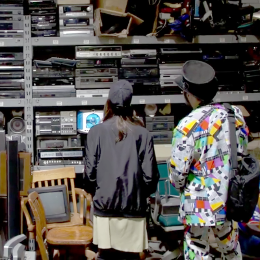
Jason Scott: "THE END" at Fronteers Conference 2017 from Fronteers on Vimeo.
Preservation is also about survivability
Scott begins with his work at the Internet Archive, but the talk quickly becomes more personal. Earlier in 2017 he had taken part in discussions about preserving United States climate data during a change of administration. Soon afterwards, while visiting Melbourne, he suffered a major heart attack. By the time he spoke at Fronteers in October, the question of what survives after a person, organisation or website disappears was no longer abstract.
That experience gives the talk its most useful idea: preservation is not only about making backups. It is about survivability. A collection is safer when another person can understand it, continue the work and recover the important material without depending on one individual, one service or one copy.
The web eats itself
Scott describes the web as a medium that continually replaces and destroys its own history. Pages change, services close, links rot and entire online communities can disappear. He points to GeoCities as a familiar example: when the service shut down, preservation groups raced to copy what they could before the remaining material vanished.
In the talk, Scott says the Internet Archive was then holding roughly 35 petabytes of unique data. The exact number is less important than the scale of the problem. Digital preservation is not a one-time act. It is an ongoing process of finding material, making copies, retaining context and keeping those copies usable.
Why the physical original still matters
One of Scott's strongest observations concerns old manuals and other physical artefacts. A scan can preserve the words and pictures, but it does not completely reproduce the object. Paper weight, cover stock, binding, dimensions, inserts and even signs of use can carry useful information. Digitisation creates access; it does not automatically replace the original.
This distinction is easy to miss when discussing a Digital Dark Age. Preservation is not simply the conversion of everything into files. It is the deliberate retention of content, context and enough provenance for a future reader to understand what the material was and why it mattered.
The activist archivist
Scott jokingly describes three virtues of the activist archivist: rage, paranoia and kleptomania. Behind the humour is a practical attitude. Notice what is at risk, assume that an apparently permanent service may disappear, and make a lawful preservation copy while the material is still available.
That makes The End more than a conference talk about the Internet Archive. It is a useful reminder for anyone maintaining a personal archive, a website or a collection: preservation works best before the emergency. Keep more than one copy, retain useful metadata, document what you are doing and make the collection understandable to somebody other than yourself.
Digital archiving links
- Jason Scott: "THE END" at Fronteers Conference 2017 on Vimeo
- Fronteers conference video archive
- Fronteers 2017 conference schedule preserved by the Wayback Machine
- Jason Scott's 2017 essay The Other Half, describing the events surrounding his heart attack
- ArchiveTeam Warrior for participating in distributed web-preservation projects