What was the Commodore C65?
The Commodore 65 (C65), developed under the name C64DX, was Commodore's attempt to modernise its enormously successful Commodore 64 without abandoning the familiar 8-bit computing experience. Work continued into 1991, but the project was cancelled before a consumer release. Commodore itself did not enter liquidation until 1994. That distinction matters: the machine did not disappear because the company suddenly folded on the eve of launch; it was a product strategy that Commodore chose not to carry forward.
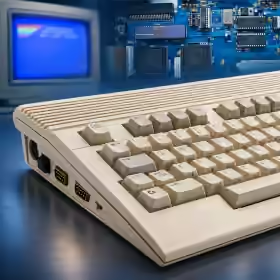
At first glance, the C65 looks like an unusually ambitious C64. Its low-profile enclosure includes a built-in 3.5-inch floppy drive; under the lid are a faster 8-bit CPU, enhanced custom video hardware and two SID sound chips. It was designed to bridge two worlds: the enormous C64 software audience and the growing expectations created by 16-bit machines such as the Amiga and Atari ST.
Inside the prototype: more than a faster C64
The C65's central processor was the CSG 4510, incorporating a 65CE02-family CPU core. Prototype documentation lists clock speeds of approximately 3.54 MHz, compared with roughly 1 MHz for a typical PAL C64. This does not mean every C64 program would run three-and-a-half times faster: software compatibility, display timing and hardware access all complicate the comparison.
The machine featured 128 KB of built-in RAM, a VIC-III graphics chip offering new display modes, two SID chips for stereo six-voice sound, and BASIC 10.0. The built-in floppy drive was intended to bring disk-based computing into the standard package. Those details make the C65 an unusually appealing machine to study: it preserved the character of the C64 while attempting to remove some of its best-known constraints.
For a more technical account, see our C65 system engineering overview, memory map and operating modes. These companion articles are a better place to explore hardware registers, memory banking and the distinction between native C65 operation and C64 compatibility.

Would the C65 have had a market?
My favourite question about the C65 is not whether it was impressive. Of course it was. The harder question is whether an improved 8-bit machine still made commercial sense as the 1990s began. Commodore already had the C128, a vast established C64 user base and an Amiga family increasingly suited to richer graphics and applications. A C65 could have offered a familiar, lower-cost route forward for households, education and hobbyists—but only if its price and software compatibility were compelling.
There is a tempting tendency to call the C65 a lost Nintendo or Sega killer. That is a colourful counterfactual, not an established outcome. Console competition depended on licensed games, distribution and marketing as much as computer specifications. Equally, an enhanced C64 was not automatically a substitute for an Amiga. Commodore would have had to sell two different visions of the home computer without making either redundant.
The C65 therefore sits at a fascinating junction in personal-computer history: technically plausible, commercially uncertain and cancelled just before the question could be answered in shops.
Why C64 compatibility was difficult
Backward compatibility was central to the sales proposition, but the C65 was never simply a C64 motherboard running at a higher clock speed. Its new chips and altered timing created opportunities for programs that relied on precise C64 behaviour to misbehave. This was particularly significant for games, fast loaders and demos that communicated directly with the original machine's hardware.
Our article on C65-to-C64 compatibility limitations examines why the enormous C64 library was both the new computer's greatest opportunity and one of its toughest engineering challenges.
The prototypes that survived
Only a limited number of C65 prototypes are known to have escaped Commodore's development and warehouse system. Estimates vary, and prototype hardware and ROM revisions differ. Some machines have appeared at collectors' auctions, where condition, provenance and completeness can matter as much as whether the unit boots.
That makes a working C65 a particularly revealing artefact. Unlike a finished consumer computer, it is evidence of a design process in motion: decisions not yet standardised, experiments still visible and ambitions that never reached a production line.
Watch a Commodore C65 in operation
The surviving machines are rare, so contemporary demonstrations are valuable. The following third-party video offers a glimpse of a working C65 and period software. It is presented as a demonstration of a prototype rather than proof that every model behaved identically.
Please note that youtube and the video author(s) have not endorsed this article. The video is served directly by YouTube. Please read YouTube's privacy and copyright policy. The opinions expressed may not reflect the opinion of this site.
For another first-hand encounter, an account of a C65 shown at the 2019 World of Commodore event records an opportunity for visitors to examine the machine: World of Commodore 2019. As with any prototype, individual examples may differ.