AIWA AX-7500

This was one of AIWA's most powerful amplifiers in 1976, producing an inspiring 110W musical power, rated at a more meaningfully quoted 30 watts (@ 8Ω) per channel.
The front is finished in polished metal and is complimented by an array of knobs of varying sizes. The dominant feature is the large tuning knob, twin VU meters and the full width tuner frequency display. All the dials are circular and there is a single square power button protruding of the left of the face. The electronics are advertised as solid state.
Although the MW radio receiver may not be that useful these days, it is the external inputs for an external turntable, tape input and auxiliary source that will be of most use to the modern collector. This amplifier unit will look impressively placed in a Danish-style teak shelving system.
Buying an AIWA AX-7500 Today
Things to check before purchasing
- Does every input work?
- Do both VU meters operate?
- Has it been recapped?
- Is the timber cabinet original?
- Does the tuner lock correctly?
- Is the faceplate scratched?
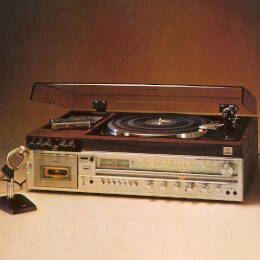
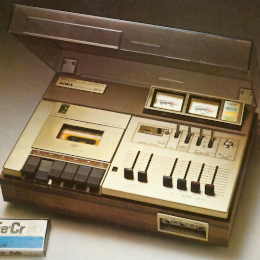
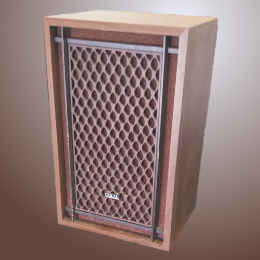
Once you've found a suitable example, compare the seller's photographs against the catalogue images above to confirm originality.
Performance
110 Watts of musical power (@4Ω) • Highly sensitive stereo tuner with PLL circuit • OCL = equal current (= capacitor) coupled, complementary power amplifier circuit with asymmetrical push-pull output stage (= SEPP) • Function selection buttons for two tape inputs with monitor circuit, magnetic phono input can be controlled up to 200mV, AUX, AM and FM • afc = FM tuning can be switched off, reception instrument and FM radio zero crossing instrument • muting = switchable FM-mute tuning • loudness = proper volume control, can be switched off • microphone mix controller • two speaker groups, can be switched off • Ironless power amplifiers with short-circuit protection and other up to date properties.
Amplifier
Music performance: 110W@4Ω; 90W@8Ω
Sinusoidal power (both channels controlled according to DIN45500 1kHz): 2x33W@4Ω; 2x30W@8Ω
Power range: at 0.2% distortion factor: 10Hz to 50kHz
THD: at nominal power: 0.2%
Frequency range: Phono RIAA equalized 30Hz-15kHz ±3dB; AUX, Tape 1+2 (DIN) 10Hz-70kHz ±3dB
Physical
Semiconductors: 1 IC, 44 diodes, 1 FET
Power supply: 120 Watt
Dimensions: 150(H) x 450(B) x 300(I)mm
Weight: 11kg
PLL circuit = FM sound decoder for optimal channel separation
The 19kHz pilot signal is compared in phase with the 38kHz
switching signal. Hence the stability and excellent channel
separation and low signal-to-noise ratio.
OCL circuit = capacitorless output circuit
A directly coupled, truly complementary power amplifier.
Advantages: large bandwidth, dynamic range, low distortion.
The equalizer or compensation amplifier is also designed as a
directly coupled circuit
SEPP = Asymmetric push-pull circuit (single-end push-pull circuit)
The positive and negative pulses of the input signal are amplified
separately in order to achieve an output power with a linear frequency
range and low distortion.